
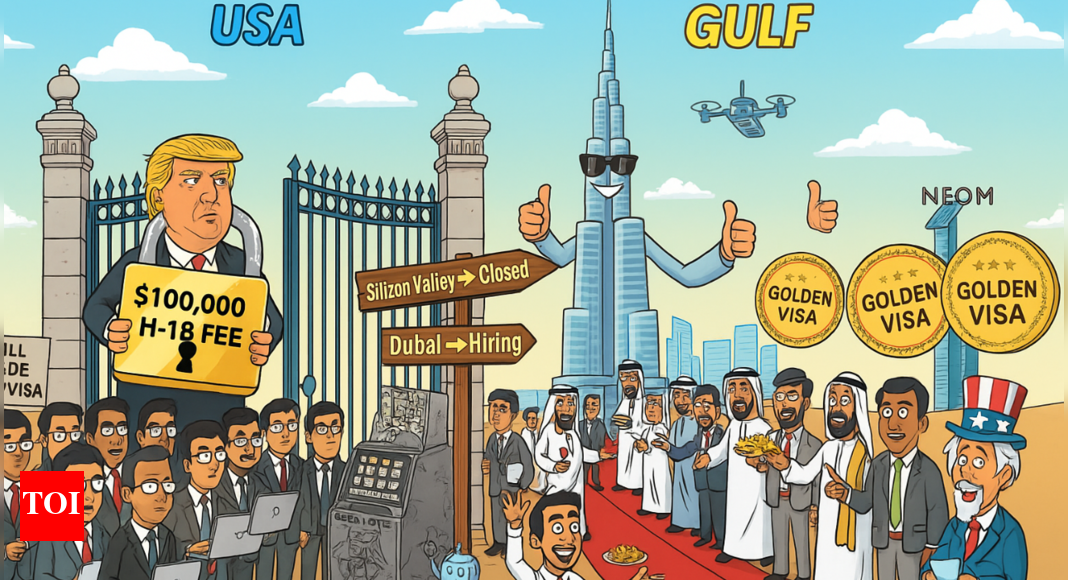

As America raises barriers for foreign talent, Gulf nations like UAE and Saudi Arabia are opening doors with visas and incentives/ AI Image
When Donald Trump first came back to the White House in January 2025, many in Silicon Valley hoped he would go easier on the H-1B visa programme. Instead, by September, he dropped a bombshell: any U.S. company hiring a foreign H-1B worker from abroad would now have to pay a $100,000 fee per visa. This proclamation, framed as a way to “protect American workers” — has effectively shut the door on thousands of Indian engineers, IT specialists, and other foreign professionals who once saw the U.S. as the ultimate destination.For decades, the H-1B was the golden ticket. It was how Infosys coders, TCS analysts, and IIT graduates made their way to Seattle, New York, and Austin. Now, with the new price tag, the message is clear: only the absolute elite, or those whose employers are wealthy enough to bear the cost, will make it through. For everyone else, the search for opportunity must shift elsewhere. And increasingly, that “elsewhere” is the Gulf.
The US proclamation: A closed door in disguise
Trump’s September 19 proclamation makes the case that the H-1B programme has been “deliberately exploited” to replace Americans with cheaper labour. The White House cites statistics: foreign STEM workers in the U.S. doubled between 2000 and 2019, unemployment among young computer science graduates is higher than that for biology majors, and big IT firms have been laying off locals while simultaneously importing thousands of H-1B workers.The fee is designed to act as a filter. At $100,000 per application, only companies desperate for “the best of the best” will pay. But for the average Indian engineer — especially those recruited in bulk through outsourcing firms — the pipeline to America just got prohibitively expensive. Even if firms decide to sponsor, the visa lottery and bureaucracy remain barriers. For many ambitious professionals, the “American dream” suddenly feels out of reach.
The Gulf alternative: Wide open doors
At the very moment Washington is raising walls, the Gulf is rolling out red carpets. Countries like the United Arab Emirates, Saudi Arabia, and Qatar have recognised that to diversify beyond oil, they need global talent — and they’re making it easier, not harder, for expats to come.
Mega-projects and tech ambitions
Saudi Arabia’s Vision 2030 is not just a slogan. It’s pouring billions into giga-projects: NEOM, The Line, the Red Sea resorts — developments so vast they need armies of engineers, architects, IT systems designers, and AI specialists. Between 2020 and 2025, nearly 700,000 Indians were hired in Saudi Arabia, many tied to these projects.The UAE has its own roadmap: Dubai 2040 Master Plan, Abu Dhabi’s AI and space exploration initiatives, and a booming fintech sector. Qatar, post-World Cup, is turning its stadiums, tourism infrastructure, and tech hubs into magnets for expats. Across the Gulf, governments are hiring aggressively for data science, cybersecurity, cloud computing, renewable energy, and smart city design.In short: while the U.S. is shrinking the funnel, the Gulf is expanding it.
Visa and residency incentives
Unlike the U.S. lottery system, the Gulf’s visas are straightforward and plentiful.
- UAE Golden Visa: A 10-year residency for skilled professionals earning over AED 30,000 a month, or for investors and entrepreneurs. No sponsor required.
- Green Visa: A 5-year permit for skilled workers with a bachelor’s degree and salary above AED 15,000. Again, no employer sponsorship needed.
- Saudi Arabia: Introducing tiered residencies and long-term permits for specialists as part of Vision 2030.
- Qatar: Expanding residency programmes for investors, entrepreneurs, and high-skilled workers.
Compare that with the US: one chance per year, random lottery selection, years of uncertainty, and now a six-figure barrier fee.
Tax-free advantage
The most obvious lure of the Gulf is zero personal income tax. A software engineer earning $80,000 in Dubai keeps almost all of it. In the U.S., federal, state, and local taxes could eat away 25–35% of the same salary. For Indians who remit money home, the difference is dramatic.Even when factoring in VAT (5–10% on goods in most Gulf countries), expats find their savings rate far higher than in the West. Employers often sweeten the deal with housing allowances, health insurance, school fee support, and even annual flight tickets.
Lifestyle and safety
The Gulf is no longer the “hardship posting” it once was. Dubai, Abu Dhabi, and Doha now rival London or New York in terms of infrastructure, leisure, and healthcare. Expat surveys consistently rank the UAE in the global top ten for quality of life and ease of settling in. Safety is a major plus: Qatar ranks among the safest countries in the world, with crime rates far lower than most Western cities.For Indians in particular, the Gulf feels familiar. With over 3.5 million Indians in the UAE and 2.5 million in Saudi Arabia, you’re never far from a dosa joint, a temple, or a cricket ground. Indian schools, cultural festivals, and Bollywood cinemas are everywhere. Community networks make relocation smoother than in the U.S., where diaspora numbers are significant but scattered.The conclusion is stark: unless you’re among the top 1% of tech hires whom U.S. firms will pay six figures just to bring over, the Gulf offers better stability, financial advantage, and career growth.
Why Indians are choosing the Gulf
Indians have long powered Gulf economies — from construction labour to nurses to oil engineers. But in recent years, the profile has shifted upward. More and more IIT graduates, startup founders, and IT professionals are heading to Dubai and Riyadh instead of Silicon Valley.Three reasons stand out:
- Practicality: The Gulf is just a short flight from India, making family visits easier and cheaper.
- Policy Certainty: You don’t have to pray to win a lottery or worry about sudden deportation; visas are relatively secure.
- Financial Sense: Even if salaries are slightly lower, tax-free income plus benefits mean higher net savings.
And unlike the U.S., there’s no cultural hostility brewing against foreign workers. In Washington, H-1B has become a political punching bag. In Dubai, Indian expats are seen as essential pillars of the economy.
| Factor | United States (Post H-1B Fee) | Gulf Countries (UAE, Saudi, Qatar) |
|---|---|---|
| Visa Cost | $100,000 per worker (employer-paid) | Standard work permit fees ($1,000–$5,000), or free with Golden/Green Visas |
| Lottery/Cap | 85,000 visas/year, random lottery | No lottery; employer sponsorship or direct residency |
| Processing Time | 6–12 months, often longer | Weeks to a few months |
| Taxes | Federal + state + city; 25–35% | 0% income tax |
| Salary (Tech Mid-Level) | $90K–$120K, pre-tax | $60K–$90K, tax-free (often equal or higher take-home) |
| Community | Large but dispersed | Very large, often majority expat workforce |
| Stability of Stay | Linked to employer, green card backlog decades long | Long-term visas now available (5–10 years, renewable) |
Emerging trends: Gulf as the “New America”
Startups & Venture Capital: Dubai and Riyadh are positioning themselves as fintech and AI hubs, with generous funding for startups.
- Education & Research: The Gulf is building world-class universities and research centres to lure talent. NYU Abu Dhabi, KAUST in Saudi Arabia, and Education City in Qatar are already attracting global faculty.
- Global Headquarters: Multinationals are shifting regional HQs to the Gulf because of tax incentives and central geography. That means more jobs for expats.
- Remote Work Integration: Dubai now offers digital nomad visas, letting professionals live in the UAE while working for global employers, something the U.S. doesn’t even contemplate.
All of this makes the Gulf increasingly look like “America 2.0” for skilled Indians: high growth, high demand, fewer barriers, and tax-friendly.
Bottomline
Trump’s $100,000 H-1B fee is a signal that America wants fewer foreign workers and only at the very top end. For the vast majority of Indians and other expats, the U.S. is becoming more trouble than it’s worth. The Gulf, by contrast, is signalling the opposite: come, build, settle, and thrive.In the next decade, the story of Indian migration may no longer be about “going West.” Instead, it might be about looking a little closer to home — where Dubai, Riyadh, and Doha are ready to play the role that Silicon Valley once did. Go to Source

 "‘Likely to have humanitarian consequences’: India warns Trump’s $100k H-1B visa fee hike may hit families")
