
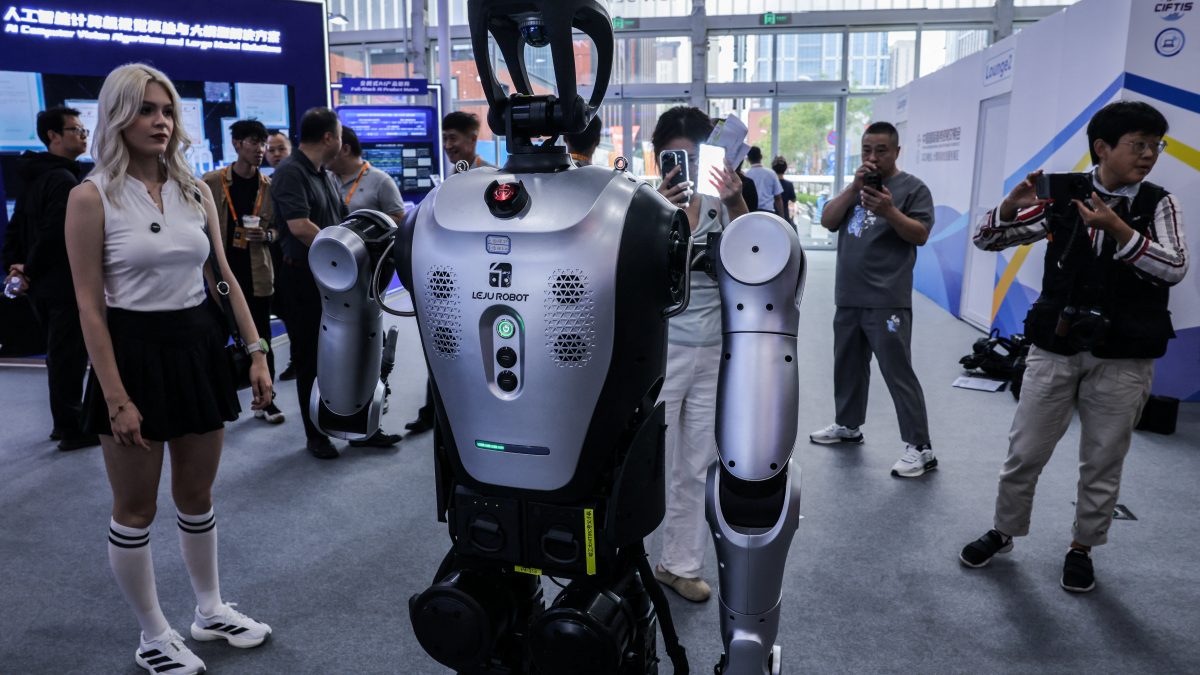
 "China now has more factory robots than rest of the world combined: 2 mn at work")

China now operates more than two million factory robots, a figure that surpasses the total number of industrial robots working in the rest of the world combined.
According to the International Federation of Robotics, Chinese factories installed nearly 300,000 new robots in 2024 alone, while the United States added just 34,000 over the same period, The New York Times reported. This staggering gap shows how far ahead China has pulled in automating its manufacturing sector compared with other industrial powers.
A diverse army of machines
The robots operating in China span a wide range of functions, from claws lifting boxes onto conveyor belts to machines welding car parts.
Increasingly, these robots are paired with advances in artificial intelligence that allow factories to track performance and optimise operations. Some factories have been able to reduce their reliance on human workers, while others are reshaping roles for employees alongside automation.
The shift reflects broader global trends, but the speed and scale in China are unmatched.
State-driven expansion of robotics
Beijing has been a central driver of the robotics boom. Through subsidies, low-interest loans and directives, the government has systematically pushed domestic manufacturers to invest in robotics.
The Made in China 2025 strategy, announced in 2015, explicitly identified robotics as a priority industry where the country should reduce dependence on foreign technology.
By 2021, a detailed national plan for robot deployment was in place and the effects are now visible. Factories in China have installed more than 150,000 robots annually since 2017, cementing the country’s lead.
From importer to global supplier
China’s industrial strategy has not only expanded the number of robots in use but also transformed its position in the supply chain. Until recently, most robots installed in Chinese factories were imported. But in 2024, nearly three-fifths of the machines were made in China, evidence that domestic manufacturers are closing the gap with foreign rivals.
The country’s share of the global robot manufacturing market rose to a third last year, surpassing Japan, which long dominated the industry.
Mirroring manufacturing dominance
The surge in factory automation mirrors China’s broader role in global manufacturing. By the start of this year, Chinese factories were producing nearly a third of all manufactured goods worldwide, more than the United States, Japan, Germany, South Korea and Britain combined.
Robotics has been essential to sustaining this scale of output, giving Chinese manufacturers an efficiency edge over international competitors. For comparison, Japan installed 44,000 robots last year, while Germany and South Korea saw declines in their totals.
US lags behind in automation
The contrast with the United States is stark.
With only 34,000 new robots installed last year, US factories are adding machines at a fraction of China’s pace. Overall, China now has five times as many industrial robots as the United States, deepening the structural imbalance in global manufacturing capabilities, The New York Times reported.
While American firms continue to innovate at the high end of robotics and artificial intelligence, the mass deployment of robots is increasingly centred in China.
Human factor in automation
One advantage for China has been its large pool of skilled electricians, engineers and programmers who can install and maintain robots. Even so, demand for specialists has outstripped supply, driving salaries for installation experts to nearly $60,000 a year—considered high by Chinese industrial standards.
The growing need for technical expertise highlights how automation, rather than eliminating all human roles, is transforming the workforce into one focussed on high-skill support and integration.
Humanoid robots on the horizon
While factory robots remain the core of the sector, China has also cultivated a booming start-up ecosystem focussed on humanoid robots.
Companies like Unitree Robotics, based in Hangzhou, are developing affordable humanoid models, priced at a fraction of what US companies such as Boston Dynamics charge.
Although China still lags in some advanced components, including high-end sensors and semiconductors, the government’s backing has created fertile ground for experimentation and commercialisation in this field.
Artificial intelligence as an accelerator
Beyond hardware, China’s flourishing artificial intelligence industry is giving its factories a further advantage. AI systems are increasingly used to monitor machine performance, detect inefficiencies and predict maintenance needs.
This integration of AI with robotics is creating highly adaptive manufacturing environments.
While many countries view AI primarily through the lens of consumer products or services, China is applying it aggressively to industrial settings, reinforcing its manufacturing edge.
A global industrial shift
The rapid rise of Chinese robotics represents more than just technological adoption—it signals a global shift in industrial balance.
Countries like Japan, Germany and South Korea, once leaders in factory automation, are seeing slower growth in robot installations.
Meanwhile, China’s scale and government-driven strategy have allowed it to surge ahead, reshaping global supply chains in the process. The result is that China not only dominates the production of manufactured goods but is also becoming the largest supplier of the machines that make them.
Strategy meets scale
China’s rise to having more than two million factory robots at work is not accidental. It is backed by the state support, industrial policy and an ramped-up manufacturing base.
By combining government incentives with massive production capacity, China has overtaken long-established leaders and put distance between itself and rivals like the United States.
As robotics and artificial intelligence reshape manufacturing worldwide, China has positioned itself not just as a participant but as the dominant force.
End of Article
 "South Korea to bring tattoos out of the shadows with a ‘medical act’ reform")

&description=China+now+has+more+factory+robots+than+rest+of+the+world+combined%3A+2+mn+at+work)