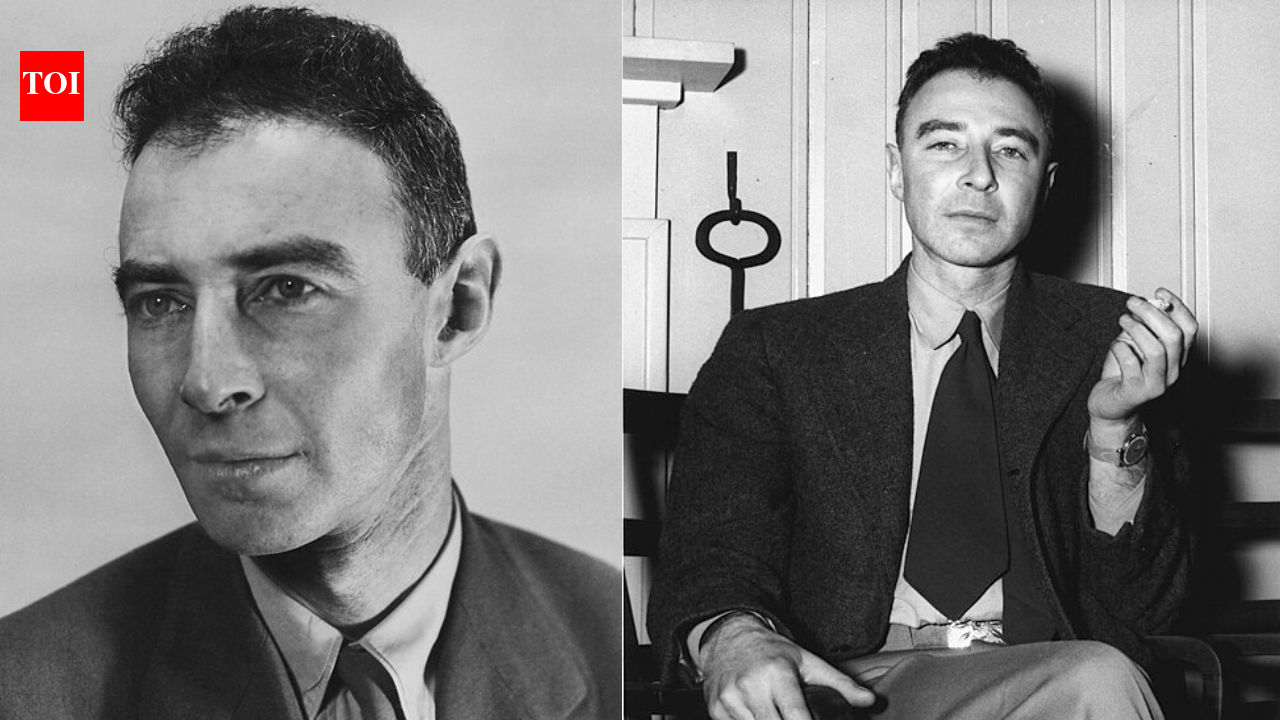

Image(s): J. Robert Oppenheimer/Wikipedia
Prior to 1945, nuclear weapons were just an idea that could be discussed in theoretical physics literature. This changed when J. Robert Oppenheimer, the American theoretical physicist from America, who was responsible for directing the scientific work of the Manhattan Project in the Second World War, took command of the project. With the assistance of numerous scientists, engineers and members of the military service, Oppenheimer led the creation of the first-ever atomic bombs, including the successful test of Trinity, which occurred on 16 July 1945 in the desert of New Mexico. This marked the beginning of the nuclear age and brought humanity into the possession of a weapon capable of destroying a whole city in seconds.
The Manhattan Project united thousands of scientists in a race to build an atomic bomb
The Manhattan Project was launched in 1942 after fears grew that Nazi Germany might develop nuclear weapons first.The United States, working with Britain and Canada, assembled one of the largest scientific collaborations ever undertaken. At its centre was Los Alamos Laboratory in New Mexico, where Oppenheimer served as scientific director. Although he had never managed a project of such scale, he brought together many of the world’s leading physicists, chemists and engineers to solve the enormous technical challenges involved in creating a functioning atomic bomb. The project ultimately employed more than 130,000 people across multiple secret sites, combining advances in nuclear physics, metallurgy, chemistry and engineering under extraordinary wartime secrecy.
The Trinity test proved nuclear weapons were no longer theoretical
According to the US Department of Energy, in the early hours of 16 July 1945, the Manhattan Project reached its defining moment. At the Trinity test site in the Jornada del Muerto desert of New Mexico, scientists detonated the world’s first nuclear weapon, a plutonium implosion device known simply as “the Gadget”.This explosion yielded energy that was equal to 25,000 tons of TNT (25 kilotons) and resulted in an intense flash brighter than sunrise, a mushroom cloud and a shockwave that was heard from a distance. This test proved that there could be a powerful weapon created through nuclear fission.As reported by the BBC, following the explosion, Oppenheimer later recalled a line from the Bhagavad Gita that became closely associated with the event: “Now I am become Death, the destroyer of worlds.”
Some scientists feared the explosion could ignite Earth’s atmosphere
Before Trinity, the experiment’s unprecedented nature raised extraordinary questions. Some physicists briefly considered whether the immense temperatures produced by the bomb might trigger a self-sustaining nuclear reaction in the atmosphere or ignite the Earth’s oceans. Detailed theoretical calculations, particularly by Hans Bethe, showed that such a chain reaction was effectively impossible, allowing the test to proceed.Although scientists concluded there was no realistic danger, the fact that the possibility was seriously examined illustrates how little was known about the behaviour of nuclear explosions before the first test.
Hiroshima and Nagasaki changed warfare forever
Less than a month after Trinity, the United States used atomic weapons against Japan.On 6 August 1945, the uranium bomb Little Boy destroyed much of Hiroshima. Three days later, the plutonium bomb Fat Man was dropped on Nagasaki.The explosions and their immediate effects killed tens of thousands of people instantly, while many more later died from burns, injuries and radiation-related illnesses. Historians estimate that more than 225,000 people ultimately lost their lives as a result of the two bombings.Japan announced its surrender on 15 August 1945, bringing the Second World War to an end in the Pacific. At the same time, the attacks demonstrated that humanity had entered an era in which a single weapon could devastate an entire city.
Oppenheimer later questioned the consequences of the weapon he helped create
After the end of the war, Oppenheimer was considered one of the leading proponents of international control of the nuclear arsenal. He spoke out against the rapid development of the hydrogen bomb and argued that an uncontrolled development of nuclear armament was extremely dangerous for mankind. His political stance and his security considerations caused the withdrawal of his security clearance in 1954 and his dismissal from government affairs despite the invaluable scientific work he had done.Today, Oppenheimer is perceived as a very controversial person. On one hand, he is considered the scientist who directed the greatest scientific project in history and, on the other, the scientist whose research changed warfare and politics forever as well as mankind’s perception of the destructiveness of its own capabilities. Go to Source