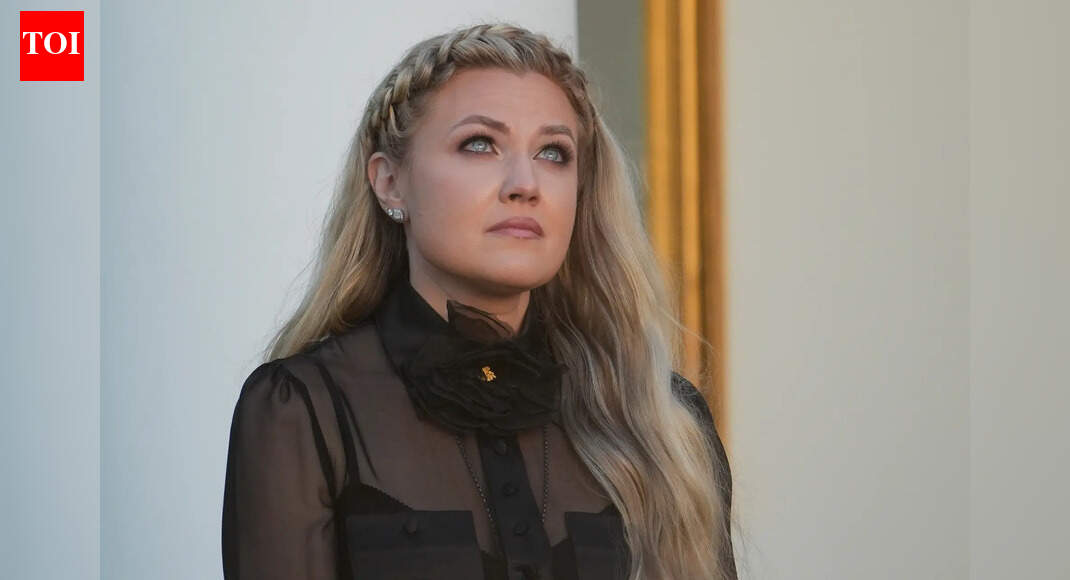


When Charlie Kirk was shot dead at Utah Valley University in September 2025, the stage was set for a familiar American battle. A high-profile conservative figure killed by a rifle while discussing mass shootings came loaded with symbolic weight. Yet the person at the centre of the tragedy, Erika Kirk, chose a sharply different narrative. She has insisted since the attack that her husband’s death was “not a gun problem” at all. Instead, she sees the violence as evidence of a deeper rupture in American life — one rooted in human nature, not firearm access.
Driving the news
Speaking at the New York Times DealBook summit, Erika Kirk confronted the question millions had silently asked: had her view on gun violence changed after losing her husband to it? She said it had not. According to her, the problem was not the weapon but the state of the individual who used it. She described an America where people increasingly view violence as an acceptable response to viewpoints they oppose. For her, the killing reflected this cultural descent more than the availability of guns.Her remarks came at a time when she had just taken over Turning Point USA, becoming a central figure in conservative politics. They also arrived as public concern about political assassinations and ideological extremism was already high, making her refusal to cite gun laws even more striking.
Why she says it’s not a gun problem
Erika’s explanation is inseparable from the beliefs Charlie Kirk championed in life. He argued consistently that the Second Amendment was a foundational freedom, and Erika sees abandoning that in the aftermath of his murder as a betrayal of the principles he lived by. In her view, the tragedy should not redefine his convictions or turn his death into evidence against them.She has also framed the attack as a matter of internal breakdown. She described the roots of the crime as “deeply human,” driven by a person unwilling to tolerate disagreement. The ideology behind the weapon mattered more to her than the weapon itself. Rather than focusing on the rifle used to kill her husband, she points to the emotional and psychological forces that shaped the man who pulled the trigger. For Erika, the story begins and ends with human agency, not legislative failure.
How forgiveness shapes her stance
Her position is bound tightly to how she has processed her grief. Erika has avoided watching the video of her husband’s final moments, refusing to let those seconds overshadow the years that preceded them. At his memorial, she publicly forgave the accused shooter. This was not an indulgence but an intentional act — a way to prevent anger from controlling her life.Forgiveness, in her explanation, releases the victim from remaining spiritually or emotionally attached to the wrongdoing. It allows her to grieve without hardening into bitterness. That lens shapes how she speaks about the killing. Instead of turning to policy demands or political retaliation, she keeps returning to the human factors underlying the violence.
The political meaning of her stance
Erika’s position carries political significance for the movement she now leads. Turning Point USA grew rapidly after Charlie’s death, fuelled by a sense of martyrdom and ideological urgency. In a political culture where tragedies often transform victims’ families into activists, Erika’s refusal to demand gun reforms is a defining choice.Her commentary reinforces a core belief within conservative spaces: that America’s violence problem stems from moral decline, isolation, anger and ideological extremism rather than access to firearms. It is a narrative of cultural deterioration rather than legislative deficiency, and it shapes how thousands of young conservatives are interpreting the assassination.
The bigger picture
Erika’s stance also intersects with America’s uniquely complex relationship with guns — a relationship that often defies global logic. For decades, the country has witnessed mounting data on gun deaths, mass shootings, domestic violence and accidental killings. Study after study has shown correlations between firearm availability and firearm harm, and most developed nations with stricter gun laws experience sharply lower rates of gun-related violence. Yet many Americans, on both cultural and political grounds, remain reluctant to place blame on the guns themselves.This reluctance is rooted in identity as much as ideology. Guns in the United States are symbols of freedom, frontier mythology, self-reliance and personal sovereignty. For millions, to question gun rights is to question an entire worldview. It is why even in moments of staggering tragedy — Sandy Hook, Las Vegas, Uvalde — the national discourse splits almost immediately between those who see policy failure and those who see individual pathology. The cultural reflex is powerful: blame the person, not the weapon.Erika Kirk’s framing sits firmly within that tradition. She argues that Charlie’s murder says far more about the shooter’s state of mind than about the accessibility of high-powered firearms. By emphasising the “soul” behind the violence, she reflects a broader American instinct to explain gun crime through moral decline, mental health crises and ideological rage. Her refusal to blame guns is not an anomaly — it is a window into a country where even overwhelming evidence struggles to outweigh generations of cultural inheritance.At the same time, the irony surrounding Charlie Kirk’s final moments deepens the intensity of the debate. He was answering a question about mass shootings when the bullet struck him. It was the kind of moment that, for many Americans, would feel like cruel confirmation that the problem lies with the guns themselves. But Erika resists that conclusion. She sees a wounded society, not a flawed statute; a broken human, not a broken amendment.And as the political world continues to map meaning onto the tragedy, it is Erika’s framing — personal, ideological and deeply rooted in American cultural instincts — that now guides how a significant portion of the country understands what happened on that stage in Utah. Go to Source