
 "Was Putin critic Alexei Navalny poisoned in Russian jail?")

The mysterious death of Russian opposition leader Alexei Navalny continues to be a flashpoint, especially between Russia and the West.
New claims raise questions as to whether he was deliberately poisoned.
More than a year after his sudden passing inside a remote Arctic prison, Navalny’s widow, Yulia Navalnaya, has announced that two independent laboratories have confirmed he was poisoned.
What Yulia Navalnaya said
On Wednesday, Yulia Navalnaya released a video message on X and YouTube detailing her findings.
In the statement, she said that soon after her husband’s death in February 2024, his supporters managed to secretly remove biological samples from Russia and send them abroad for testing.
According to Navalnaya, these samples were examined by laboratories in two different countries, which independently came to the same conclusion.
“Labs in two different countries reached the same conclusion: Alexei was killed. More specifically, he was poisoned,” Navalnaya declared.
She urged these laboratories to release their reports publicly, describing their findings as an “inconvenient truth” that some parties may be hesitant to disclose.
“I demand that the laboratories that conducted the analyses publish their results,” she said.
We managed to transfer Alexei’s biological materials abroad. Laboratories in two different countries conducted examinations. These laboratories, independently of each other, concluded that Alexei was poisoned. These results are of public importance and must be published. We all… pic.twitter.com/Sp8w1322gY
— Yulia Navalnaya (@yulia_navalnaya) September 17, 2025
Navalnaya suggested that there were attempts to suppress or delay the release of the findings due to political sensitivities, accusing unnamed entities of “pandering to Putin on account of so-called higher considerations.”
In her message, Navalnaya directly blamed Russian President Vladimir Putin for her husband’s death. “I assert that Vladimir Putin is responsible for the murder of my husband, Alexei Navalny,” she stated, calling on world leaders to stop making concessions to the Kremlin.
“Stop appeasing Putin for some higher ‘considerations’. You cannot placate him. While you stay silent, he doesn’t stop,” she said.
Navalnaya also recounted some of Navalny’s final days in prison, referencing his last letter to her, written just a day before he died.
One post also shared photos on Navalny’s cell, saying, “This is the punishment cell where Alexei Navalny lay dying. A Bible lies on the table, an English-Russian dictionary lies on a nailed-down bench, and prison mittens, a scarf, and a hat lie on the floor. The bed is bolted to the wall; the guards fled beneath it, leaving Alexei screaming in pain and begging them to call a doctor. This is a small part of what we know about that horrific day, but there’s still much we need.”
Это камера ШИЗО, в которой умирал Алексей Навальный. На столе лежит библия, на прибитой скамейке англо-русский словарь, на полу арестанские варежки, шарф и шапка. Кровать пристегнута к стене, под ней Алексея оставили разбежавшиеся вертухаи, когда он кричал от боли и просил их… pic.twitter.com/9Ni3mEcNcJ
— Георгий Албуров (@alburov) September 17, 2025
She described how prison authorities allegedly ignored his initial complaints of feeling unwell and shared photographs of the cell where he became seriously ill.
While she did not disclose the specific poison identified by the laboratories, her announcement is the first claim backed by independent foreign testing since Navalny’s death.
These findings directly contradict the official Russian narrative, which attributed his death to natural causes.
How Alexei Navalny’s cause of death has been dubious at best
On February 16, 2024, at 14:19 Moscow time (11:19 GMT), the Russian Federal Penitentiary Service announced that the 47-year-old opposition leader had died at Penal Colony FKU IK-3 in Kharp, a remote settlement within the Yamalo-Nenets Autonomous Okrug, above the Arctic Circle.
Authorities stated that Navalny had felt unwell after a walk and collapsed shortly afterwards. Initial reports from Russian state media suggested a blood clot as the cause of death.
However, this explanation was quickly disputed by Alexander Polupan, a doctor who had previously treated Navalny and was familiar with his medical history.
The Russian investigative committee later released a report claiming that Navalny’s death resulted from “a combination of diseases.”
This conclusion was rejected by Navalny’s family and his supporters, who have consistently accused the government of covering up the true circumstances of his death.
Following his death, Navalny’s body was withheld from his family for a week. His mother and legal team were denied access to his remains, with officials citing an ongoing investigation into the cause of death.
Navalnaya and other members of his team accused the authorities of deliberately hiding evidence. His body was finally released on February 24, 2024.
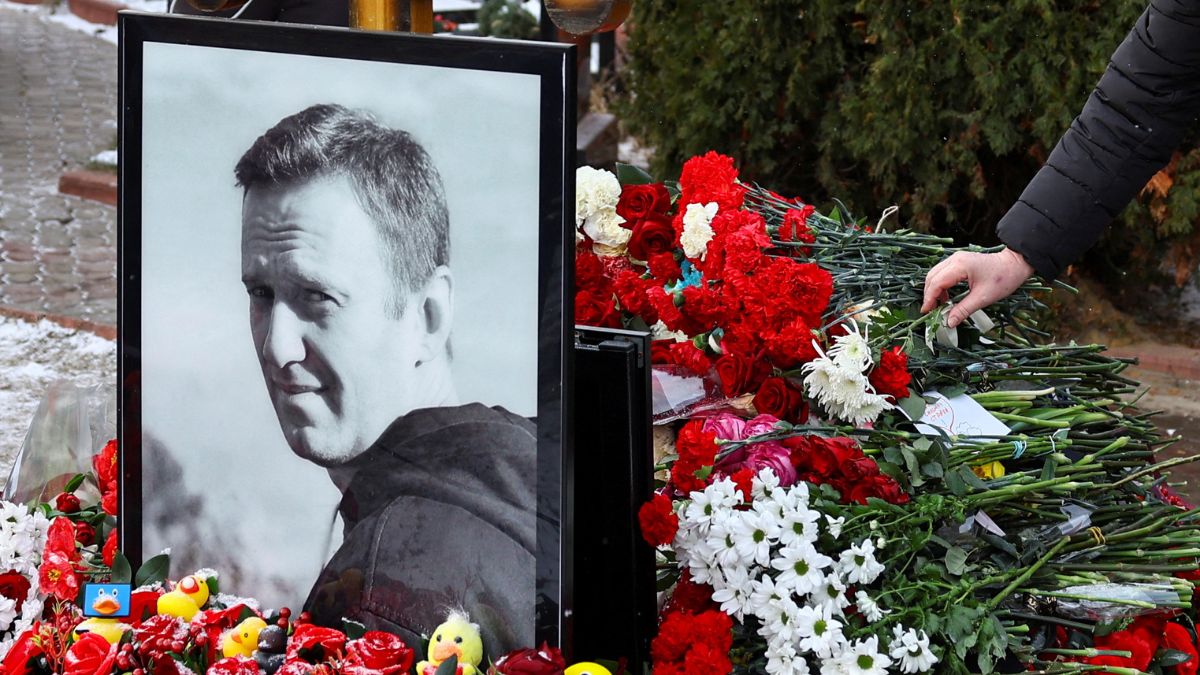
On March 1, 2024, thousands of people attended Navalny’s funeral in Moscow at the Church of the Icon of the Mother of God Soothe My Sorrows in the Maryino District. He was later buried at the Borisovskoye Cemetery in the Brateyevo District.
In the days surrounding his funeral, hundreds of people were arrested across Russia for laying flowers or participating in public vigils honouring Navalny’s memory.
How Navalny challenged Putin
Alexei Anatolyevich Navalny, born on June 4, 1976, became Russia’s most well-known opposition leader and anti-corruption activist.
Through his Anti-Corruption Foundation (FBK), which he founded in 2011, Navalny and his team released numerous investigations into alleged corruption among Russia’s political elite, including senior officials and business figures close to the Kremlin.
His work earned him international recognition. Amnesty International designated him a prisoner of conscience, and in 2021 he was awarded the European Parliament’s Sakharov Prize for Freedom of Thought.
Navalny’s sharp criticism of the government made him a prominent target of state repression. In a 2011 interview, he famously labelled the ruling United Russia party as a “party of crooks and thieves,” a phrase that became widely popular among his supporters.
Navalny’s political career was marked by repeated attempts to run for office, including the 2013 Moscow mayoral race, in which he won 27.2 per cent of the vote but ultimately lost to the Kremlin-backed candidate.
Despite his popularity, he was repeatedly barred from contesting national elections, including the 2018 presidential race, due to criminal convictions widely regarded as politically motivated.
The story of Navalny has also been immortalised through the documentary Navalny, which won several international awards, including the Academy Award for Best Documentary Feature in 2023.
When Navalny was poisoned in 2020
Navalny’s conflict with the Kremlin escalated dramatically in August 2020, when he was poisoned with a military-grade Novichok nerve agent during a trip within Russia.
He fell critically ill and was eventually flown to Berlin for emergency medical treatment, a move that likely saved his life.
Investigations later implicated members of Russia’s Federal Security Service (FSB) in the poisoning. Navalny himself publicly accused President Putin of being directly responsible.
Remarkably, despite the danger he faced, Navalny returned to Russia in January 2021. Upon arrival, he was immediately arrested for allegedly violating parole conditions related to a previous case while he was hospitalised in Germany.
His detention triggered widespread protests across Russia and condemnation from international governments and human rights organisations.
In the years that followed, Navalny was subjected to multiple trials and prison sentences. In February 2021, his suspended sentence was converted into more than two and a half years in prison.
In March 2022, he was sentenced to an additional nine years for embezzlement and contempt of court. By August 2023, Navalny received yet another sentence — this time for 19 years on extremism charges.
Collectively, he was facing over three decades behind bars.
Navalny’s organisations, including the FBK, were declared extremist and dissolved, effectively silencing much of his formal political network.
His imprisonment also coincided with increasing crackdowns on dissent within Russia, especially after the country’s full-scale invasion of Ukraine in 2022.
How Navalny spent his final months in the Arctic
In December 2023, Navalny disappeared from public view for almost three weeks.
When he resurfaced, it was revealed that he had been transferred to the Arctic prison colony where he would eventually die.
Conditions at Penal Colony IK-3 were notoriously harsh.
Located in one of Russia’s most isolated regions, the facility was known for its extreme climate and severe restrictions on inmates. Navalny’s allies warned that placing him in such a remote location effectively cut him off from the outside world.
According to his wife, Navalny was in relatively stable health before his sudden collapse in February 2024. His final communication with her came in the form of a letter the day before his death.
Navalnaya has since alleged that prison authorities ignored his initial complaints of illness, failing to provide timely medical assistance.
Navalny’s death prompted immediate condemnation from Western governments. Then-US President Joe Biden expressed his anger and frustration, saying he was “both not surprised and outraged.”
European leaders also issued statements holding the Kremlin responsible. The Russian government dismissed these accusations as “absolutely rabid statements.”
Protests erupted across Russia and abroad, with demonstrators accusing Putin’s administration of orchestrating the death of its most prominent political opponent.
Russian security forces responded with mass arrests, detaining hundreds of individuals for acts as simple as laying flowers at memorials.
While many Western governments blamed the Kremlin, subsequent reports from US intelligence agencies concluded that Putin himself likely did not personally order Navalny’s killing.
These assessments acknowledged the Russian state’s responsibility for his imprisonment and treatment but stopped short of directly implicating Putin in a deliberate assassination order.
With inputs from agencies
End of Article

&description=Was+Putin+critic+Alexei+Navalny+poisoned+in+Russian+jail%3F)