
 "After Nepal, why have Gen-Z protests broken out in Morocco?")

Morocco has been shaken by a wave of youth-led protests that have spread across the country since last week on September 27.
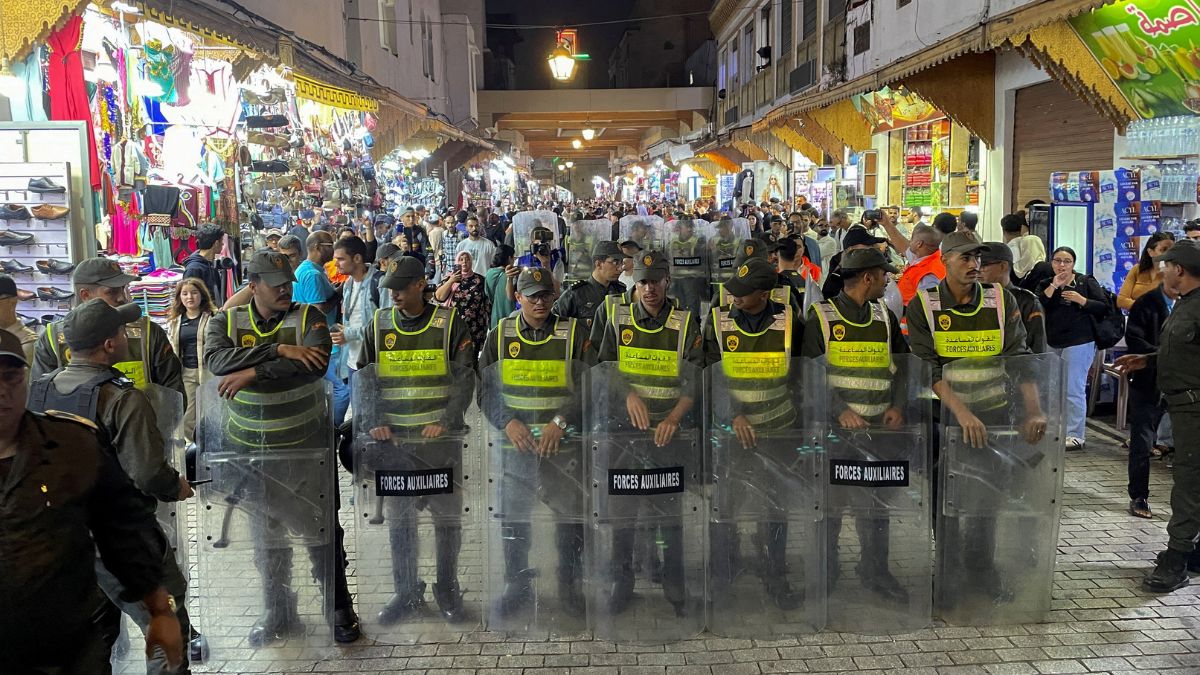
The demonstrations, organised primarily online by a network calling itself GenZ 212, began as calls for improvements in healthcare and education but have escalated into some of the largest and most volatile protests the country has seen in years.
In recent days, towns and cities across Morocco — from Rabat and Casablanca to Agadir, Oujda, Tangier, and Marrakech — have seen crowds of young demonstrators, many in their teens and early twenties, filling public squares and streets.
Some gatherings remained calm, while others spiralled into confrontations with security forces, destruction of property, and casualties.
The unrest comes at a time when Morocco is pouring resources into preparations for hosting the 2030 FIFA World Cup, a point of contention among protesters who accuse the government of prioritising stadiums and international image over hospitals, schools, and basic public services.
How the Gen Z protests turned deadly
The most serious incident took place on Wednesday night in Lqliaa, near Agadir, when protesters attempted to storm a gendarmerie facility.
Local authorities reported that demonstrators were armed with knives, set fire to part of the building and a vehicle, and tried to seize weapons.
Security forces first deployed tear gas but, when this failed, opened fire in what they described as self-defence.
Two people were killed and several others injured in the confrontation, marking the first fatalities since the start of the protests.
Earlier demonstrations in Agadir and surrounding towns such as Sidi Bibi, Biougra, and Taroudant had already been marked by vandalism and fires.
In Sidi Bibi, masked youths burned the commune headquarters and blocked a major road.
Editor’s Picks
In Biougra, a bank was looted and shops were damaged.
Taroudant, normally a quiet town east of Agadir, saw cars burned and businesses attacked.
The violence was not limited to the south. On the same night, unrest spread to Salé, near Rabat, where witnesses reported that groups of young men attacked banks, torched police vehicles, and clashed with security forces in densely populated neighbourhoods.
In Tangier, youths threw stones at police, while in Marrakech, a police station was set on fire.
How the GenZ 212 movement emerged
The GenZ 212 movement’s name refers to Morocco’s telephone country code, but its identity is deliberately opaque. It operates without clear leadership, refusing affiliation with political parties or established activist groups.
Organisers rely heavily on social media and gaming platforms, particularly TikTok, Instagram, and Discord, where protest strategies are shared and grievances aired.
In just a week, membership on the group’s Discord server skyrocketed from around 3,000 to more than 130,000, demonstrating its rapid influence among Moroccan youth.
The group’s anonymity is symbolised by the use of anime avatars, gamer handles, and faceless posts. This approach sets it apart from Morocco’s earlier February 20 Movement, which emerged during the Arab Spring in 2011.
That earlier wave of protests featured leftist activists and members of Islamist organisations who openly negotiated demands and engaged with political processes. In contrast, GenZ 212 participants are often too young to have prior activist experience.
Many protesters captured on video during the recent demonstrations appear visibly inexperienced with confrontations, with some filmed crying as police arrested them or calling for their parents.
Others posed for selfies while being detained. Despite this, their demands are serious and consistent: improved public services, better access to healthcare and education, and job opportunities.
In a statement shared online, the movement stated, “The right to health, education and a dignified life is not an empty slogan but a serious demand.”
The organisers also urged their followers to avoid violence, stressing that their grievances were with the government, not with security forces.
Why the Gen Z in Morocco is protesting
The grievances fuelling the protests are rooted in economic hardship and social inequality. Morocco’s official unemployment rate stands at 12.8 per cent, but among young people it rises to 35.8 per cent, with nearly 20 per cent of university graduates unable to find work.
Hospitals and schools are underfunded, with visible shortages in staff, equipment, and infrastructure.
A particularly tragic incident cited repeatedly by protesters was the death of eight pregnant women at a public hospital in Agadir, which they described as emblematic of the health sector’s collapse.
The demonstrations also reflect anger at perceived government mismanagement of resources. Protesters question why billions are being invested in sports facilities for the 2030 FIFA World Cup, when everyday citizens struggle with inadequate healthcare and overcrowded schools.
Chants like “Health before football” and “Stadiums are here, but where are the hospitals?” capture this sentiment.
One young protester put it bluntly, telling The New Arab, “Why are they spending millions on the World Cup instead of fixing the health system? We’re peaceful. We are just asking for freedom and dignity.”
How the govt has responded
The Moroccan Interior Ministry said it would uphold the right to peaceful assembly but warned that unauthorised gatherings would be met with “rigorous and firm” action.
By Thursday, the ministry reported that 409 people had been detained, with 193 facing trial, mostly on bail. Charges include arson, looting, and attacks on security forces.
Officials also said 263 members of the security forces and 23 civilians had been injured in the clashes, and that 142 police and gendarmerie vehicles were damaged along with 20 privately owned cars.
Authorities have stressed that security interventions were proportionate.
An unnamed security expert told the state news agency MAP that interventions were “balanced,” pointing out that most protests were dispersed peacefully. The official argued that the use of force was restrained and targeted only at those committing acts of vandalism or violence.
Still, rights groups have voiced concerns about arbitrary arrests and the treatment of minors. The Moroccan Association for Human Rights (AMDH) reported that at least 37 protesters arrested in Oujda on September 29, including six underage participants, were scheduled to appear in court.
Amnesty International’s regional office called on Moroccan authorities to engage with the youth’s “legitimate demands” and avoid excessive force.
How the Gen Z movement has gained support
The GenZ 212 protests have resonated beyond traditional activist circles, gaining support from athletes, musicians, and social media influencers. Moroccan goalkeeper Yassine Bounou and rapper El Grande Toto expressed solidarity with the youth movement.
Football ultras announced boycotts of upcoming national team matches, while GenZ 212 urged a boycott of the Africa Cup of Nations in December as a protest against the government’s spending priorities.
The movement has also attracted international attention, with comparisons drawn to youth-led protests in other countries such as Brazil, Nepal, and Madagascar.
Like the demonstrations that shook Brazil ahead of the 2014 World Cup, Morocco’s unrest is partly rooted in opposition to large-scale spending on sports infrastructure at a time of deepening inequality.
What this means for Morocco’s current govt
The protests pose a serious challenge to Prime Minister Aziz Akhannouch and Morocco’s three-party governing coalition.
Demonstrators in Casablanca, Oujda, and Taza have called for his resignation, chanting slogans like “The people want an end to corruption.”
Parliament is expected to hold discussions on healthcare and hospital reform, with the government under pressure to demonstrate concrete action.
Officials insist that shortcomings in public services were inherited from previous administrations, but that argument has not quelled public anger.
Meanwhile, prosecutors have announced charges against individuals accused of spreading false protest videos on social media, saying some were reposting foreign footage as Moroccan events to build their online following.
The GenZ 212 protests represent the largest youth-driven mobilisation since the Rif protests of 2016-2017.
But unlike earlier movements led by seasoned activists, today’s protesters are a digitally native generation using memes, gamer networks, and online platforms to fuel a decentralised and unpredictable wave of dissent.
What unites them is a sense of betrayal: that Morocco’s celebrated modernization — high-speed trains, renewable energy megaprojects, and preparations for international football tournaments — has not translated into better schools, hospitals, or jobs for ordinary citizens.
With inputs from agencies
End of Article
 "China trying to create legal basis for invasion with UN resolution’s interpretation, says Taiwan")
&description=After+Nepal%2C+why+have+Gen-Z+protests+broken+out+in+Morocco%3F)