- Global trade shifts from protectionism to precautionism, prioritizing safety.
- US withdrawal from WTO dispute settlement weakens global trade rules.
- India should leverage strengths in services and trade diplomacy.
- Bilateral agreements are valuable if they reduce trade obstacles.
Global trade is no longer being shaped only by tariffs and free-market ambitions. Geopolitics, security fears, and rising protectionist instincts are rewriting the rules of commerce worldwide. In an exclusive conversation with ABP Live English, former WTO Director-General Pascal Lamy explains why the world is shifting from “protectionism” to “precautionism”, why Donald Trump’s tariff politics may not succeed globally, and why India must double down on its strengths in services, education, and trade diplomacy to stay competitive in an increasingly fragmented economic order.
For those unaware, Lamy is largely credited with maintaining the relevance of the WTO as a monitoring and negotiations body.
ALSO READ: Deep Dive | Washington’s Solar Strike Signals Tougher Trade Posture On India
Q: As WTO head in 2005-13, how was your experience of dealing with the trade environment? How have the power equations shifted?
Lamy: It was very different from what it is today. I mean it was a period when overall geo-economics still had the upper hand over geo politics. There was rather a large consensus that trade should be open and should be handled according to WTO rules and that WTO disciplines should be enforced by a proper dispute settlement mechanism.
We are in a totally different world now. India is now an important member of the WTO, more active than at that time. China is accumulating a huge trade surplus which is no more a trade problem but a macro-economic problem. The US-China rivalry, invasion of Ukraine plus the war in the Gulf presents a totally different picture where the notion that international trade has to be rules based in order to be predictable and to allow for the efficiency gains of a fairly wrong international division of labour is seen differently.
It’s not that we don’t have international trade. By the way, international trade is not doing bad if you look at last year’s trade volumes which increased, importantly in a year when Mr Trump tried to ruffle the system.
So for the moment we are in a contrast with a WTO that is less central than in the past but evolution of trade still remains quite dynamic which shows that global market capitalism benefits from the remains of the rules but also can find its way when the rules are less solid than they used to be.
China has positioned itself in the WTO as a major player, progressively shifting from a poor developing country, which was 20-30 years ago, to a reasonably dynamic, emerging country and China is following its own path. The G-77 solidarity that was there 20-30 years back is inevitably loosening given that some developing countries have emerged more rapidly than others.
Q: You have often indicated structural shifts that are changing the character of global trade. Can you highlight the most impactful?
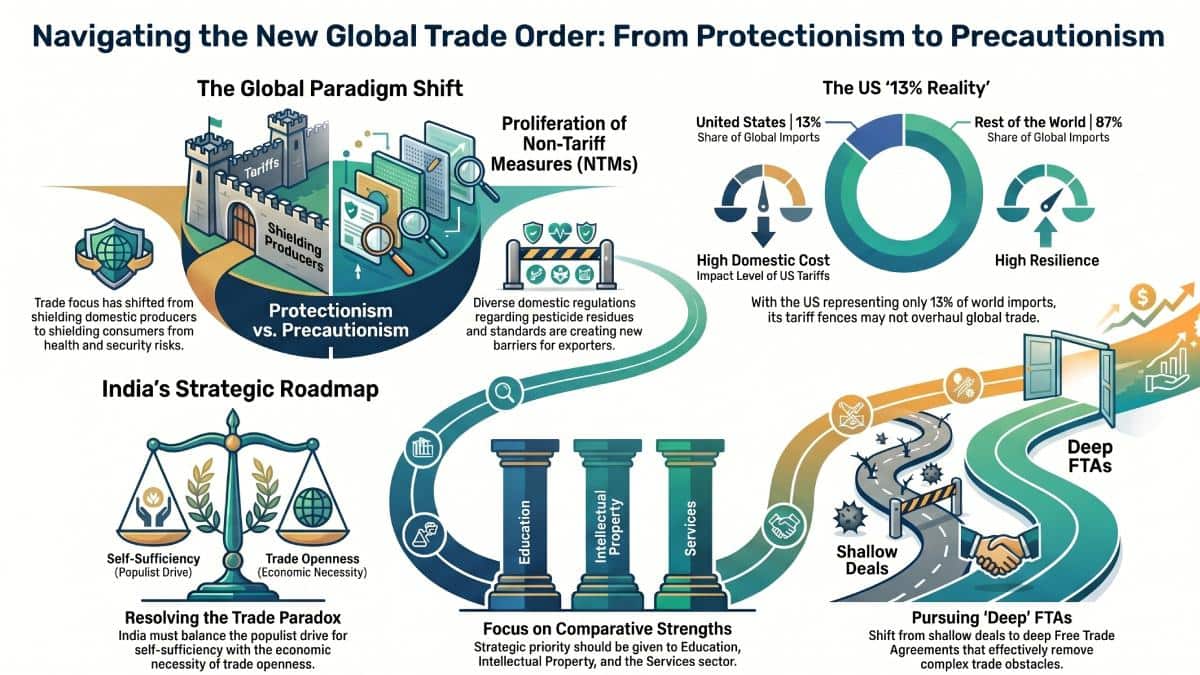
Lamy: One of the main structural shifts which I see and which in my view none of the WTO negotiators are focused upon is the shift from protectionism to what I call precautionism. Protectionism is when you safeguard your producers from foreign competition; precautionism is when you shield the people from risks: health, the environment and even national security which are growing concerns which were not as large 20 years ago than they are now.
These are about pesticide residues, these are about standards for services. These non-tariff measures (NTMs) the purpose of which is not to protect your producer but to reduce the risk for the consumer are proliferating and they are proliferating in very different ways because this is about domestic regulation and there is nothing in place that harmonises the way these domestic regulations are built.
They are built differently which creates regulatory discrepancies which are de facto observable to trade because if I am an exporter and I have to segregate my field depending on exporting to the US, to EU or to Japan, I lose a part of my comparative advantage.
I think this is a major issue going and this is very important for developing countries
Q: The world has witnessed Trump’s distortion and manipulation of the global trade structure. Why hasn’t the WTO stepped in?
Lamy: First, I don’t believe Trump will succeed in overhauling international trade. He might succeed in surrounding the US economy with a 10 per cent average tariff fence but the US are 13 per cent of world imports, if the remaining 87 per cent, this will be a problem for the US, it will not be a problem for us.
I am not saying that a 10 per cent tariff is not a problem, but it is not a big problem especially on the US market which usually is more profitable than others and when importers adjust on the margins which are usually more comfortable in the US market. So I am not that worried about Mr Trump. Others will find alternate ways.
The WTO does not step in simply because the US has left the WTO de facto. The US is sitting on the commitment they have taken to behave. They have used procedure fixtures in the dispute settlement of the WTO in a way that does not allow other members of the WTO, as they would do, to drag the US into a dispute settlement where their rights and duties would be adjudicated.
Thanks to the EU, China and a few others, we have replaced this dispute settlement with a system that adjudicates disputes for instance between the EU and China. The US are not in this system, so they are outside of the reach of the courts.
ALSO READ: Oil Shock, Subsidy Surge: Why India’s Budget Is Under Pressure Right Now
Q: You may have observed the US retaliatory moves on tariffs vis à vis India, marked by tough levies, some relief and only to come back with more actions against us. What do you have to say about this and India’s efforts to widen export markets?
Lamy: I regret it, that’s the way Mr Trump believes he should run his business. I don’t agree with that. I think we all have to learn how to be a little more resilient again. Let us increase our trade, between the EU and India and between the EU and Indonesia.
I think we have to look for alternatives and install some sort of order. This is beginning to happen. If you see the outcome of the recently concluded WTO ministerial which was not a big success but on electronic commerce, 60 or 70 countries decided that although the US would object, they would go ahead and put together a plurilateral agreement and that’s probably one of the options we have to move forward.
On India’s trade strategy, I think as always India is on two minds with regard to trade. On one side, the discourse in the country is that India has to become more self-sufficient which is not very trade positive.
On the other side, for geopolitical and a variety of other reasons, India wants to have more active trade diplomacy.
Now we have these two elements and how they pan out depends on how the Government rides this rather populistic notion that India should trade more with itself and less with the West and the other side which is more on trade openness.
These two vary but given where India has comparative advantages, I believe, as always, that India would benefit from further opening of its trade, both on the import and export side.
Q: At a time when bilateral trade agreements are proliferating, how do you assess India’s move to pursue FTAs and its recent successes?
Lamy: With regard to India’s proactive signing of FTAs, I think this is the direction although these bilateral trade agreements can be shallow or deep.
So you don’t have to look only at the number of these trade agreements but whether they go deep or not into opening commerce and there are a whole range of these possibilities from the deepest ones like the EU has with Korea, Japan or more recently with MERCOSUR and the shallow deals like the ones that exist in Asia, notably that China is part of.
I never saw a contradiction between opening trade bilaterally and opening trade multilaterally. I follow the Chinese saying that ‘don’t mind the colour of the gap provided it catches the mice’.
So if a trade agreement catches obstacles to trade, I am in favour of it.
Q: What would you advise India’s policymakers on our trade strategy looking ahead?
Lamy: It’s about exploiting better. India has comparative strengths in education, intellectual property, and services.
For the moment India has not been as successful as China in industry but with a different political system, it explains part of this difference. I think what is important is to push where you are better than others. It automatically creates a trade opportunity.
(Mukherjee is a contributing writer for ABP Live English. A business journalist for more than 15 years, she has written extensively on the economy, policy, and international relations in Indian newspapers and magazines)