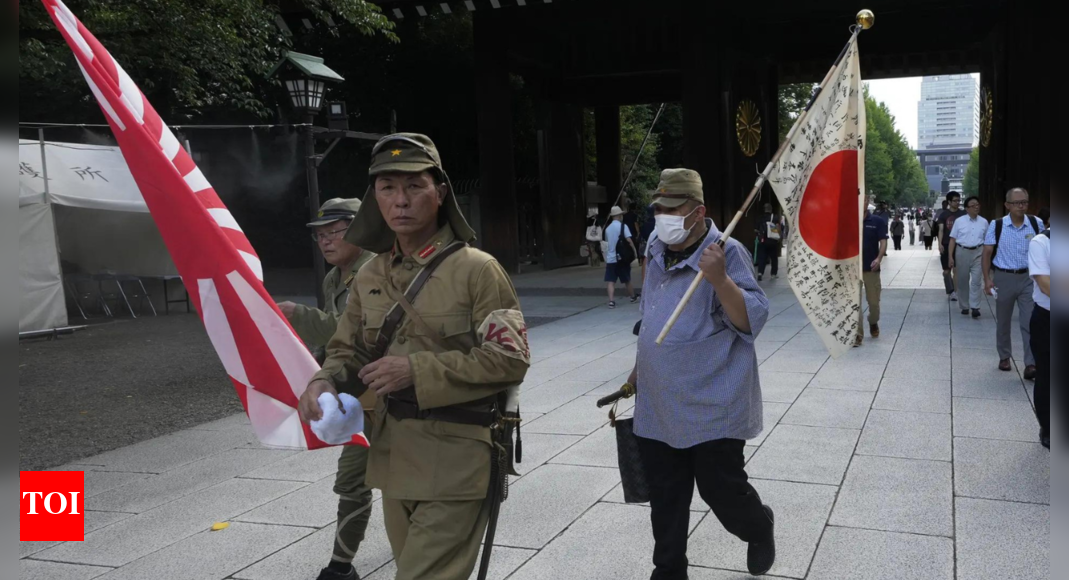

Representative image (Picture credit: AP)
August 15th marks the 80th anniversary of Japan’s unconditional surrender and the end of World War II, putting focus once again on reckoning with the country’s past. The domestic debate in Japan on shaping narratives about World War II is so tense that it is often referred to as “history wars.”Japan’s actions during the war are also a sore spot in international diplomacy. China and both North and South Korea have bitter memories of life under Japanese occupation, and rarely miss an opportunity to remind their neighbour of the past.Inside Japan, what were once far-right fringe voices have grown more prominent in recent years by insisting on a narrative denying or minimising the brutality of Imperial Japan during World War II. Historical revisionist groups want the victims of Imperial Japan’s rampage across Asia and the Pacific eight decades ago to leave history in the past.”There are very few people alive today who experienced the war in any of these countries, but I do not think they will ever stop talking about it because it is an effective tool with which to bash Japan,” said Hiromichi Moteki, chairman of the Tokyo-based Society for the Dissemination of Historical Fact, which promotes a narrative of Japan’s actions during World War II that denies the atrocities that Japan committed. “They want to claim the moral high ground over Japan, but all we want to do is have the right to remember and honour our war dead and teach our younger generations the history of the nation,” he told DW.Historical denialism in JapanMoteki’s organisation seeks to spreads its message by translating Japanese nationalist works of historical revisionism into English.An article published in the Georgetown University’s Journal of International Affairs exploring historical revisionism in Japan describes Moteki’s organisation as part of an “interlocking web of small but vocal lobby groups” that emerged as part of a “denialist movement” in the 1990s.Other groups with similar aims include the “International Research Institute of Controversial Histories” or the “Historical Awareness Research Committee.”Moteki’s group, for example, claims World War II was not a war of aggression started by Japan but an act of self-defence against the US and European nations that had colonised Asia. It claims Imperial Japan “liberated” the countries it conquered.Similar to other nationalist organisations, the society also falsely insists that euphemistically named “comfort women,” most of whom were from Korea, were not abducted and forced into sexual servitude but were in fact well-paid prostitutes. It also contends that Allied prisoners of war were well treated and that labourers from Korea and Taiwan willingly toiled in mines, shipyards or factories during the conflict.Seeking to make Japan a ‘victim’ of foreign conspiraciesAt the same time, the group says the US committed war crimes by dropping atomic bombs on Hiroshima and Nagasaki. The deniers claim that the hundreds of trials carried out by the allies prosecuting Japanese troops for war crimes were merely “victor’s justice.””These groups share a distinctive method of historical writing similar to the methods of Holocaust denialism,” writes Tessa Morris-Suzuki, professor emerita of Japanese history in the College of Asia and Pacific at Australian National University.”They seize on historical documents that are often relatively obscure and cherry-pick them for information that supports their cause. These fragments of information are then strung together without contextualization into writing that overlooks source reliability, ignores contradictory evidence, and fundamentally misrepresents content,” Morris-Suzuki wrote in the Georgetown Journal of International Affairs.”These issues are embedded in a wider, all-embracing view of twentieth-century Japanese history: one that presents Japan as the victim and attributes negative images of Japan’s pre-war and wartime past to international propaganda conspiracies,” she continues.The Georgetown report, which was published in 2021, said a “substantial number” of conservative lawmakers “belong to lobby groups which disseminate revisionist views.”Historical revisionist lobby groups have also worked with diplomats on propaganda efforts abroad, including opposing monuments to “comfort women” in countries like the US and Germany.Japan’s history seen through the eyes of victimsYuji Hosaka is a professor of history and politics at Sejong University in South Korea who has long been critical of Japan’s failure to honestly address its past, or to teach younger generations of Japanese the truth about the war-time era.”I see many on the right in Japan who just want to forget about all the bad things that happened when Japan occupied Korea and invaded China and Southeast Asia,” he said. “These people often say that Japan brought development and modern technology to help these countries, but that just makes the people of Korea angry.”Korean historians largely agree that after annexing the peninsula from 1910, Japan forcefully assimilated the Korean people, forbade them from speaking their own language, suppressed the indigenous culture and exploited the land and its people. The intent was to make Korea a part of the Japanese empire, with thousands of Koreans serving in the Japanese military during the war.Hosaka says that Japanese history school books still gloss over the atrocities carried out by the Japanese military, with often little or no mention of the Nanjing Massacre which killed hundreds of thousands in China, the abuse of civilian labourers and POWs, or other crimes for which Japanese were executed after the war.”Those who forget the past will inevitably find themselves in a similar situation again in the future,” he said. “It is imperative that Japan learns from the past.””In the past, Germany and France worked together to create common history books for their children,” he added. “I believe that Japan should reach out to Korea and China and do the same thing.”An editorial in the July 7 edition of the China Daily newspaper declared, “It’s time Japan faced its war crimes and militarist past.” For China, the Nanjing Massacre continues to bear weight in the present day.According to Chinese historians, 300,000 civilians and soldiers were killed in a six-week frenzy of murder, torture, rape, arson and looting after the invading Japanese military entered Nanjing, then the capital city of China, on December 13, 1937. The massacre is recognised internationally as well. The Encyclopaedia Britannica writes that the “number of Chinese killed in the massacre has been subject to much debate, with most estimates ranging from 100,000 to more than 300,000.”Those who had ordered the massacre were executed after being found guilty of committing war crimes by the International Military Tribunal for the Far East in 1948.Japan should ‘stop apologising’Moteki and others on the right say successive Japanese leaders have expressed genuine remorse for what happened nearly a century ago but that other countries always say the apologies are inadequate or are insincere.”It will never change,” said Moteki, who was born in 1941.”Japan has to defend itself from these criticisms and verbal attacks. But the time has come for Japan to stop apologising because it is meaningless now.”On August 15, the anniversary of the emperor announcing in a radio broadcast that Japan was surrendering, Moteki will go to the controversial Yasukuni Shrine in central Tokyo to pay his respects to war dead.He will be surrounded by thousands more who want to mark the anniversary, including dwindling numbers of old soldiers, the relatives of men who fought, and far-right groups in uniforms.Yasukuni is the last resting place of more than 2.4 million military and civilian victims of war in Japan since 1869. To other nations, however, Yasukuni is a controversial symbol, as it also honours more than 1,000 people convicted of war crimes. Go to Source