
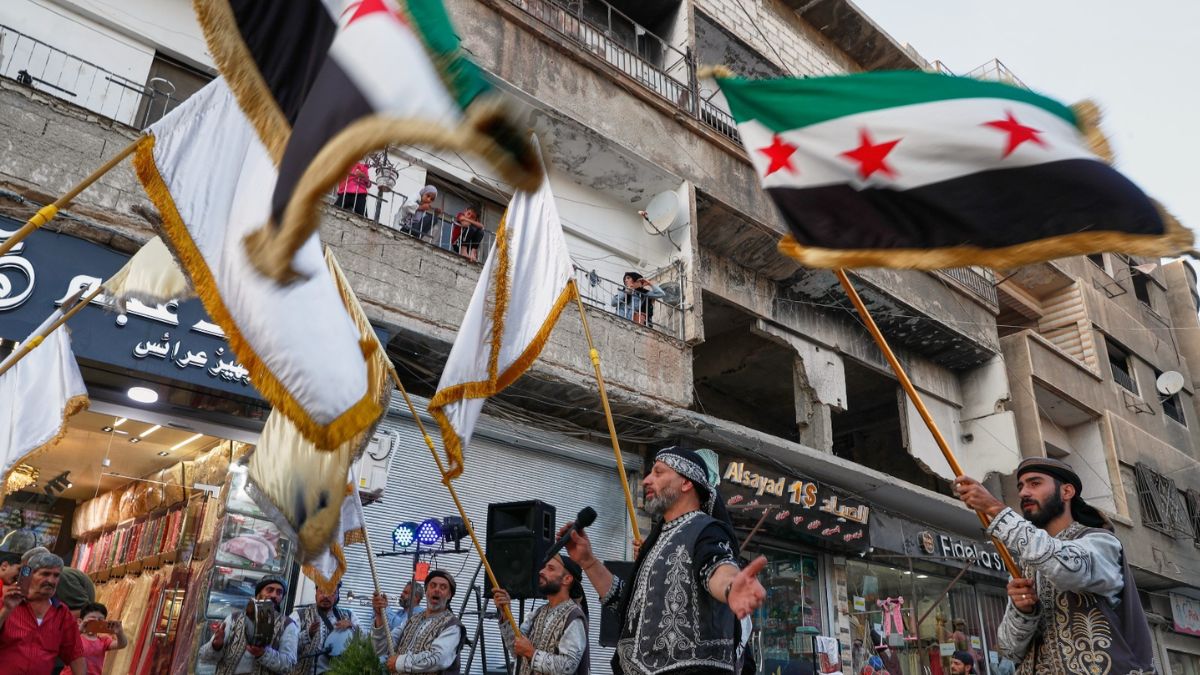
 "After decades of turmoil, Syria holds its first parliamentary elections. What to expect")

Syria holds its first parliamentary elections since Bashar Assad’s ouster, with most seats chosen by electoral colleges and one-third appointed, amid concerns over inclusivity and representation.
Syria is holding parliamentary elections on Sunday for the first time since the fall of the country’s long-time autocratic leader, Bashar Assad, who was unseated in a rebel offensive in December. Under the Assad dynasty’s 50-year rule, Syria held regular elections in which all citizens could vote. In practice, however, the Assad-led Baath Party dominated parliament, and votes were widely seen as sham elections.
Outside analysts said the only competitive element was the Baath Party’s internal primary system before election day, where members competed for positions on party lists. Sunday’s elections will again fall short of full democracy. Most of the People’s Assembly seats will be chosen by electoral colleges in districts, while one-third will be appointed by interim President Ahmad al-Sharaa.
Although not a popular vote, the results are expected to be viewed as a gauge of the interim government’s seriousness about inclusivity, particularly for women and minorities.
How the elections will operate
The People’s Assembly has 210 seats. Two-thirds will be elected, and one-third appointed. Elected seats will be chosen by electoral colleges in districts, with seat distribution based on population. Originally, 7,000 electoral college members in 60 districts were to vote for 140 seats.
However, elections in Sweida province and Kurdish-controlled areas in the northeast have been postponed indefinitely due to tensions between local authorities and Damascus, leaving those seats empty. As a result, about 6,000 electoral college members will vote in 50 districts for roughly 120 seats.
The Aleppo district is the largest, with 700 electors voting for 14 seats, followed by Damascus with 500 electors for 10 seats. All candidates must be members of the electoral colleges.
After Assad’s ouster, interim authorities dissolved all existing political parties, most of which had close ties to the Assad government, and have not yet created a system for registering new parties. Consequently, all candidates are standing as individuals.
Why there is no popular vote
The interim government says creating an accurate voter registry and organising a popular vote is impossible at this stage, due to the displacement of millions of Syrians by the nearly 14-year civil war and loss of personal documents.
The new parliament will serve a 30-month term, during which the government aims to prepare for a popular vote in the next elections.
Critics have described the absence of a popular vote as undemocratic, though some analysts find the government’s reasoning valid. Benjamin Feve, senior research analyst at Karam Shaar Advisory, said: “We don’t even know how many Syrians are in Syria today. It would be really difficult to draw electoral lists today in Syria or arrange logistics for Syrians abroad to vote.”
Haid Haid, senior research fellow at the Arab Reform Initiative and Chatham House, stressed the lack of clarity over how electors are chosen. “Especially when it comes to choosing subcommittees and electoral colleges, there is no oversight, and the process is potentially vulnerable to manipulation,” he said. He added that electoral authorities had removed names from published lists without explanation, fuelling criticism.
Inclusivity and representation concerns
There is no fixed quota for women or religious and ethnic minorities in the parliament. Women must make up 20% of electoral college members, but this does not guarantee a comparable percentage among candidates or those elected. According to state-run news agency SANA, citing Mohammed Taha al-Ahmad, head of the national elections committee, women make up 14% of the 1,578 candidates on the final lists. In some districts, women account for 30–40% of candidates, while in others, there are none.
The exclusion of Sweida and Kurdish-controlled areas has intensified concerns over minority representation. Recent sectarian violence has killed hundreds of civilians from Alawite and Druze communities, many at the hands of government-affiliated fighters.
Feve noted that electoral districts appear designed to create minority-majority districts. “The government could have merged these districts with majority Sunni Muslim districts to limit the number of minorities, which it did not do,” he said.
Officials have suggested that al-Sharaa’s authority to appoint one-third of the parliament could improve inclusivity if fewer women or minorities are elected. However, Haid warned that the lack of participation from Sweida and the northeast would remain a significant issue, regardless of appointments. “The dispute between de facto authorities and Damascus over their participation in the political process will remain unresolved,” he said.
(With agency inputs)
End of Article
 "Man United manager Amorim says players want him to stay; Mount reveals inside details: ‘They don’t want to change’")
&description=After+decades+of+turmoil%2C+Syria+holds+its+first+parliamentary+elections.+What+to+expect)