
 "<div>How Nepals Gen-Z protests led to the fall of the KP Sharma Oli govt in 24 hours</div>")

Nepal is facing one of the most severe political crises in its recent history after two days of widespread unrest forced Prime Minister KP Sharma Oli to step down on Tuesday.
His resignation came amid escalating violence triggered by the government’s decision to ban multiple social media platforms, a move that sparked a nationwide movement against corruption and state overreach.
The crisis has left the country’s coalition government on the brink of collapse, with several ministers quitting and major political parties considering withdrawing support.
The events of the past 48 hours have exposed deep dissatisfaction among young Nepalis and put a spotlight once again in the ever long political instability of the Himalayan nation.
The unrest traces back to a government order issued last week that blocked (now lifted) access to 26 social media platforms, including Facebook.
Authorities justified the move by claiming that these companies had failed to register with the government and were being used to spread false information and conduct online scams.
Critics, however, viewed the decision as a direct attack on free speech.
Civil society groups and opposition leaders accused the government of attempting to silence dissent, particularly voices criticising widespread corruption and the lavish lifestyles of political elites.
Anger over the ban was most visible among young Nepalis. Social media had become a vital outlet for discussing political grievances, organising activism, and exposing alleged misuse of power by public officials.
Editor’s Picks
Many young users had been posting about what they described as the “luxurious lives of the families and children of corrupt politicians and civil servants” at a time when unemployment and poverty remain widespread.
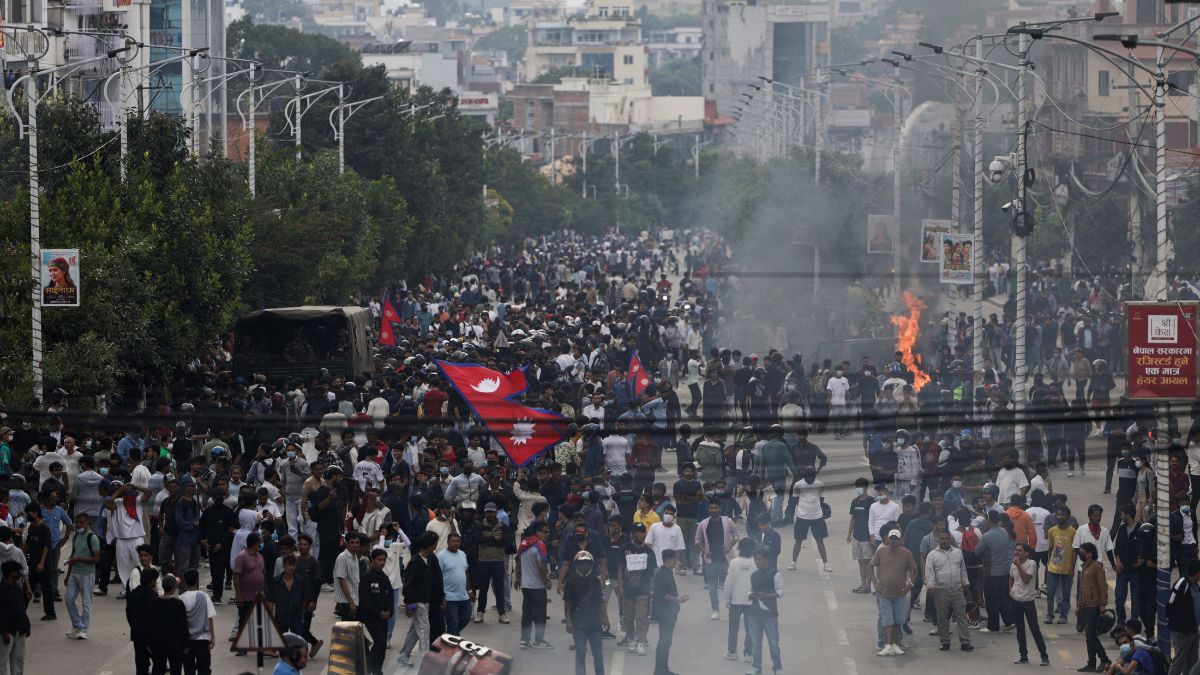
By Monday, this simmering frustration erupted into massive street demonstrations. Tens of thousands of protesters, largely students and young professionals, converged in Kathmandu under the banner of the so-called “Gen Z” movement.
#WATCH | Kathmandu, Nepal | A protestor says, “It is very good for our country that Nepal Prime Minister K.P. Sharma Oli has resigned. Now the youth will stand and give its contribution in developing the nation…” pic.twitter.com/Bx9cmZp7xG
— ANI (@ANI) September 9, 2025
Their placards read messages such as “shut down corruption, not social media” and “youths against corruption,” directly linking the ban to broader anger at the political establishment.
How the Nepal protests turned violent
The protest in Kathmandu began peacefully but soon escalated. Demonstrators surrounded the Parliament building, demanding the government immediately reverse the ban and take action against corruption.
As tensions rose, some protesters breached the Parliament complex, prompting security forces to respond with tear gas, water cannons, and eventually live rounds.
By the end of Monday, 19 people had been killed and over 250 injured, according to official figures.
Another death was reported on Tuesday.
Eyewitnesses described chaotic scenes as crowds scattered while police attempted to regain control of the area.
The violence was not confined to the capital. Protests quickly spread to other major urban centers, including Pokhara, Butwal, Bhairahawa, Bharatpur, Itahari and Damak.
Demonstrators in these cities echoed the demands of Kathmandu protesters, calling for the immediate lifting of the ban and a government overhaul.
Nepali Home Minister Ramesh Lekhak announced an indefinite curfew in Kathmandu starting at 8:30 am Tuesday. Similar restrictions were enforced in Lalitpur and Bhaktapur districts.
Despite these measures, crowds continued to gather, defying police orders and chanting slogans like “Punish the murders in government. Stop killing children.”
How protesters pressured the govt by targeted attacks
Protesters reportedly set a partial fire to the Parliament building on Tuesday and launched coordinated attacks on the private residences of top leaders.
Amongst the targets were Oli’s residence, the home of President Ram Chandra Poudel, and the house of Sher Bahadur Deuba, leader of the Nepali Congress party, which is the largest party in Parliament.
#WATCH | Nepal: Protesters set the private residence of former PM K.P. Sharma Oli, in Bhaktapur, on fire as demonstrations against the Government over alleged corruption tore through the country. PM Oli stepped down this afternoon amid protests.
(Video Source: TV Today Nepal) pic.twitter.com/KKN3rUsIaU
— ANI (@ANI) September 9, 2025
The residence of Maoist leader Pushpa Kamal Dahal was also vandalised.
In another related incidents, a private school owned by Foreign Minister Arzu Deuba Rana, who is married to Deuba, was set ablaze. Videos circulating online showed flames engulfing the property as demonstrators cheered.
Security forces struggled to contain the widespread unrest. At least a dozen army helicopters were deployed to evacuate government officials from ministerial quarters in Bhaisepati.
Reports suggested that five helicopters were specifically tasked with transporting key ministers to safety.
Tribhuvan International Airport in Kathmandu, Nepal’s main aviation hub, was also forced to halt operations on Tuesday afternoon. Authorities cited serious security risks, including protesters attempting to disrupt flights using drones, fireworks, and laser lights aimed at aircraft.
International flights had been halted since 12:45 pm after heavy smoke was seen near Koteshwar.
Domestic carriers, including Buddha Air, also suspended services after crew members were unable to reach the airport safely.
How Oli went from political maneuvering to resigning
In a last-ditch effort to defuse tensions, Oli addressed the nation, urging demonstrators to exercise restraint, “Any form of violence is not in the national interest. We must adopt peaceful dialogue and discussion.”
He also announced an all-party meeting scheduled for later in the evening to explore solutions through dialogue.
However, behind the scenes, Oli’s position had become untenable.
According to army sources, Oli reached out to Nepal Army Chief General Ashok Raj Sigdel seeking military assistance both to restore order and to ensure his personal safety.
Sigdel reportedly told Oli that the military could only stabilise the situation if he agreed to step down voluntarily.
As the situation spiraled out of control, Oli agreed to resign.
His formal letter was submitted to Poudel on Tuesday evening, marking the end of his fourth term as prime minister since Nepal became a republic in 2008.
In his final hours in office, Oli attempted to take measures to ease public anger. He announced the formation of an investigation committee to look into the events of Monday, with instructions to submit a report within 15 days.
He also promised compensation for the families of those killed during the protests and free medical treatment for the injured. However, with his resignation, the future of these plans remains uncertain.
What this means for Nepal’s current government
Several members of Oli’s cabinet had already resigned, either citing moral reasons or expressing dissatisfaction with how the crisis was handled.
Home Minister Ramesh Lekhak was the first to step down late Monday night following the deadly crackdown.
On Tuesday, Agriculture Minister Ramnath Adhikari announced his resignation. Health Minister Pradeep Paudel had also signalled his intent to quit.
Youth and Sports Minister Teju Lal Chaudhary and Water Minister Pradeep Yadav also resigned.
Nepali legislator Asim Shah also vacated his position.
The crisis has destabilized Nepal’s ruling coalition. The Nepali Congress, which holds 89 seats in the 275-member House of Representatives, is deeply divided.
Senior leader Shekhar Koirala has instructed his allies to resign from the government, further eroding support for Oli’s coalition.
The Maoist Centre, with 32 seats, has also threatened to withdraw from the alliance. Smaller parties, including the Janata Samajbadi Party and others, collectively hold around 10 seats, but their positions remain uncertain.
Compounding the problem, the National Independent Party (NISP) has decided that all 21 of its MPs will reprotedly resign en masse.
NISP has been a vocal supporter of the protest movement and is now demanding the dissolution of Parliament and the announcement of fresh elections.
With these defections, the coalition’s numbers have dwindled dangerously close to falling below the majority threshold of 138 seats.
Opposition leaders are calling for the formation of a caretaker government and the holding of early elections.
The army has so far refrained from taking direct control.
Meanwhile, protesters continue to occupy streets in Kathmandu and other cities, showing little sign of relenting until they see meaningful political change.
With inputs from agencies
End of Article

&description=How+Nepal%E2%80%99s+Gen-Z+protests+led+to+the+fall+of+the+KP+Sharma+Oli+govt%C2%A0in%C2%A024%C2%A0hours)