
 "Land trade, easier visas, direct flights: India and China warm ties with new deals")

In a sign of warming relations after years of strained ties, India and China have agreed to a series of trade and connectivity measures aimed at restoring economic confidence, reopening stalled exchanges, and building new foundations for people-to-people contact.
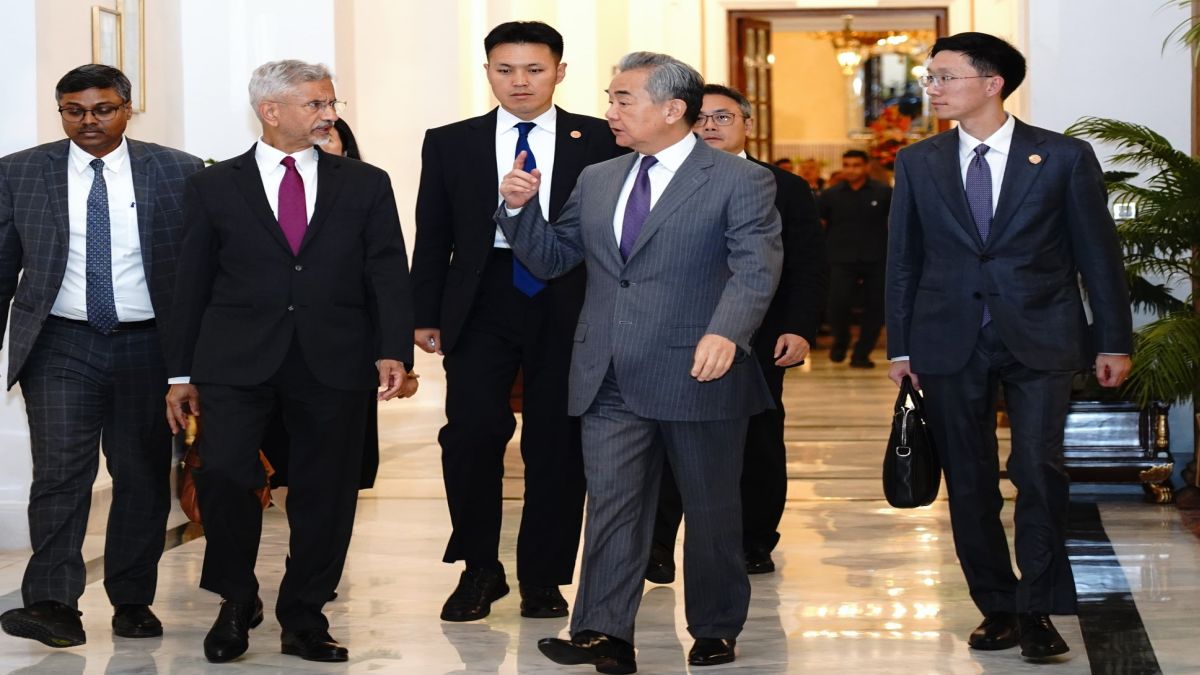
The announcements made in India’s official release, following wide-ranging talks that External Affairs Minister S Jaishankar and National Security Adviser Ajit Doval had with visiting Chinese Foreign Minister Wang Yi in New Delhi. The agreed measures marked a cautious but significant step towards easing tensions and reviving bilateral cooperation.
Land border trade routes to open again
Among the most striking outcomes of the joint discussions was the decision to reopen border trade through three traditional passes — Lipulekh, Shipki La and Nathu La. These routes have long been associated with local commerce and cross-border exchanges.
These routes were closed in the aftermath of China’s aggressive posturing on the Line of Actual Control (LAC), leading to the 2020 Galwan Valley clashes and long-drawn military stand-off in eastern Ladakh. Their reopening represents a tangible economic boon for communities in the Himalayan region and symbolises a cautious resumption of trust.
Diplomats from both sides emphasised that the move was not merely symbolic: reopening of trade posts is expected to revive long-standing regional economic activity and provide opportunities to traders who depend heavily on cross-border markets.
More trade and more investments
The two countries also pledged to take “concrete measures” to facilitate trade and investment flows. The leaders from India and China underscored the significance of mutual investment promotion in their talks during Wang Yi’s New Delhi visit on August 18 and 19.
India, looking to reduce trade deficits and diversify supply chains, emphasised the need for balanced exchanges. China, for its part, took note of India’s concerns and expressed its commitment to fostering a more predictable trade environment.
While details of the proposed measures are not immediately known, reports quoting government officials have suggested that discussions focussed on easing regulatory hurdles, scaling up sector-specific investments, and supporting enterprises navigating bilateral markets.
How much India and China trade with each other
According to official trade statistics, India–China economic exchanges have remained substantial despite recent bilateral tensions. Bilateral trade in 2023 reached $136.2 billion, with India importing goods worth $101.8 billion from China while exporting $34.4 billion. This resulted in a trade deficit of $67.4 billion, making China India’s largest single-country source of imports as well as its most significant trade deficit partner.
Figures for India’s 2023–24 financial year show a similar trade gap. Imports from China stood at $101.7 billion, whereas India’s exports were considerably lower at $16.7 billion, bringing the overall trade to $118.4 billion. The shortfall of more than $85 billion has been one of the key economic concerns that India has consistently raised with China.
While two-way trade crossed the $100 billion mark for the first time in 2021, peaking at nearly $136 billion in 2022, the deficit has steadily widened over the past decade and a half – rising from $16 billion in 2007–08 to its current levels.
India’s imports continue to be dominated by electrical machinery, telecom equipment, chemicals and pharmaceutical ingredients, while its exports are largely concentrated in raw materials such as iron ore, cotton and certain petroleum products.
Although the reopening of traditional border trade routes may have limited effect on the overall volume, it carries symbolic weight and promises concrete benefits for local communities. The wider package of measures, particularly on investment facilitation and air services, is also being viewed in New Delhi as part of a longer-term attempt to secure more balanced and diversified exchanges with China.
In public focus: Direct India-China flights
Air connectivity — another casualty of bilateral tensions — is also set to make a comeback. Though no deadline has yet been announced, the direct flights between the two countries are likely to resume soon. China has long sought resumption of direct flights, while New Delhi has been cautious weighing Beijing’s request.
India and China agreed to resume direct flights between Indian cities and the Chinese mainland “at the earliest”. The two countries are likely to finalise an updated Air Services Agreement in the coming days to institutionalise connectivity.
The resumption of flights could be critical to restoring business and tourism exchanges, which have been hampered following China’s Galvan ambush attempt five years ago. Direct services would also offer relief to students and professionals who continue to seek opportunities across the border, often forced to take longer indirect routes.
Direct flights to also see easier visa processes
In a further boost to mobility, both governments committed to facilitating visas for tourists, businesspersons and other categories of travellers including media representatives. The announcement is expected to benefit stakeholders on both sides who have been calling for a simpler, faster and more reliable visa regime.
By enhancing cross-border mobility, policymakers hope to encourage not only commerce but also interpersonal links and cultural familiarity — factors seen as essential in tempering political misunderstandings.
Kailash and Manasarovar: Pilgrimage tourism to get a boost
As part of efforts to promote cross-border engagement, the two sides also announced that starting in 2026, the scale of annual pilgrimages from India to Mount Kailash and Lake Manasarovar in Tibet would be expanded.
Though religious in nature, these journeys generate considerable economic activity, supporting tour operators, local guides, and services on both sides of the border. Expanding pilgrimage access could become another layer of people-centred diplomacy, blending cultural tradition with tourism-driven growth.
Rivers and resources another sphere of cooperation
Recognising the importance of trans-boundary resources, India and China agreed to strengthen cooperation on rivers through their expert-level mechanism on trans-border rivers. New Delhi and Beijing will also maintain communication on renewing relevant Memoranda of Understanding.
Crucially, China has agreed to share hydrological information during emergency situations, a step considered vital given the vulnerability of downstream regions to flooding and climate variability.
China also agreed to lift curbs on the exports of rare earths, fertilisers and equipment such as boring machines to India. These curbs have come in the spotlight against the backdrop of tariff measures announced by US President Donald Trump. The agreement on these exports is being seen as attempts by India and China to counter Trump tariffs by showing solidarity for a multipolar world as well as a multipolar Asia, as Jaishankar put forth during his talks with Wang.
But it is still a cautious thaw
The trade and connectivity measures form part of a wider package announced after Wang Yi’s meetings in New Delhi, alongside discussions over border stability and de-escalation in Ladakh. While political and security issues remain contentious, both governments signalled their willingness to compartmentalise and build on areas of convergence in the economic domain.
The timing of the announcements reflected both strategic and practical considerations. India has sought greater diversification of trade ties amid global uncertainties and has an interest in reopening avenues that benefit its exporters and border communities.
China, facing economic headwinds at home and wary of prolonged estrangement, appears keen to normalise exchanges and stabilise one of its key bilateral relationships in Asia.
Up next: PM Modi flies to China
Prime Minister Narendra Modi is scheduled to travel to Tianjin later this month to attend the Shanghai Cooperation Organisation summit, where a meeting with President Xi Jinping is expected. PM Modi told Wang, who called on the Indian prime minister on Tuesday evening, that he was “looking forward” to the proposed meeting with President Xi during his visit for the SCO summit.
The latest agreements on trade, flights, visas and resource management are likely to set the stage for higher-level discussions, offering a roadmap for cautious yet deliberate rebuilding of a relationship that had suffered deep mistrust.
Despite lingering scepticism, the reopening of border trade, restoration of direct air links, and facilitation of investment and people flows mark an important recalibration in the India-China bilateral ties, strained over Chinese attempts to alter the status quo in eastern Ladakh and against the backdrop of Trump-induced chaos in the established global order. The policy thrust, Indian government officials suggested as quoted in reported, is to move towards “a stable, cooperative and forward-looking relationship” while managing differences responsibly.
End of Article
 "Why Trump levied penalty tariff on India, not on China: Even US is confused")

&description=Land+trade%2C+easier+visas%2C+direct+flights%3A+India+and+China+warm+ties+with+new+deals)