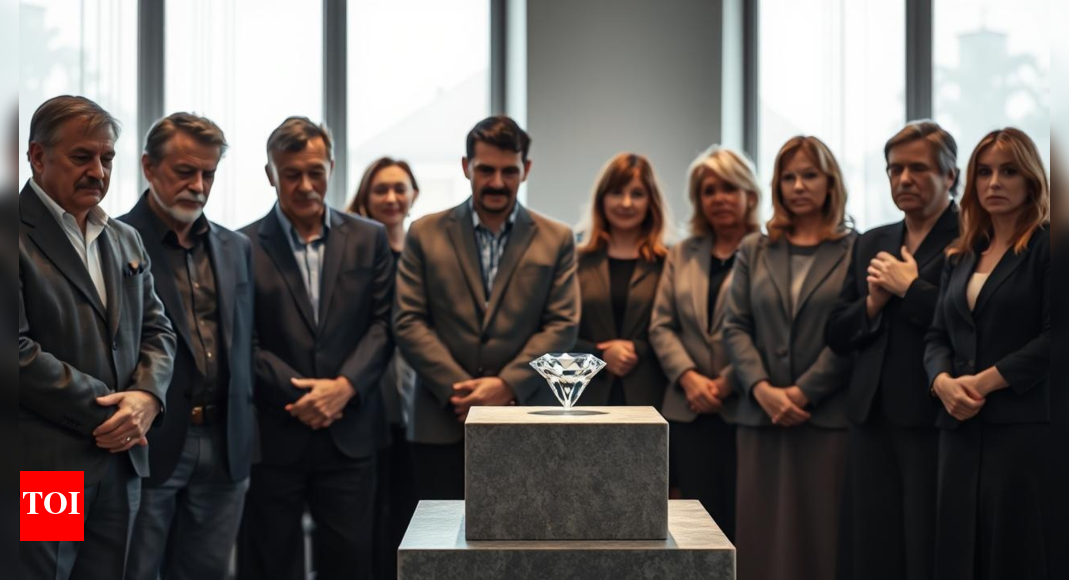

AI-generated image
The German states of Rhineland-Palatinate and Saxony-Anhalt have overhauled their burial legislation, with lawmakers in the western German state taking the biggest stride. “After more than 42 years we have created a new framework that reconciles the individual ideas and wishes of the people in the state with a dignified act of bidding farewell,” said Rhineland-Palatinate Health Minister Clemens Hoch, of the center-left Social Democrats (SPD).From October 1, people in the western state will now be able to choose the Rhine, the Moselle, Lahn or Saar rivers as their final resting place. Until now, it has not been possible to scatter cremated remains in Germany rivers.The new legislation, introduced by the coalition government of the SPD, environmentalist Greens and the neoliberal Free Democrats (FDP), also caters for homebodies, giving loved ones the chance to keep an urn containing remains at home — another first — or opt to scatter the remains in the garden.
Creating memorial diamonds from human ashes
The new laws in Rhineland-Palatinate and the eastern state of Saxony-Anhalt also allow for the creation of “memorial diamonds” from the ashes of the deceased.The synthetic diamonds are grown at high temperatures from the extracted carbon — a process introduced in Switzerland two decades ago. Such keepsakes are growing increasingly popular.The conservative opposition in Rhineland-Palatinate, the Christian Democrats (CDU), is worried the legislation might ring the death knell for cemeteries — with CDU politician Christoph Gensch accusing Hoch of being their “grave digger” in a state parliament debate. There has also been criticism from the main christian churches. Peter Kohlgraf, catholic bishop of Mainz, told public broadcaster ZDFthat nobody would really know what happened to remains in private homes.”I hate to think of urns getting forgotten in a move or jewelry made from ashes getting lost,” Dorothee Wüst, the president of the Protestant Church in the Palatinate, told the Evangelical Press Service (epd).
German burial laws out of step with social changes
The Federal Association of German Undertakers, the BDB, has, however, been lobbying for change. It represents 90% of the nation’s funeral directors, some 5,000 companies. Secretary general Stephan Neuser said the new laws enshrined the will of the people. Neuser told DW that members were often approached by bereaved relatives wanting to take urns home or remove ash for the creation of jewelry mementos. “The burial culture that we have in Germany has greatly changed in recent years,” he said. Some three-quarters of Germany’s dead are now cremated. Only one in five are buried. With urns taking up much less space, plot leases sometimes as short as 10 years and rising upkeep costs, graveyards have long been disappearing nationwide. In Berlin’s cemeteries, for example, an area of land equivalent to 476 soccer fields now lies vacant, according to a 2024 report by the city’s Technical University.
Trend towards more personalized mourning and memorials
Sociologist Thorsten Benkel said the trend reflects increasing mobility and changing attitudes toward mourning. “People no longer want to be dictated to about where or how they should mourn. Many people never visit graves for various reasons because they live far away, because they find it depressing. They often tell us: ‘The place of mourning is wherever I am and not where the dead body is,'” he told DW.Digital space has increasingly become a space for grief and the preservation of memories. The researcher from the University of Passau nevertheless does not think that graveyards will vanish — but become one option among many.Benkel believes people in Germany should have a freer hand in deciding what graves should look like, as in the Netherlands. The new laws in Rhineland-Palatinate and Saxony-Anhalt mirror increased sensibility for the pain of losing babies in the early stages of pregnancy, with burial now obligatory for “Sternenkinder” (“children from the stars”) — the terms miscarriage and still birth are consciously avoided.Saxony-Anhalt now also permits shroud burial for the first time for Muslims and Jews, while Rhineland-Palatinate has extended the option to everyone irrespective of faith.
Green funerals increasingly popular
Religious and cultural diversity, secularization and concern for mental well-being and the environment are growing, even if funeral legislation has often not kept pace. Woodland burial grounds have become increasingly popular in Germany. The first was set up in 2001, and now the main two operators alone run 175 sites. Many people prefer the informal natural setting to the regimented rows of conventional graveyards. It’s also cheaper, and leases can run up to 99 years. This turn toward nature is reflected, too, in the interest in river and sea burials despite their potential environmental impact.River burials in Rhineland-Palatinate will be strictly regulated and are in line with existing rules about sea burials. Ashes must be consigned to the waters in a biodegradable urn from a ship.In a far more radical back-to-nature act, the northern state of Schleswig-Holsteinis testing natural organic reduction or terramation. Bodies are placed in straw-lined “cocoons,” where microorganisms convert the remains to soil in about 40 days.The pilot project, now extended to June 2026, is being monitored by the University of Leipzig. No environmental risks have been so far detected.
Preventing ‘death tourism’
Aeternitas, a funeral care consumer initiative, would like the changes in Rhineland-Palatinate and Saxony-Anhalt to catch on, but fears considerable resistance.”One problem in Germany is that the burial rules are predominantly characterized by mistrust and outdated traditions, whereas a much more liberal approach is usual in other countries. Many people simply don’t follow the existing rules,” press officer Alexander Helbach told DW.Some Germans have simply been cremating their loved ones outside the country and taking away their remains — or sending urns to crematoriums abroad to get access to the ashes.To stop that kind of “death tourism,” only people living in Rhineland-Palatinate will be eligible for river burials. Even nostalgic ex-residents stand no chance.And if someone you have designated to take care of your urn moves to another German state, they are neither permitted to keep it in their home nor pass it on to someone else. These differences in regional laws could lead to absurd — and potentially heartbreaking — scenarios. Go to Source