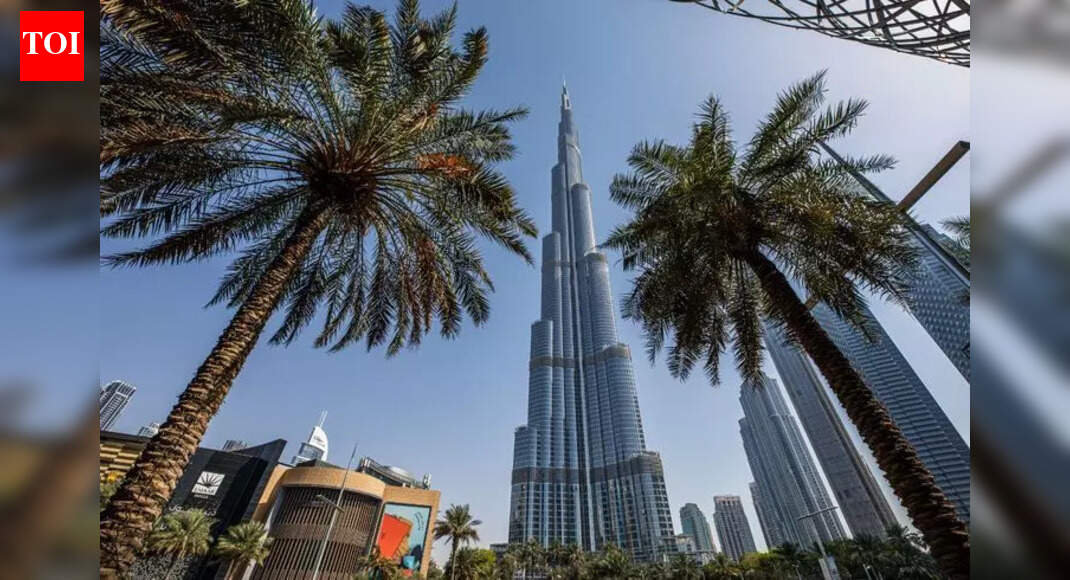


Burj Khalifa Was Never Meant to Be This Tall: Design Trick That Lets Dubai’s Skyscraper ‘Confuse the Wind’ and Stay Rock Solid
When the Burj Khalifa opened on January 4, 2010, it did not just take the title of the world’s tallest building, it announced Dubai to the world as a hub of ambition, innovation and architectural daring. More than a decade later, architects and engineers still marvel at how it was done and how the structure continues to stand as a benchmark of engineering excellence. At the centre of that success is Bill Baker, the structural engineer whose pioneering designs made the 828-metre landmark possible. Read on as we explore the groundbreaking systems and safety features that not only helped build Burj Khalifa but keep it safe, stable and relevant in 2026, by design as much as by physics.
Burj Khalifa as a vision of height and how it grew taller
Did you know that the original concept for the Burj Khalifa was not always as tall as it is today? The building began life planned for about 518 metres but as engineers tested and refined the design, they realised it was possible to go much higher while keeping stability and cost efficiency in check. Through iterative wind-tunnel experiments and modelling, the team increased the design by another 310 metres, roughly the height of the Eiffel Tower, without compromising safety or performance. This refinement was not just ambition, it was engineering evolution. From the outset, the project’s core team, led by Emaar Properties and coordinated with global experts, approached the build with flexibility and scientific rigour. The result is not just a taller building but a smarter one.
Burj Khalifa’s breakthrough: Buttressed core system
At the heart of Burj Khalifa’s structural resilience is an innovative design known as the “buttressed core”, a concept developed by Baker and his colleagues at Skidmore, Owings & Merrill (SOM). This system uses a central reinforced core shaped like an irregular hexagon, with three wings extending outward in a Y-shaped plan. For its torsional stability, the hexagonal core acts much like an axle, resisting twists and turns that wind forces cause at great heights. For wind resistance, each wing buttresses the others, distributing load evenly and making the structure incredibly stable even in strong gusts. Burj Khalifa’s aerodynamic efficiency is credited to the unusual shape that helps “confuse the wind”, so vortices don’t form consistently around the surface, dramatically reducing oscillation forces. This structural system made it possible for Burj Khalifa to break previous height records by a huge margin, not incrementally but dramatically. It is a standard-setter that has since influenced other super-tall buildings around the world.
Burj Khalifa’s engineering against the elements: Wind, heat, sand
Dubai’s environmental conditions presented unique challenges. With summer temperatures often exceeding 50 °C and desert winds exerting unpredictable force, the design team needed solutions on multiple fronts. For the wind tunnel testing, the team conducted over 40 wind tunnel analyses to model how the building would respond to every possible force, adjusting setbacks and facade angles accordingly. For concrete and cladding, special cladding panels (about 26,000 of them) were hand-cut to fit perfectly and minimise thermal and light stress. Ultra-reflective materials protect the structure from heat gain. For its foundations, instead of sitting directly on loose sand, Burj Khalifa rises from a reinforced concrete mat supported by deep bored piles, anchoring the entire 828-metre tower on solid ground. Beyond these classical engineering feats, modern protective technologies like cathodic corrosion protection help guard steel reinforcement in the foundation from salt-rich groundwater, ensuring a long lifespan for the structure at its base.
Burj Khalifa’s safety, sustainability and built in innovation
The Burj Khalifa was designed long before “sustainability” became a global buzzword, yet some of its features anticipated today’s priorities. Its efficient skin design is such that because of its Y-plan, only one-sixth of the building’s surface is exposed to direct sunlight at any time, which reduces solar heat gain and improves cooling efficiency. For fresh water harvesting, instead of letting condensate from air-conditioning systems drain away, the building’s design captures the equivalent of 20 Olympic-size pools of water each year, which is a hidden but smart reuse strategy. For climate-responsive comforts, higher floors benefit from cooler temperatures and clearer air, making upper-level conditions surprisingly pleasant despite the desert environment. From energy efficiency to water management, Burj Khalifa’s design anticipated elements of today’s sustainability standards long before they were industry norms.
Burj Khalifa: A legacy that is larger than its height
Fifteen years after opening, the Burj Khalifa stands not just as an architectural icon but as a symbol of what coordinated vision and structural innovation can achieve. Bill Baker himself described the tower as a statement of optimism and ambition, which was part engineering marvel and part cultural milestone that inspires millions of visitors every year. The “Burj Effect” goes beyond tourism as properties with views of the skyscraper command premium prices and the building’s presence reshaped Dubai’s skyline and global image. For Baker and the original design team, the real reward is not just in the height record or technical achievements, it is in seeing how the building continues to stand tall, safe and relevant more than a decade after its completion.Looking ahead, experts say that Burj Khalifa’s core concepts will continue to influence future tall-building design, even as materials and technologies evolve. Baker has hinted that even taller structures, potentially breaching the kilometre mark, are possible, though they would likely require new structural systems and solutions for challenges like vertical transportation and pressure changes at extreme heights.In the meantime, Burj Khalifa remains a testament to the blend of human ambition, scientific rigour and architectural artistry. It is a building that did not just redefine Dubai but reshaped what the world believes is possible in vertical architecture. Go to Source