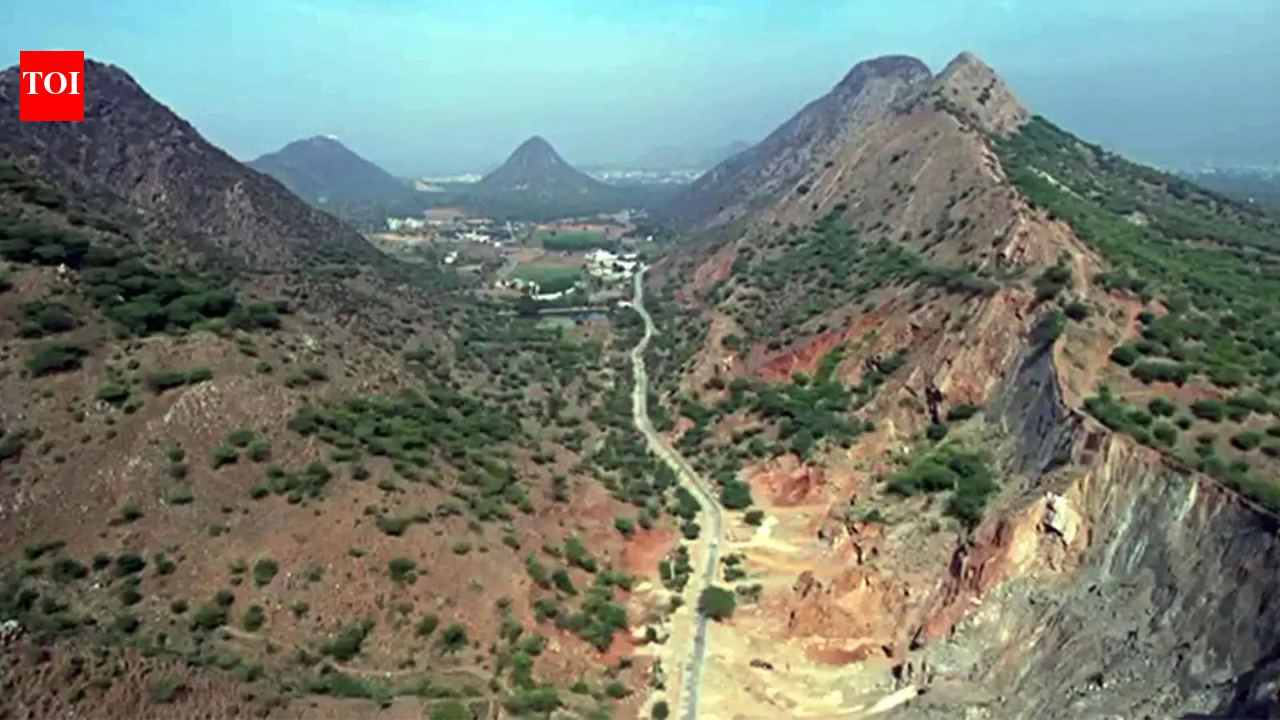

The range has shaped everything — from livelihoods to culture, faith and language — for the many communities and tribes it has cradled. Even as controversy over an official definition has led Supreme Court to seek a review, voices on the ground say the Aravallis’ imprint far exceeds physical dimensionsWhat are the Aravallis? An answer to this seemingly straightforward question was stayed by Supreme Court last Dec after it sparked a public outcry for being too narrow in scope. The top court now wants a new yardstick to define the range, which stretches 600km across four states and, at close to 2 billion years old, represents India’s oldest fold mountains. But talk to people on the ground in Rajasthan, the state synonymous with the Aravallis, and it becomes evident that the measure of these mountains lies not so much in their height, but in how deeply they have shaped the lives of the people who call the landscape home.The now-shelved definition — involving a 100m elevation cutoff and proximity of 500m between hills for demarcating the range — had inspired fears that a significant portion of the Aravallis would be stripped of environmental protections. For people who live in its folds, the stakes are immediate: if the map shrinks, so do forests, grazing commons, water systems, sacred groves, and the checks that stand between community life and mining, fragmentation and forced migration.Shelter And Sustenance“The Aravallis and our communities share a bond that goes back centuries. These mountains are not just geography for us. They are a living god, central to our identity and survival,” says Hari Ram Meena, tribal writer and former IPS officer.
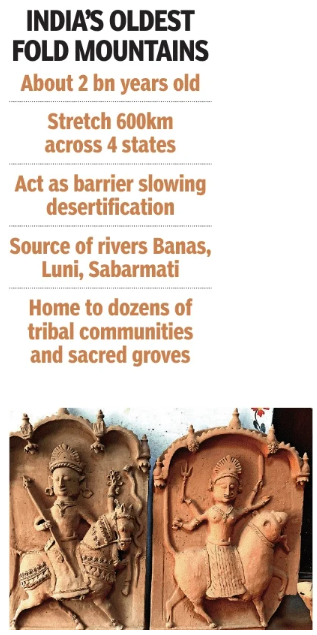
The Aravallis are home to some of Rajasthan’s oldest communities. The Meena tribe once ruled large parts of the Jaipur region, controlling strategic passes of the Aravallis before the rise of the Kachwaha Rajputs. In southern Rajasthan, Bhil chieftains held sway over vast forested tracts. “The Bhils were known as the ‘kings of the forest’. So crucial was their role that the royal coat of arms of Mewar depicts a Rajput warrior on one side and a Bhil warrior on the other,” Meena adds.The mountains also shaped warfare. During Maharana Pratap’s resistance against the Mughals, the Aravallis enabled guerrilla tactics and hidden movement based on local knowledge of forests, mountain passes and water sources.If the hills protect, they also sustain. The Aravallis are Rajasthan’s ecological spine. It regulates climate, arrests desertification, feeds rivers like the Banas, Luni and Sabarmati, and helps forests survive in a largely arid landscape. It is also a cultural watershed, separating not just river systems flowing towards the Arabian Sea and the Bay of Bengal, but also shaping traditions, languages and ways of life.
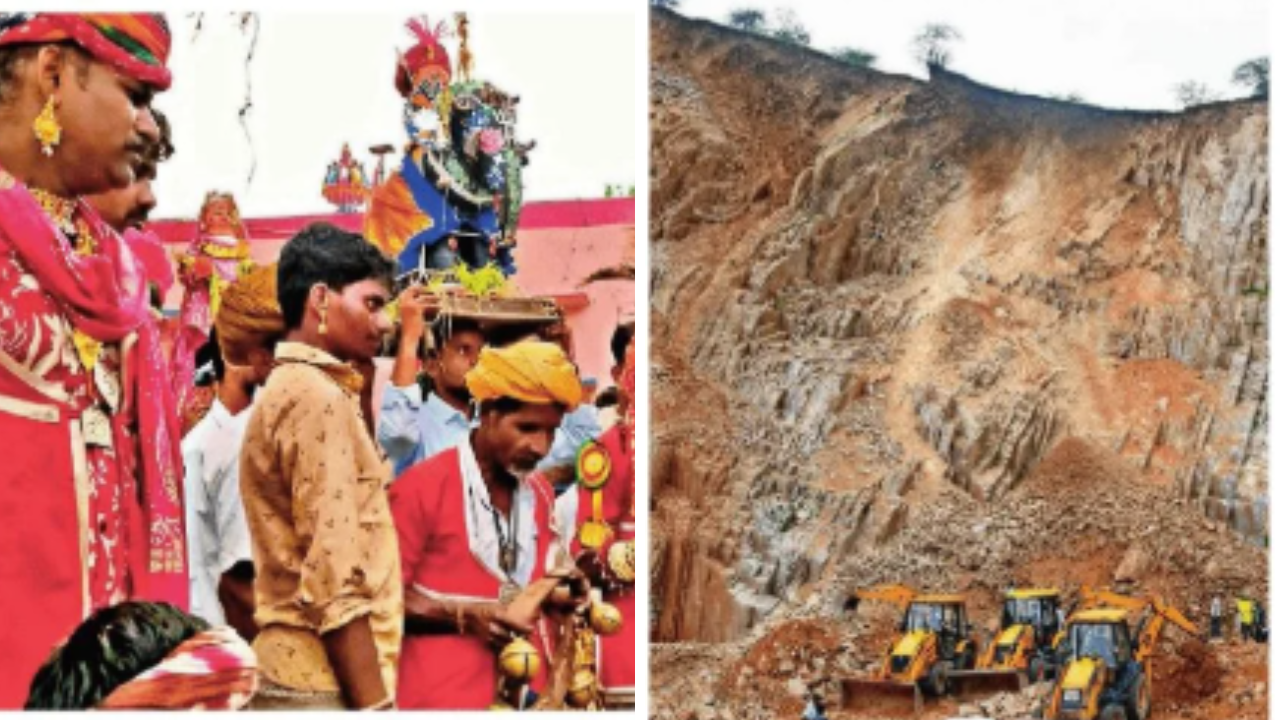
For communities such as the Bhil, Meena, Garasia, Saharia, Raika, Rewari, Mogia, Nath, and Gurjar, the mountains are not a resource, but a living presence. Temples, sacred groves, hilltop shrines, and forest deities dot the landscape and the mountains are treated as a ‘prakriti tirtha’, a sacred geography.Embedded In Everyday LifeLife in the Aravallis has always revolved around forest produce, livestock and water. Communities collect food, fuelwood, medicinal herbs, bamboo, tendu leaves and wild fruits from the forest. Rain-fed terraced farming supports hardy crops such as millets and pulses, while hill slopes provide grazing areas for cattle, sheep, goats and camels.Traditional water systems are central to survival. ‘ Johads ’, stepwells, nadis and baoris — built and maintained collectively — harvest rainwater and recharge groundwater. “Our water structures are our lifeline. They are protected not by law but by community ethics,” Meena says.Social activist Kunj Bihari Sharma explains how deeply human and animal life are intertwined here. “Aravalli forests are not just greenery,” he says. “They are sources of fuel, fodder, herbs and water. In summers, even wild animals depend on village wells and grazing areas. Humans and wildlife survive together.”But this balance has been steadily eroded. Over the years, communities were told that forests belonged to the state, not to them. “Earlier, people built johads through collective labour. Now, even that is restricted. At the same time, illegal mining and stone mafia hollow out the hills,” Sharma says.Nowhere is the impact more visible than among Denotified Tribes (DNTs) and nomadic communities, whose lives depend entirely on grazing landscapes. Gopal Keshawat, former chairperson of the Development and Welfare Board for Denotified, Nomadic, and Semi-Nomadic Communities, warns that mining has triggered a deep livelihood crisis. “Pastoral communities survive on livestock, milk, wool and leather. When grazing lands are destroyed, their entire economy collapses,” he says.Keshawat says that nearly 10% of India’s nomadic population and more than one crore people in Rajasthan depend on Aravalli-linked ecosystems. He recalls that commissions such as the Ayyangar Committee, and Balkrishna Renke Commission had clearly recommended mining bans in the Aravallis and separate grazing lands for DNT communities. “These recommendations were to protect both people and nature. Ignoring them puts animals and humans at equal risk,” he said. But, where laws fail, cultural practices continue to protect biodiversity.Living MountainsAcross Rajasthan, ‘orans’, or community-protected sacred groves, remain untouched due to religious beliefs. Social sanction rather than written rules prohibit tree-cutting and hunting in these forests, dedicated to local deities like Bhadarva Dev and Pandurimata.Among the most powerful expressions of this belief is the Gawari dance of the Bhil community. Dedicated to Shiva and Parvati and performed over 45 days by men in parts of Udaipur district, the dance is both spiritual and ecological — what social activist Kishan Gurjar says “is not entertainment, but the worship of nature”. “Cutting forests is considered a sin, and Gawari spreads the message of conservation,” Gurjar adds.The Aravallis are also deeply linked to nomadic communities such as the Sapera or Kalbelia. “The Kalbelia learned to live with snakes, treat snake bites and understand forest behaviour,” says social justice researcher Navin Narayan, who has worked with these groups for over 20 years. Kalbelia were once seen as protectors of villages, not entertainers. Amid mining and forest loss, Narayan warns that the shrinking Aravallis are threatening not only their livelihoods, but also the traditional knowledge that connected people with nature for generations.“The survival of the Aravallis is largely because of indigenous communities. These hills have protected people, and people have protected the hills,” says Manish Barod, block president of the Scheduled Areas Reservation Front in Udaipur. It’s a link that is repeatedly stressed with an eye on the Aravallis’ future, with activists and stakeholders saying that protecting the mountains is much more than a simple definition. “Reducing Aravallis to physical measurements denies its reality. It is a socioecological organism where folk culture, agriculture and community knowledge are deeply intertwined,” says sociologist Shyam Sunder Jyani.What is at stake is not just forests or hills, but Rajasthan’s living memory — its languages, rituals, arts and ways of life shaped over millennia.Mountains that define art, cultureAlong the banks of the Banas river, which originates in the Aravallis, lies Molela village that’s famed for its terracotta sculptures of deities. Ask potter Prabhu Gameti, and he says the craft exists because of the mountains. “The clay from the Banas is smooth and flexible. When fired, it doesn’t crack. That’s why idols made here last generations,” he explains.Researcher and folk artist Madan Meena warns that environmental destruction directly erases culture. “When livelihoods collapse, people migrate. And when people migrate, languages die,” he says, referring to the more than two dozen languages and dialects, many existing only in oral tradition, that are spoken in the region. An art form carries hundreds of words linked to seasons, tools, etc. “When an art form disappears, an entire vocabulary disappears with it,” he says.Communities like the Mogiya, who collect medicinal herbs, and the Nath sect, whose shrines such as Pandupol lie deep within the hills, show how belief, livelihood and landscape merge seamlessly. Also, Jain temples, Buddhist remnants and folk shrines together reflect the Aravallis’ religious diversity. “The Aravallis prevented cultural homogenisation in Mewar. Its geography ensures this region’s diversity,” says C S Sharma, a history professor in Udaipur. Go to Source