
 "Will ‘sinking’ islands like Maldives exist once the seas take over their land?")

Avidan Kent, University of East Anglia and Zana Syla, University of East Anglia
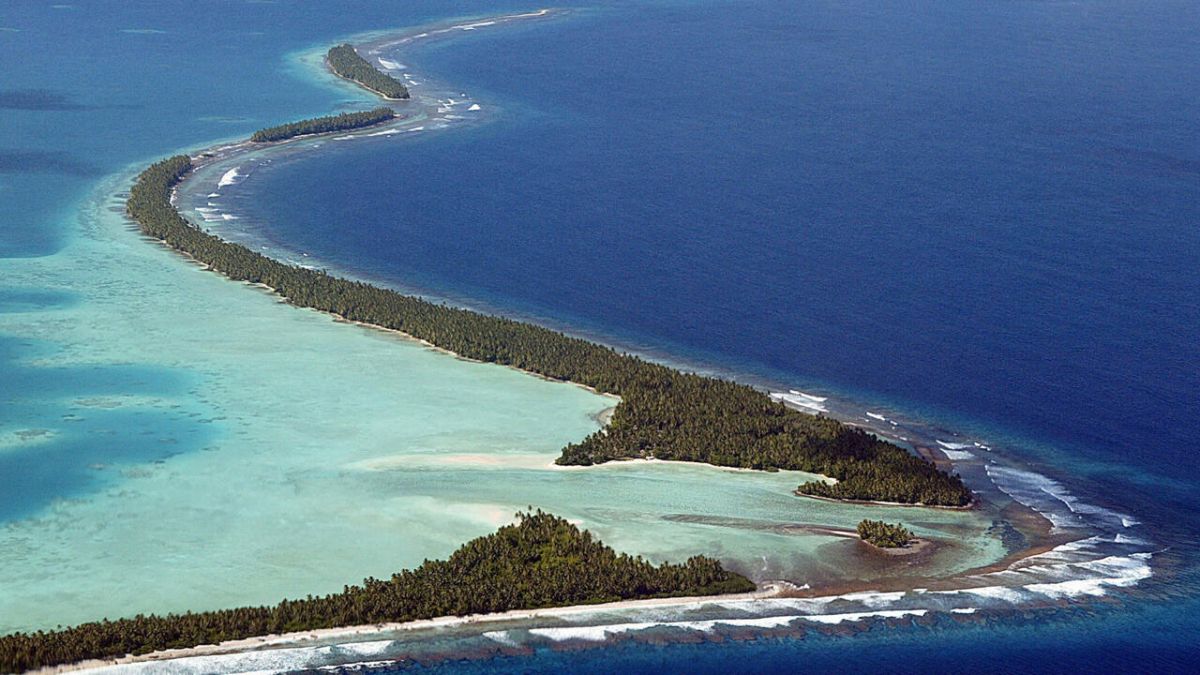
Small island nations such as Tuvalu, Kiribati, the Maldives and Marshall Islands are particularly vulnerable to climate change. Rising seas, stronger storms, freshwater shortages and damaged infrastructure all threaten their ability to support life.
Some islands even face the grim possibility of being abandoned or sinking beneath the ocean. This raises an unprecedented legal question: can these small island nations still be considered states if their land disappears?
The future status of these nations as “states” matters immensely. Should the worst happen, their populations will lose their homes and sources of income. They will also lose their way of life, identity, culture, heritage and communities.
At the same time, the loss of statehood could strip these nations of control over valuable natural resources and even cost them their place in international organisations such as the UN. Understandably, they are working hard to make sure this outcome is avoided.
Tuvalu, for example, has signed a treaty with Australia to ensure it will be recognised as a state, regardless of the impact climate change has on the islands.
Beyond affirming that “the statehood and sovereignty of Tuvalu will continue … notwithstanding the impact of climate change-related sea-level rise”, Australia has committed to accepting Tuvaluan citizens who seek to emigrate and start their lives afresh on safer ground.
Editor’s Picks
Facing the threat of physical disappearance, Tuvalu has also begun digitising itself. This has involved moving its government services online, as well as recreating its land and archiving its culture virtually.
The aim is for Tuvalu to continue existing as a state even when climate change has forced its population into exile and rising seas have done away with its land. It says it will be the world’s first digital nation.
Elsewhere, in the Maldives, engineering solutions are being tested. These include raising island heights artificially to withstand the disappearance of territory. Other initiatives, such as the Rising Nations Initiative, are seeking to safeguard the sovereignty of Pacific island nations in the face of climate threats.
But how will the future statehood of small island nations be determined legally?
What does international law say
Traditionally, international law requires four elements for a state to exist. These are the existence of population, territory, an effective and independent government and the capacity to engage in international relations.
With climate change threatening to render the land of small island nations unliveable or rising seas covering them entirely, both population and territory will be lost. Effective and independent government will also become inoperative. On the face of it, all the elements required for statehood would cease to exist.
But international law does recognise that once a state is established it continues to exist even if some of the elements of statehood are compromised. For instance, so-called failed states such as Somalia or Yemen are still regarded as states despite lacking an effective government – one of the core elements required under international law.
However, the threats posed to the statehood of small island nations by climate change are unprecedented and severe. They are also very likely to be permanent. This makes it unclear whether international law can extend this flexibility to sinking island nations.
The International Court of Justice (ICJ) recently issued its advisory opinion on the obligations of states in respect of climate change. The ICJ addressed a wide range of issues concerning the legal obligations of states in the context of climate change. This included the future statehood of small island nations.
In this regard, the ICJ acknowledged that climate change could threaten the existence of small islands and low-lying coastal states. But it concluded its discussion with a single, rather cryptic sentence: “once a state is established, the disappearance of one of its constituent elements would not necessarily entail the loss of its statehood.”
What exactly did the court mean by this remark? Unfortunately, the answer is not entirely clear. On the one hand, the decision seems to confirm the traditional flexible approach of international law to statehood.
In their separate opinions, some of the court’s judges interpreted this sentence as extending the flexibility previously applied in other contexts – such as failed states – also to the situation of sinking island nations. In other words, a state could retain its legal existence even if it disappears beneath rising seas.
At the same time, a closer reading of the decision suggests that the court stopped short of explicitly confirming that the flexibility of the term “statehood” could be stretched so far as to mean a state could exist even if completely submerged under the seas.
The court noted only that the disappearance of “one element … would not necessarily” result in the loss of statehood. But in the case of sinking island nations it is likely that all key elements – population, territory, government and ability to enter into international relations – would disappear.
For now, the ICJ has left the matter open. The decision points to flexibility, but it avoids the definitive statement that many vulnerable nations had hoped for. The legal future of sinking islands remains uncertain.
Avidan Kent, Professor of Law, University of East Anglia and Zana Syla, PhD Candidate in the School of Law, University of East Anglia
This article is republished from The Conversation under a Creative Commons license. Read the original article.
End of Article


&description=Will+%E2%80%98sinking%E2%80%99+islands+like+Maldives+exist+once+the+seas+take+over+their+land%3F)