
 "Why did Pakistan air force bomb its own villages in Khyber Pakhtunkhwa?")

It has been labelled as the ‘most dangerous place in the world’ and Pakistan’s Khyber Pakhtunkhwa lives up to its reputation.
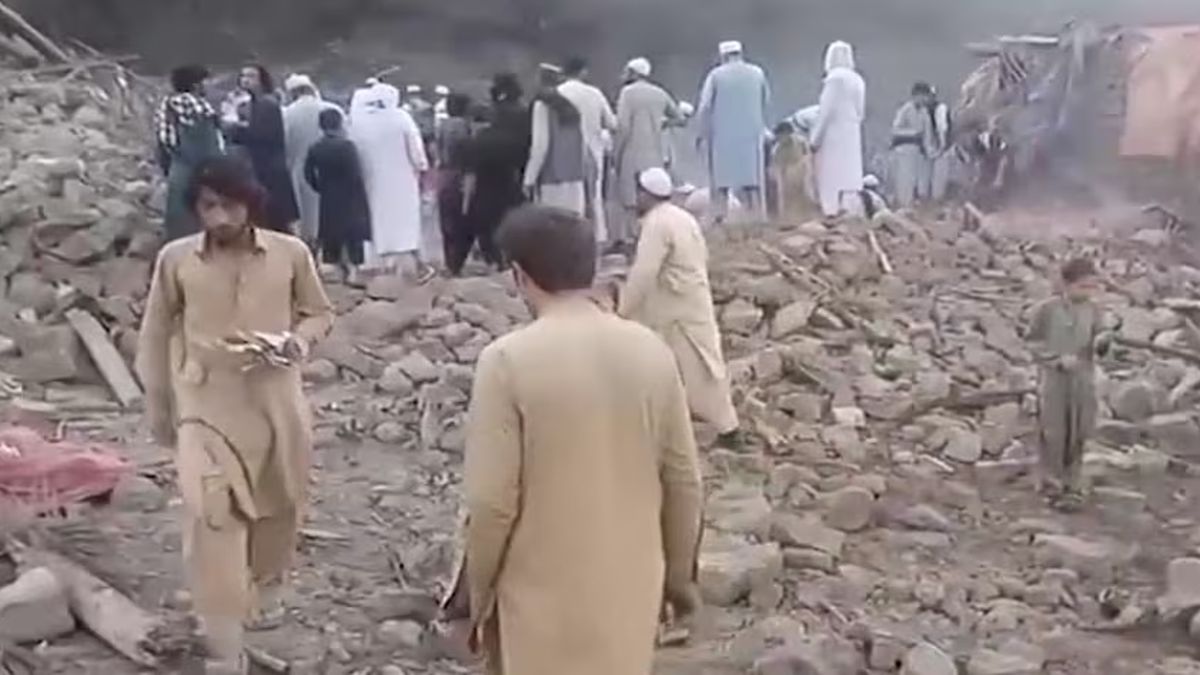
On Monday (September 22), the Pakistani Air Force launched strikes at the arid mountain region in northwestern Pakistan, killing 30 people, including women and children.
But why is it that Pakistan’s authorities launched air strikes against its own people? The answer lies in the history of the region of Khyber Pakhtunkhwa. We explain.
Pakistan air strikes in Khyber Pakhtunkhwa
In the wee hours of Monday, Pakistan air force launched air strikes, dropping bombs on its Khyber Pakhtunkhwa region. According to local media reports, eight LS-6 bombs were dropped from JF-17 fighter jets on the Pashtun-majority Matre Dara village around 2 am. For the unaware, the LS-6 bombs are Chinese-made precision-guided munitions. They are similar in roles to the American Joint Direct Attack Munition (JDAM) kit but with longer ranges.
The air strikes have resulted in the deaths of at least 30 people, including women and children with local reports adding that several others have also been injured, but their situation remains unclear.
Shortly after the strikes, disturbing pictures and videos emerged on social media, showing bodies lying around. Rescue teams were engaged in searching for bodies under rubble in Tirah Valley, raising fears of the death count rising further.
KP, a hot bed for militancy
As per local reports, the strikes on Monday came as Pakistan’s air force was targeting the Tehreek-e-Taliban Pakistan (TTP) hideouts in the area. In fact, in recent times, the Pakistani forces have stepped up military operations in the area. On Sunday, the army announced that seven TTP terrorists were killed during an intelligence-based operation in Dera Ismail Khan district.
This comes as the Khyber Pakhtunkhwa region is known to be a hot bed of militancy with Pakistani authorities stating that it is the base for Tehrik-e-Taliban Pakistan (TTP), also known as the Pakistan Taliban.
Earlier, an official report released recently by the provincial police department reveals that Pakistan’s Khyber Pakhtunkhwa province has witnessed 605 terror-related incidents until August this year. And in this 605 incidents, 138 civilians have been killed and 352 have been injured. The report further added that as many as 79 police personnel have been killed, while 130 sustained injuries in these incidents.
Editor’s Picks
In August alone, the province reported 129 terror attacks that claimed the lives of 17 civilians and 13 police personnel, leaving 51 civilians and 46 policemen injured. Meanwhile, 351 suspects were named in terrorism incidents, 32 were gunned down, and five were arrested in August.
The most recent terror attack in this area occurred in June. At least 13 Pakistani soldiers were killed and dozens wounded when terrorists took aim at a military convoy. Security officials said the coordinated attack occurred when a suicide bomber detonated explosives near a bomb disposal unit vehicle from the 22nd Frontier Force Regiment.
“A suicide bomber rammed an explosive-laden vehicle into a military convoy,” said a local government official in the North Waziristan district of Khyber Pakhtunkhwa province. Later, a faction of the TTP claimed responsibility for it.
The worst terror attack in the region dates back to 2014 when they targeted the Army Public School (APS) in KP’s Peshawar, killing more than 130 students.
And how did this region become a base for terrorists belonging to the TTP and the Islamic State? The New York Times explains that the Soviet invasion of Afghanistan in 1979 turned the region into a staging ground for Islamic fighters backed by the United States, Arab nations and Pakistan who were battling Moscow’s forces.
After the Soviet withdrawal in 1989, the region descended into lawlessness, becoming a hub for fugitives, criminal networks, smugglers of arms and drugs, and kidnappers demanding ransom. It then became a terrorist stronghold following the 9/11 attacks, as US military operations in Afghanistan pushed Taliban and Al-Qaeda terrorists into Pakistan’s tribal areas.
Sectarian violence persists in Khyber Pakhtunkhwa
Another reason that makes the northwestern region of the country dangerous is the sectarian violence that continues there.
For instance, over 100 people have died in Khyber Pakhtunkhwa’s Kurram district in a span of 10 days last November as a result of sectarian violence. Kurram is the only district in Pakistan where Shia make up the majority of the population, in contrast to the rest of the country, where Sunnis are the majority. Waves of violence have been unfolding since July, when tensions between Shia and Sunni tribes flared over a land dispute.
Political marginalisation hurts Khyber Pakhtunkhwa
Experts note that the existing political conditions in Khyber Pakhtunkhwa make it conducive for militancy and terrorism.
The federal government in Pakistan and its powerful military, which has an oversized role in domestic and foreign affairs, have also eroded democratic norms and institutions in the region.
Amnesty International in June even noted that the recurrent drone strikes in the region signal an disregard for civilian life in Pakistan. “Pakistani authorities have failed to take action to protect the lives and property of civilians in Khyber Pakhtunkhwa who continue to pay the price of an escalating number of drone strikes in the province,” said Isabelle Lassee, Deputy Regional Director for South Asia at Amnesty International.
Echoing similar sentiments, Syed Irfan Ashraf, a university lecturer in the northwestern city of Peshawar, said Pakistan’s military has tried to enforce an “authoritarian governance model” in Khyber Pakhtunkhwa. “This governance model is taking a huge toll now,” he was quoted as telling RFERL.org.
With inputs from agencies
End of Article


&description=Why+did+Pakistan+air+force+bomb+its+own+villages+in+Khyber+Pakhtunkhwa%3F)