
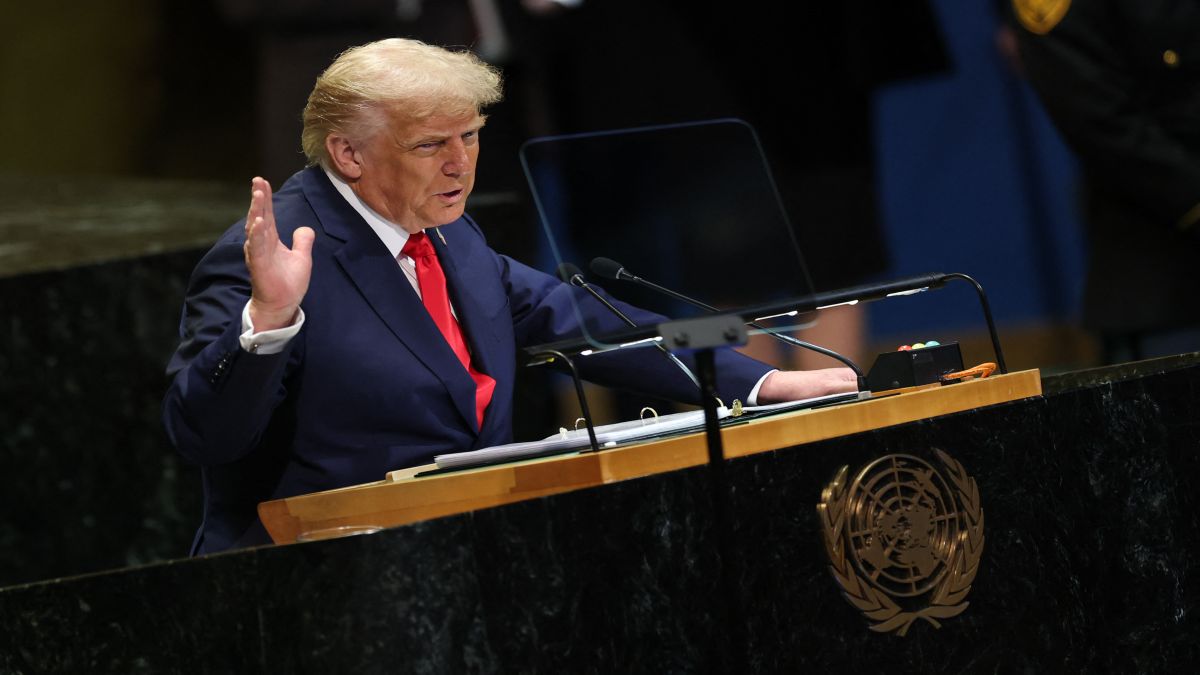
 "What Trump can learn from his trans-Atlantic allies: Europe quietly cuts illegal immigration by 52%")

President Donald Trump has long positioned himself as the global champion of hardline anti-immigration politics. From deploying federal troops in US cities to threatening mass deportations, his approach has relied heavily on spectacle and highly visible shows of force.
Rights groups have often questioned the legality of his measures, while critics have derided them as authoritarian or unconstitutional. Yet across the Atlantic, Europe has managed to dramatically reduce illegal migration with far less fanfare.
In the first eight months of 2025, irregular border crossings into the European Union dropped by 52 per cent compared with the same period in 2023, according to The Economist.
The contrast between Trump’s style and Europe’s methods reveals important lessons about how to address migration in effective and sustainable ways, while also highlighting the moral costs of harsh deterrence.
Trump’s spectacle versus Europe’s quiet calculations
Trump’s approach to immigration has always been highly visible and deeply polarising. His most recent deployment of federal troops to Portland, Oregon, to “protect immigration agents” symbolised the performative dimension of his enforcement drive, The Hill.
Much of his energy has gone into shutting down legal pathways, such as suspending refugee programmes, targeting parole authority and attempting to block birthright citizenship. These actions have prompted strong pushback from rights organisations and even the courts.
For instance, his order seeking to strip citizenship from children born in the US to parents on visas was halted by a federal judge as blatantly unconstitutional.
By contrast, the European Union has managed its migration problem without resorting to dramatic domestic displays.
Instead, the bloc has quietly pursued deterrence through external partnerships and enforcement networks that extend far beyond its own borders. Rather than relying on spectacle, Europe has built a system designed to reduce crossings before migrants even reach its territory.
While the outcomes may look similar—fewer illegal entries—Europe’s methods have been more strategic, less theatrical and far more effective in raw numerical terms.
Europe’s numbers tell a different story
The drop in irregular migration into Europe is striking.
In 2023, some 231,000 people crossed into the EU illegally. By 2025, that number had fallen to 112,000 over the same eight-month period, representing a decline of more than half, The Economist said.
Crucially, these reductions have occurred despite the fact that the pressures driving migration have not disappeared. Afghanistan remains repressive, Sudan is still wracked by conflict and poverty continues to push people out of Egypt and Bangladesh.
The decline, then, is not due to an easing of global crises but to a recalibration of European policy.
While Trump insists that migration is an unstoppable tide, the European example demonstrates that carefully designed deterrence can significantly reduce numbers even in the face of worsening push factors. This stands as a direct challenge to Trump’s narrative that the crisis is beyond control without extreme domestic crackdowns.
The “invisible wall” of externalisation
At the core of Europe’s strategy is the construction of what has been described as a “big, invisible wall.” Instead of focussing exclusively on fortifying its own borders, the EU has signed deals with transit countries such as Tunisia, Egypt and Mauritania.
In exchange for billions in aid and investment, these governments intercept and block migrants before they can advance to European shores.
The results have been immediate. After a €1 billion deal with Tunisia in 2023, crossings along the central Mediterranean route dropped by 58 per cent. Similarly, an agreement with Mauritania slashed migration flows along the western African route by 52 per cent in 2025.
The strategy is reinforced by technology, as Frontex, the EU’s border agency, now uses drones to monitor waters off North Africa and direct local authorities to intercept boats.
For Trump, who has long touted the virtues of a physical wall at the southern border, Europe’s “invisible wall” offers an alternative vision.
By extending enforcement beyond its immediate territory, Europe has achieved a level of deterrence that a wall alone cannot provide.
The lesson is that the true front line of border security often lies thousands of miles away.
Human costs and criticism
Yet Europe’s success has not come without controversy.
Rights groups accuse the EU of outsourcing brutality to authoritarian or unstable governments. Libya’s coastguard, supported with European funding and training, has been accused of acting like a militia, detaining migrants under appalling conditions, with reports of abuse, rape and even enslavement.
Tunisia has allegedly abandoned thousands of migrants in desert borderlands, while Mauritania has pushed people back into volatile regions of Mali and Senegal.
Trump’s record has faced similar criticism.
By dismantling lawful entry pathways, including the CBP One app that allowed migrants to schedule asylum appointments, he has been accused of forcing people into the hands of cartels and smugglers.
Just as Europe risks compounding suffering by outsourcing enforcement, Trump risks fuelling irregular migration by eliminating legal options. In both cases, deterrence has been achieved partly at the expense of human rights.
Parallels between Europe and Trump
Despite the differences in strategy, there are undeniable parallels between Europe’s recent success and Trump’s own approach. Both have overseen sharp reductions in illegal migration during their respective periods of enforcement.
Trump’s second term has seen illegal entries into the US decline significantly, the result of tightened enforcement and a dismantling of programmes that allowed lawful entry. Europe’s reduction mirrors this trend but is rooted in international agreements and surveillance rather than domestic crackdowns.
This comparison teaches a central lesson.
Trump has often cast his domestic fight as singular and unprecedented, yet Europe has achieved comparable—indeed superior—results through a less visible but more comprehensive strategy.
If Trump were to look beyond the rhetoric of toughness, he would see in Europe’s example a model of deterrence that is both innovative and adaptable.
Risks of dependency
Europe’s model is not without its risks.
By outsourcing border control to foreign governments, the EU has created dependencies that may undermine its sovereignty.
For the United States, a similar strategy could prove double-edged.
Outsourcing enforcement to Mexico or Central American nations might reduce short-term pressure at the southern border, but it could also leave Washington beholden to governments willing to weaponise migration for political or economic gain.
Trump’s instinct for unilateral action contrasts sharply with Europe’s reliance on partnerships, but the latter approach highlights both the promise and the peril of externalised deterrence.
Quiet success, loud lessons
Europe’s 52 percent reduction in irregular migration demonstrates that deterrence need not rely on spectacle. By quietly constructing an “invisible wall” through international agreements, aid and technological surveillance, the EU has reshaped migration flows with remarkable speed.
Trump’s highly visible deployments and headline-grabbing executive orders have not delivered comparable results.
The lesson for Trump is clear.
Results matter more than rhetoric, and sustainable enforcement requires strategy, not just theatre. At the same time, Europe’s experience warns of the human cost of harsh deterrence and the risks of overreliance on fragile foreign partners.
For the United States, the challenge is to find a balance: to deter irregular migration effectively without dismantling lawful pathways or outsourcing abuse.
As Trump continues his campaign against illegal immigration, he may find that the most valuable lessons come not from building taller walls or staging dramatic troop deployments, but from the quiet, if controversial, policies of his trans-Atlantic allies.
End of Article

 "India announces mega infra project in Bhutan, to invest Rs 4,033 cr in first cross-border railway lines")
&description=What+Trump+can+learn+from+his+trans-Atlantic+allies%3A+Europe+quietly+cuts+illegal+immigration+by+52%25)