
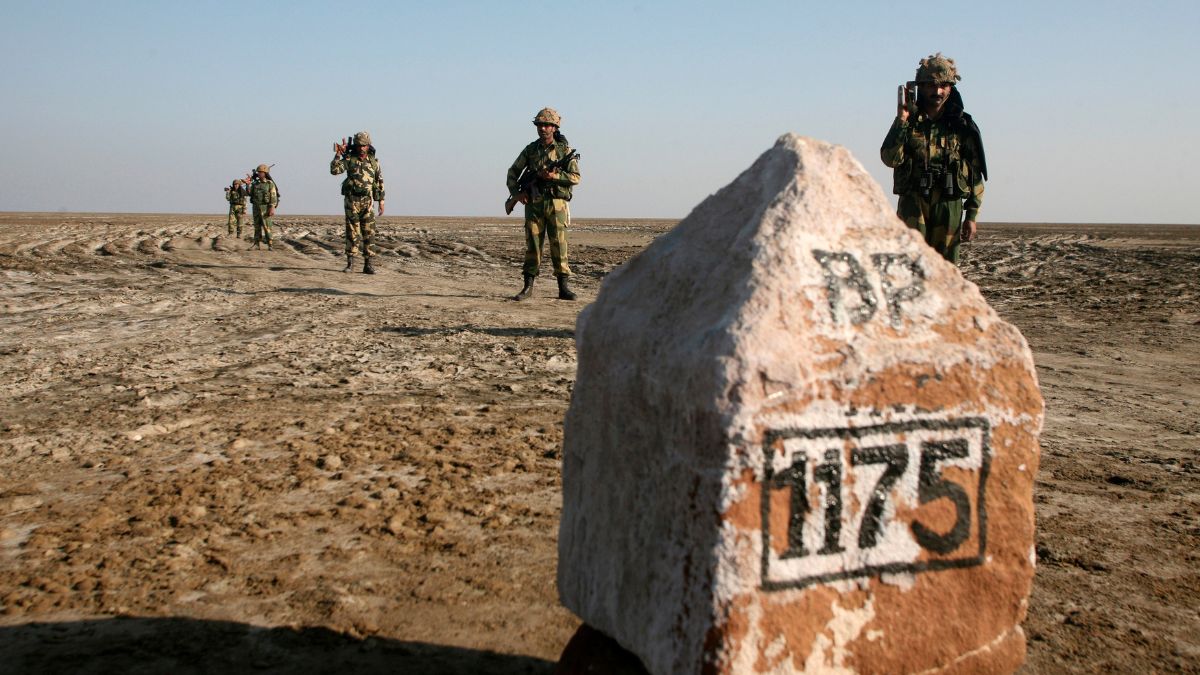
 "What is Sir Creek, the region at the centre of India’s warning to Pakistan?")

The quiet tidal estuary of Sir Creek, nestled in the marshlands of the Rann of Kutch, has once again come to the forefront of India-Pakistan tensions.
Defence Minister Rajnath Singh’s strong words directed at Islamabad in have put into the spotlight a border dispute that has endured for more than seven decades.
During his address at the Lakki Nala Military Garrison in Gujarat’s Kutch region on Thursday, Defence Minister Rajnath Singh issued a direct warning to Pakistan.
Evoking history, he said, “Let us remember that in the 1965 war, the Indian Army had reached Lahore. And in 2025, Pakistan should remember that the road to Karachi goes through Sir Creek.”
Singh accused Pakistan of pursuing “malafide intentions” in keeping the Sir Creek issue alive. He pointed out that despite India’s multiple diplomatic overtures to resolve the dispute, Pakistan continues to create obstacles.
Referring to Pakistan’s recent military build-up, the defence minister remarked, “Even after so many years of Independence, a border issue is brought up on Sir Creek. India has tried diplomacy several times to solve the issue but Pakistan has malafide intentions (niyat me khot). The way Pakistan has set up military infrastructure in the Sir Creek area shows its intention.”
He warned that any provocation from Pakistan in the creek region would be met with decisive retaliation.
“If Pakistan tries any misadventure in the Sir Creek area, it will get such a strong response that both history and geography will be changed.”
Editor’s Picks
Rajnath Singh’s visit to Gujarat coincided with the Hindu festival of Vijaydashami, also known as Dussehra. At Bhuj Military Station, he performed Shastra Puja, the traditional worship of weapons, symbolising respect for the instruments that defend the nation.
Celebrated ‘Vijayadashmi’ with the Indian Armed Forces personnel at Bhuj Military Station in Gujarat and performed ‘Shastra Puja’. ‘Shastra Puja’ on Vijayadashmi is an integral part of our Indian culture.
The worship of weapons on this day is deeply connected with India’s… pic.twitter.com/aftqSgzJFv
— Rajnath Singh (@rajnathsingh) October 2, 2025
He also observed a multi-agency operational exercise, where land, air, and naval forces, along with the Border Security Force (BSF), demonstrated their coordinated capabilities. Singh stressed the importance of joint operations for India’s defence preparedness.
“Our land, air, naval forces and the BSF are pillars of our strength. It is only when they work together that we can rise to all challenges. Our government is constantly emphasising on the ‘jointness’ of our forces. We saw an example of this during the ‘Varunastra’ exercise here today. It was also this very jointness that gave success to Operation Sindoor in record time.”
Singh also commended the armed forces for their success in Operation Sindoor, a recent counter-action against Pakistani attempts to breach India’s defences.
“Pakistan had tried to penetrate India’s defences from Leh to Sir Creek Sector, but the swift and effective counter-action of the Indian forces not only exposed the weaknesses of Pakistan’s air defence system but also sent out a clear message to the world that India can inflict heavy damage at a time, place and manner of its choosing,” he declared.
During the visit, Singh virtually inaugurated the Tidal Independent Berthing Facility and the Joint Control Centre in the Sir Creek sector.
These facilities are expected to significantly enhance India’s coastal security network by integrating operational capabilities across agencies, improving coordination, and enabling faster responses to emerging threats.
What we know about Sir Creek
Sir Creek is a 96-kilometre-long tidal estuary situated in the uninhabited salt marshes of the Rann of Kutch. Flowing into the Arabian Sea, it serves as a natural divide between Gujarat on the Indian side and Sindh on the Pakistani side.
Despite its seemingly desolate landscape, the estuary has been a matter of contention for decades, with disputes rooted in colonial-era boundary arrangements.
The origins of the conflict can be traced back to 1908 when rulers of Kutch and Sind quarreled over a pile of firewood along the creek’s banks.
The matter was taken up by the British administration of Bombay, which issued a resolution in 1914.
However, the disagreement resurfaced in the 1960s. After a series of armed skirmishes in 1965, Pakistan laid claim to territory extending along the 24th parallel in the Rann of Kutch, whereas India maintained that the border lay further north.
The matter was referred to the Indo-Pakistani Western Boundary Case Tribunal, which delivered its award on February 19, 1968.
The tribunal upheld nearly 90 per cent of India’s claims, conceding only small areas to Pakistan.
While most of the Rann of Kutch was settled, Sir Creek was excluded from the award, leaving it unresolved.
The unresolved status of Sir Creek stems from different interpretations of the 1914 resolution. Pakistan insists that the boundary should be fixed on the eastern bank of the creek, giving it control over the entire channel.
India, on the other hand, argues that the same resolution invoked the thalweg principle — which places the boundary along the mid-channel of navigable waterways.
India backs its claim with the 1925 map and the presence of mid-channel pillars. Pakistan counters that the thalweg principle applies only to rivers and not to tidal estuaries such as Sir Creek.
Another complicating factor is the creek’s changing course, as shifting tidal flows alter its navigable channels over time. This directly affects the maritime boundary and the demarcation of Exclusive Economic Zones (EEZs) in the Arabian Sea.
Why Sir Creek matters
Although the creek has limited direct military significance, it carries immense economic and strategic weight. The waters and seabed around Sir Creek are believed to be rich in oil and natural gas deposits.
Whoever controls the creek can influence the delimitation of EEZs, which extend 200 nautical miles into the sea and allow a country to exploit marine and energy resources.
Beyond hydrocarbons, the creek also plays a role in fisheries. Thousands of fishermen from Gujarat and Sindh rely on these waters for their livelihoods. However, the absence of a clearly demarcated maritime boundary often leads them into disputed zones.
Strong tidal flows and winds make it nearly impossible for small boats to determine the invisible border.
Consequently, fishermen from both sides are routinely detained, often spending years in jail before being released through formal exchanges.
International law calls for minimal penalties and the release of both crew and vessels, but in practice, the boats are usually confiscated, leaving fishers economically devastated.
How Sir Creek is seeing escalating militarisation
Since 2019, Pakistan has strengthened its presence by raising new Creek Battalions, deploying coastal defence boats and marine assault crafts, and upgrading its air defence with radars, missiles, and surveillance aircraft.
Plans for additional naval posts and patrol vessels further signal its intent to consolidate control in the region.
India has mirrored these measures, driven in part by security concerns following the 2008 Mumbai terror attacks, which were launched from the Arabian Sea.
Indian security agencies have intensified monitoring of Sir Creek, intercepting boats suspected of smuggling or infiltration.
In 2018, the BSF seized several vessels in the area, and in September 2019, abandoned boats were discovered, raising fears of another terror attempt.
What next
Another dimension of the Sir Creek dispute involves Pakistan’s Left Bank Outfall Drain (LBOD) canal, built between 1987 and 1997.
The canal was designed to discharge saline agricultural runoff and industrial effluents from the Indus basin into the sea through Sir Creek. While it helped prevent contamination of the Indus River’s freshwater supply, it created ecological and political challenges.
India argues that the LBOD canal violates Article IV of the Indus Waters Treaty, since it causes flooding and damage to land exposed during low tide on the Indian side of the creek.
Despite multiple rounds of bilateral talks over the decades, the Sir Creek issue remains unresolved. India’s position prioritises first demarcating the maritime boundary in the Arabian Sea, which would allow the equitable division of EEZs and continental shelves.
Pakistan, however, argues that the territorial dispute over the creek itself must be settled before any maritime boundary can be drawn.
With inputs from agencies
End of Article
 "As France battles debt crisis, a ‘rockstar’ economist polarises nation’s politics")

&description=What+is+Sir+Creek%2C+the+region+at+the+centre+of+India%E2%80%99s+warning+to+Pakistan%3F)