
 "Is Trump prepping for a fight with Taliban or just signalling China?")

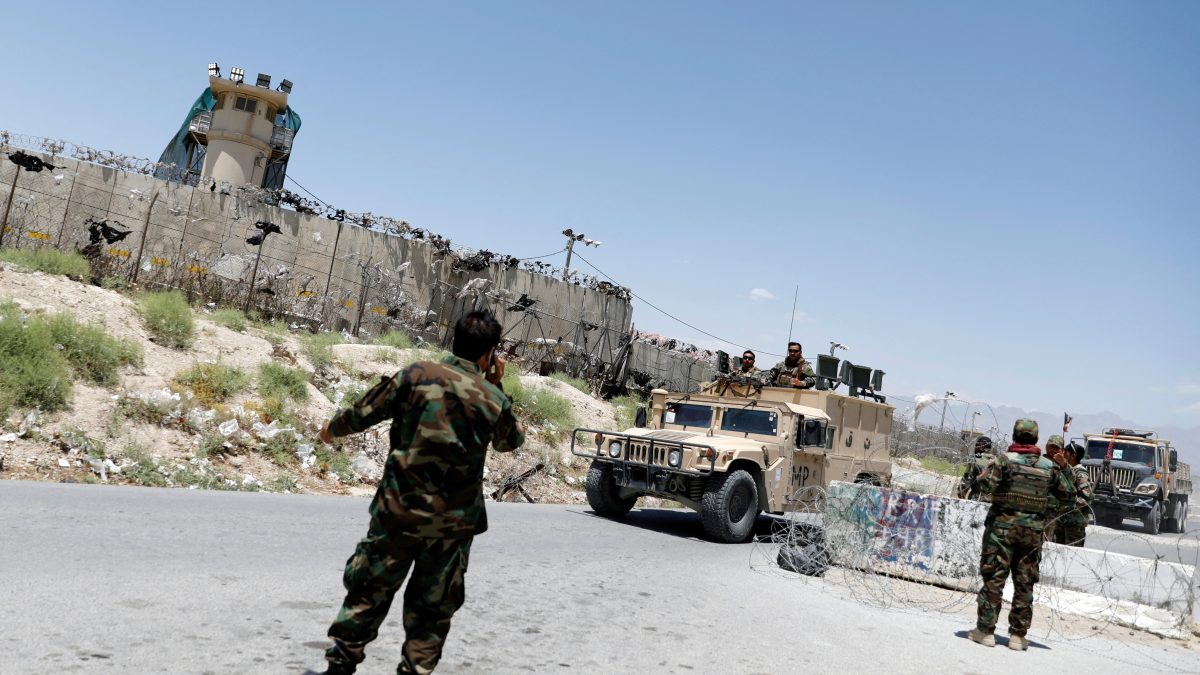
US President Donald Trump has reignited debate about Afghanistan by seeking to retake control of Bagram air base, the sprawling military facility abandoned during Washington’s chaotic withdrawal in 2021.
Speaking during recent engagements in both Washington and London, Trump said that the US is “talking now to Afghanistan” about restoring its presence there, though he offered no details of such conversations, The Associated Press reported.
The president stopped short of confirming whether US forces might return militarily but issued a stark warning. On Truth Social, he said that if Afghanistan did not hand the base back to “those that built it,” then “bad things” would happen to the country. He further hinted that the White House was leaving all options on the table, refusing to rule out a troop deployment to forcibly retake the site.
Taliban rebuff and reference to Doha Agreement
The Taliban government immediately dismissed Trump’s assertions. Zabihullah Mujahid, the movement’s chief spokesman, said in a statement that Afghanistan’s independence and territorial integrity remained non-negotiable. He urged Washington to adopt a policy of “realism and rationality,” reminding Trump that under the 2020 Doha Agreement, the United States had pledged not to use or threaten force against Afghanistan’s sovereignty.
Mujahid also stressed that Afghanistan had consistently conveyed its priorities in bilateral discussions, which he reiterated as an economy-oriented foreign policy, constructive ties with all nations and full respect for its sovereignty. Any US move to reclaim Bagram, he argued, would constitute a violation of commitments and an unacceptable infringement on Afghan soil.
A more forceful rebuke came from Fasihuddin Fitrat, the Taliban’s defence chief of staff, who declared during a televised address that “ceding even an inch of our soil to anyone is out of the question and impossible”.
Bagram’s symbolic and strategic weight
Bagram air base has long held symbolic resonance in US–Afghan relations. Originally constructed by the Soviet Union in the 1950s, the base later became the largest hub of American operations during the two-decade war that followed the September 11, 2001, attacks. At its peak, the facility included fast-food outlets for troops, a bustling commercial zone and a massive detention complex, Reuters reported.
Trump has repeatedly claimed that abandoning Bagram was one of Washington’s biggest strategic errors. He has gone further to suggest that the airfield’s value lies not just in Afghanistan, but in its proximity to China.
On multiple occasions, including in March 2025, he stated that Bagram is “an hour away from where China makes its nuclear missiles” and should have been retained “not because of Afghanistan but because of China”, The New York Times said.
His remarks hint that the push for Bagram might be less about re-engaging with the Taliban and more about projecting power towards Beijing, particularly amid rising US–China tensions over security in the Indo-Pacific.
Taliban weigh their options
While the Taliban have firmly rejected any notion of returning Bagram to US control, some officials hinted at a pragmatic willingness to engage diplomatically. Zakir Jalaly, an Afghan foreign ministry representative, noted that while Afghans would “never accept the military presence of anyone,” pathways remained open for political and economic engagement based on “mutual respect and shared interests”.
Such comments reflect the Taliban’s precarious position. Since returning to power in 2021, the movement has faced severe economic collapse, lack of international recognition and threats from rival militant factions like Isis-K.
Despite some tactical engagement with US envoys—such as a recent hostage release and prisoner exchange—the Taliban appear unwilling to risk their nationalist credentials by ceding territory to a foreign military presence, The Associated Press reported.
No country other than Russia has formally recognised the Taliban government.
Trump’s threats may reopen questions about whether the US intends to move beyond this frozen relationship. Yet for the Taliban, who celebrated the withdrawal as a decisive victory, allowing a return to Bagram would undermine the very narrative that sustains their legitimacy.
Risks of a return to Bagram
Military experts caution that retaking Bagram would not be a straightforward task for the US. American officials have, Reuters reported, privately noted that re-occupying the facility could resemble a re-invasion of Afghanistan, requiring at least 10,000 troops and advanced air defence systems to secure the site.
Even if the Taliban allowed a negotiated US return, Bagram might be easy to control. The base could face attacks from Islamic State and Al Qaeda militants still active in the country, while also being exposed to regional threats such as Iranian missile strikes. Iran has demonstrated its capability to target US bases in the region, as seen in its June strike this year on a major US facility in Qatar following tensions over nuclear sites.
The logistical and security challenges, combined with the political optics of returning to Afghanistan after such a controversial withdrawal, make Trump’s proposals highly contentious.
Political reactions in Washington
Trump’s remarks have drawn sharp criticism from his opponents in the United States. Representative Adam Smith, the ranking Democrat on the House Armed Services Committee, described the president’s comments as “deeply troubling,” even calling them “idiotic” in an interview, The New York Times reported.
The Pentagon has been cautious in its public stance. When asked about the possibility of retaking Bagram, the Department of Defence issued a general statement affirming that it “is always ready to execute any mission at the president’s direction”.
This ambiguity reflects a broader unease in Washington about reigniting military commitments in Afghanistan. Biden’s 2021 withdrawal was widely criticised for its execution but also fulfilled a bipartisan desire to end America’s longest war. Any suggestion of re-entering Afghanistan risks reopening deep political wounds.
Signalling China more than fighting Taliban?
There is another chatter going on that Trump’s fixation on Bagram is less about Afghanistan itself and more about geopolitical signaling. His repeated emphasis on the base’s location relative to China’s nuclear facilities suggests that the rhetoric may be intended as part of a broader strategy of deterrence against Beijing.
Re-establishing a US presence at Bagram would place American forces at China’s western doorstep, near sensitive regions like Xinjiang and close to strategic corridors central to Beijing’s Belt and Road Initiative. Such positioning could, in theory, offer Washington leverage in future confrontations over Taiwan or the South China Sea.
However, using Afghanistan as a staging ground carries enormous risks. The Taliban’s rejection of foreign military presence, Afghanistan’s unstable security environment and potential blowback across the Muslim world all suggest that such a gambit might cost more than it delivers.
Bluff, bargain or strategy?
Whether Trump truly intends to retake Bagram or is merely using the threat as leverage remains uncertain. His vague references to negotiations and refusal to rule out troop deployments suggest he wants to keep his adversaries guessing. For the Taliban, the rejection was swift and absolute, with officials warning against any violation of Afghanistan’s sovereignty.
The more plausible explanation may be that Trump is less concerned with Kabul than with Beijing. The controversy reflects both the unfinished business of America’s longest war and the shifting priorities of US global strategy. Afghanistan may once again become a theatre of the Great Game in the 21st century—not because of what it offers directly, but because of where it sits on the map.
End of Article


&description=Is+Trump+prepping+for+a+fight+with+Taliban+or+just+signalling+China%3F)