
 "<div>AI in Xis military parade: Why China is okay putting AI where the world is still unsure</div>")

When Xi Jinping presided over a grand military parade in Beijing, the display was more than a showcase of missiles, drones and robotic wolves. China aimed to make a statement of its technological ambitions, particularly its willingness to integrate artificial intelligence (AI) into military systems at a pace and scale that few other powers are willing to do. While many democracies are still mired in ethical debates and testing hurdles, China appears unfazed, treating AI as a cornerstone of its drive to build a “world-class” military by 2050.
A parade of power and algorithms
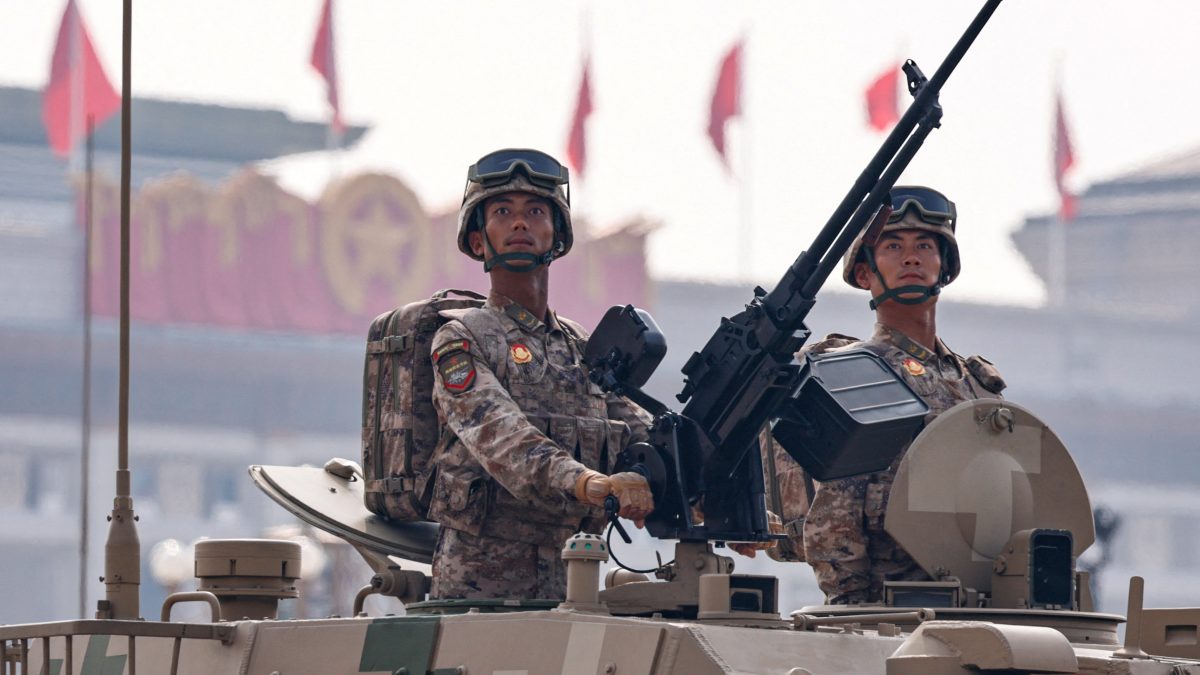
The parade, held in Tiananmen Square, featured an array of weapons designed to impress both domestic and foreign audiences. Global media widely reported the display of hypersonic anti-ship missiles capable of manoeuvering at five times the speed of sound, nuclear-capable intercontinental missiles and submersible drones that rolled past a cheering crowd.
The so-called “Guam Killer” missile was prominently displayed, with many interpreting it as one weapon that is aimed at US bases in the Pacific. Alongside these came unmanned assets: “loyal wingman” drones to fly alongside piloted jets, robotic dogs designed for reconnaissance or combat support and submersible vehicles hinting at future undersea warfare.
The most striking theme was the prominence of unmanned and AI-enabled systems. “Alacrity in the kill chain matters,” noted Alexander Neill of the Pacific Forum, pointing out that decisions made in “nanoseconds” by algorithms could give a decisive battlefield advantage, said a BBC report.
For China, the rapid deployment of AI-driven tools demonstrated its confidence in placing technology at the heart of combat.
Why other powers hold back
Despite AI’s promise, most militaries remain cautious. Western democracies in particular see risks in ceding lethal decision-making to machines. There is always the risk of accidents, unintended escalation or machines behaving unpredictably under the fog of war. “How comfortable are we in putting AI in the kill chain,” Neill asked.
The hesitation also stems from technological and operational limits. AI systems must be tested and verified to ensure reliability in chaotic combat scenarios. The complexity of integrating them with existing weapons systems slows progress. Moreover, militaries remain uncertain about AI’s maturity. While it performs well in simulations or limited skirmishes, its effectiveness in full-scale battle remains unproven.
Strategic concerns add another layer of restraint. Deploying AI weapons could spark new arms races or destabilise deterrence frameworks, raising global insecurity rather than enhancing stability. Democracies are further constrained by public debate and political oversight. Questions about accountability — who is responsible if an AI drone strikes civilians — keep countries cautious. In short, the world’s most technologically advanced militaries remain uneasy about where AI belongs on the battlefield.
Why China is comfortable with AI in the kill chain
In contrast, China has embraced AI in areas where others hesitate. Several factors explain this divergence.
First, China’s political system allows for rapid, centralised decision-making. Unlike democracies, Beijing does not face public scrutiny or parliamentary oversight that might slow the military’s adoption of controversial technologies.
Ethical debates about autonomous weapons, international humanitarian law or accountability rarely intrude on defence planning. The absence of formal restrictions frees the People’s Liberation Army (PLA) to experiment with AI-enabled weapons and decision-support tools.
Second, China has institutionalised military-civil fusion. As the Wall Street Journal reported, universities such as Shanghai Jiao Tong and private firms like iFlytek Digital are directly involved in developing AI applications for the PLA, from automated “kill webs” that adapt in real time to drone swarms sensitive to changing radio frequencies. More than 85 per cent of multiple-bid winners in recent PLA contracts were private or civilian institutions, highlighting how widely China has spread defence R&D across society.
Third, the timing has been fortuitous. AI is arriving as China enjoys a period of technological ascendancy. Xi’s government sees AI as a foundation for long-term military modernisation, part of its plan to build a force capable of rivalling the United States. The PLA already uses machine learning to analyse vast streams of battlefield data for intelligence, surveillance and reconnaissance, enhancing situational awareness at unprecedented speed.
AI as a force multiplier
The PLA’s focus on AI is not simply about prestige. It reflects lessons drawn from recent conflicts. The Ukraine war demonstrated how swarms of drones can overwhelm traditional defences, suggesting that unmanned systems can reshape modern warfare. China appears to have internalised this lesson, building doctrine around drone saturation and rapid response systems.
Research at Shanghai Jiao Tong University has already simulated AI-driven kill webs that coordinate dozens of drones against enemy missile attacks, generating optimal responses in just over two seconds. While it remains unclear how these systems will perform in real combat, the PLA is investing heavily in their development.
AI integration also promises to compensate for weaknesses in the PLA’s command structure. China’s military remains heavily top-down, often hesitant to act without instructions from above. AI tools, however, could help bridge that rigidity by offering battlefield commanders faster decision-support systems, even if the final authority remains centralised.
Global implications and strategic risks
China’s willingness to deploy AI militarily does not erase the risks—if anything, it amplifies them. The rapid integration of AI without extensive safeguards could lead to unpredictable outcomes in crisis situations. A miscalculated strike by an autonomous drone in the Taiwan Strait, for instance, could escalate a regional conflict into a trans-Pacific military conflagration, involving the United States.
Moreover, Beijing’s approach risks setting off an arms race. Democracies that have so far resisted fully autonomous weapons may feel compelled to accelerate their own programmes in response to China’s advances. Strategic stability — already under strain due to hypersonic missiles and nuclear modernisation — could become even more fragile.
China views these risks as worth the potential rewards. Chinese leaders appear to believe that showcasing technological prowess deters adversaries and bolsters their global image. The presence of foreign leaders such as Russia’s Vladimir Putin and North Korea’s Kim Jong-un at the parade reflected another dimension that the parade was as much a geopolitical signal as a military exercise. By flaunting AI-enabled systems, China sought not only to warn Washington but also to attract potential buyers for its arms exports.
The road ahead
Despite the fanfare, questions remain about how well China can actually integrate its new arsenal. The truth is the PLA has not fought a major war in decades leaving its organisational agility untested. Impressive hardware does not automatically translate into effective battlefield performance. Instances like Chinese naval vessels colliding during confrontations highlight gaps between technology and operational skill.
Nevertheless, China’s growing military assertion is unmistakable. With an authoritarian system that suppresses ethical debate, a strategy that fuses civilian and military innovation and a leadership that views AI as central to national power, the country is pressing ahead where others hesitate.
As Xi stood alongside Putin and Kim, watching robotic wolves and stealth drones roll past Tiananmen Square, the symbolism was hard to miss. China is betting that AI will redefine military power in the 21st century. Whether that gamble pays off — or destabilises the world — remains one of the defining security questions of our time.
End of Article


&description=AI+in+Xi%E2%80%99s+military+parade%3A+Why+China+is+okay+putting+AI+where+the+world+is+still+unsure)