
 "<div>A bumper harvest on US farms is now Trump's big headache</div>")

Across the American Midwest, combines are rolling through fields of corn and soybeans in what is shaping up to be one of the largest harvests in US history.
From Iowa to Illinois, yields are strong and silos are filling fast. Under normal circumstances, such abundance would be cause for celebration.
But this season, the bumper crop has collided with weakened demand and trade restrictions that have left farmers staring at a financial crisis. Prices are sinking even as costs rise and the main customer for US soybeans — China — is staying away.
The mismatch is feeding into political and economic trouble for President Donald Trump, who is now weighing a bailout of at least $10 billion to shield farmers from the fallout.
According to the Wall Street Journal, the administration is considering diverting tariff revenues into a direct aid package that could reach $14 billion, with soy producers expected to be the primary beneficiaries. The aid, if approved, would mark a repeat of Trump’s first term, when farmers relied heavily on federal support to survive the trade war with Beijing.
China’s absence leaves a massive gap
Soybeans are at the heart of the problem.
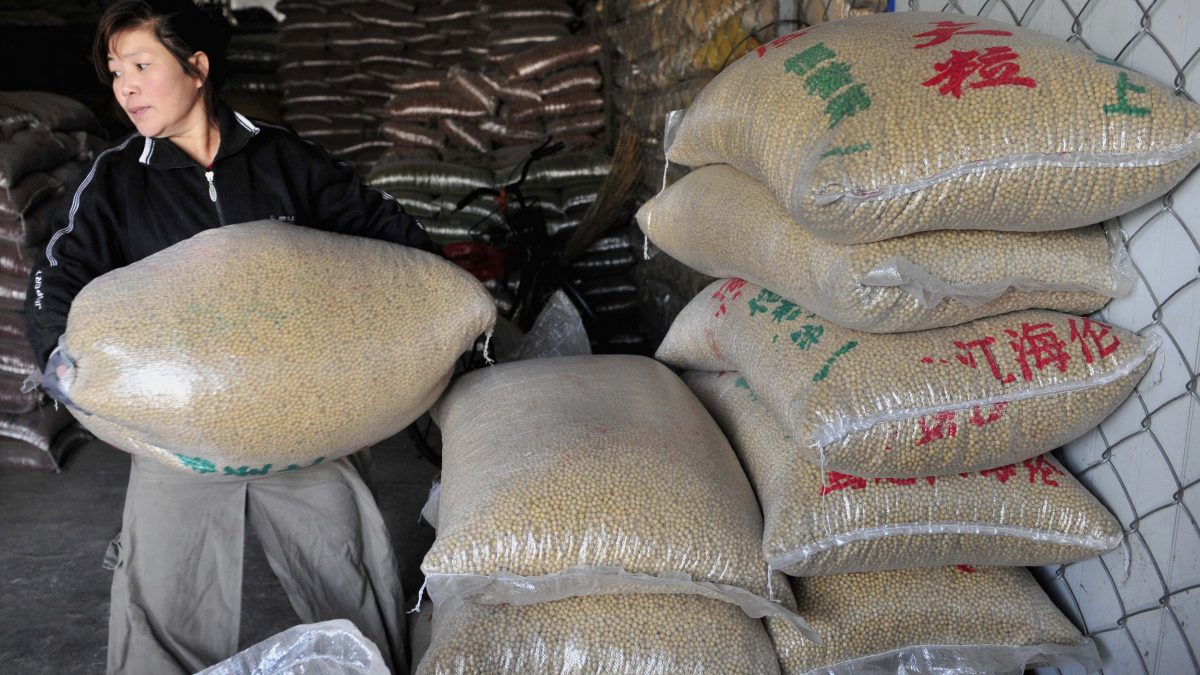
Once America’s top agricultural export to China, the oilseed has been pushed aside in Beijing’s procurement plans. Since the re-escalation of tariffs earlier this year, China has avoided buying US beans, instead sourcing heavily from Brazil.
From January to August, US soybean exports to China totalled just over 200 million bushels, compared with nearly one billion bushels in the same period last year. Brazil filled the gap, shipping more than two billion bushels north.
The consequences are devastating for Midwestern farmers. Soybean prices have slumped to near multi-year lows, hovering around $10 a bushel, with cash prices in states like North Dakota and Minnesota running $2 below futures.
Analysts estimate farmers are losing around $100 an acre on soybeans this season, a figure that quickly multiplies across thousands of acres. With rising costs for fertiliser, seeds, fuel and equipment, balance sheets are tightening.
Glut turns bumper yields into losses
Abundant harvests normally help farmers pay down debts and prepare for next season.
This year, they are amplifying the pain.
Grain bins are filling faster than buyers can be found, forcing farmers to rush sales at low prices or pay for costly storage. Some are offloading corn earlier than usual simply to make space for soybeans.
“It’s like a tidal wave of problems coming towards Illinois,” one farmer told CNN, describing storage shortages and collapsing local bids.
The bumper crop has driven corn and soybean prices down just as input inflation and high interest rates squeeze margins.
Farmers who expanded acreage in the hope of better returns are finding themselves stuck with crops they cannot sell profitably.
Many are delaying purchases of machinery or cutting back on fertiliser, decisions that could affect yields in future seasons.
Bailouts on the table — again
For Trump, the crisis carries echoes of 2018 and 2019, when his trade war with China led to a sharp collapse in farm exports.
At that time, the federal government paid more than $23 billion in aid to farmers through the Commodity Credit Corporation. That mechanism, however, is not available this year after Congress tapped it to help fund a tax-and-spending bill earlier in 2025.
As a result, the White House is considering a different approach: using tariff revenue to bankroll a bailout.
Customs duties brought in $149.2 billion in the first eight months of this year, a record sum, largely due to Trump’s tariffs.
Some lawmakers have suggested that redirecting part of that windfall to farm aid would shield rural America from the worst of the crisis. But others warn the move would tacitly acknowledge that the trade war itself has hurt the very farmers it was supposed to strengthen.
Trade diplomacy in limbo
Trump has publicly said he wants to push China to resume soybean purchases, with the two sides scheduled to meet on the sidelines of an upcoming summit in South Korea.
Treasury Secretary Scott Bessent has also hinted that new support for farmers could be announced soon, though timelines remain uncertain, particularly given the budget battles and government shutdown threats hanging over Washington.
In the meantime, Agriculture Secretary Brooke Rollins has been travelling the globe seeking alternative markets for US products. But government officials and farm groups alike acknowledge that no combination of smaller buyers can make up for the sheer scale of China’s imports.
Roughly 60 per cent of South Dakota’s soybeans typically go to China. Without that market, the state’s growers face mounting unsold surpluses.
Farmers’ patience wears thin
For many farmers, the situation feels like déjà vu. Sentiment surveys show declining optimism after a brief rebound earlier this year, and farm bankruptcies are climbing again after a 55 percent jump last year. The financial strain is spreading beyond fields, hitting rural banks and equipment dealers who depend on farm spending. Some farmers warn of a looming wave of defaults if relief or new markets do not materialise quickly.
The emotional toll is also real.
The Centers for Disease Control and Prevention has long documented higher suicide rates among farmers compared with the general population. Farm advocates caution that continued uncertainty and mounting losses could worsen mental health pressures in rural communities.
“This is not your ordinary farm crisis,” one industry leader told CNN. “We call it farmageddon.”
Political stakes in rural America
The political implications are stark.
Farmers overwhelmingly supported Trump in last year’s election, giving him margins of more than 40 points in rural areas, according to Pew Research Center. That loyalty helped secure his return to the White House, but it is now being tested by shrinking incomes and the prospect of another government bailout.
Critics say repeated aid packages risk becoming “hush money” designed to buy time rather than resolve the underlying trade conflict.
Supporters counter that farmers, as the backbone of U.S. food security, cannot be left to fail. Either way, the optics of farm states depending on federal checks undercut the traditional image of self-reliant agriculture.
Limits of alternatives
Farm groups are urging Washington to accelerate efforts to expand domestic uses of soybeans, particularly in renewable diesel and to find new export markets in Asia, Africa and Europe.
Yet such transitions take time.
Farmers are already planting next year’s crop without knowing whether today’s problems will be resolved and they cannot simply switch acreage overnight without risking further losses.
At the same time, livestock producers — who benefit from cheaper feed costs — are faring better, highlighting the uneven impact across agriculture. But the sheer scale of corn and soybean acreage in the Midwest means that the economic and political weight of row-crop farmers is hard to ignore.
A test of trade and trust
For now, the bumper harvest is both a blessing and a curse: proof of American farming’s resilience, yet a reminder of its dependence on global markets.
Trump faces a difficult choice: either secure a breakthrough with China that restores soybean sales or pour billions of tariff dollars into direct support that risks becoming another temporary fix.
The farm belt, once a stronghold of support, is watching closely.
Until there is an answer, the bins will keep filling, prices will keep falling and the bumper crop of 2025 will remain the president’s biggest agricultural headache.
End of Article
 "Sara Mullaly is Britain’s archbishop: Ex-nurse is first woman to lead Church of England")

&description=A+bumper+harvest+on+US+farms+is+now+Trump%E2%80%99s+big+headache)