
Last Updated:
Pressuring India to halt these imports would shrink the global pool of refined fuels, a move that risks reigniting fuel inflation, particularly in Western economies



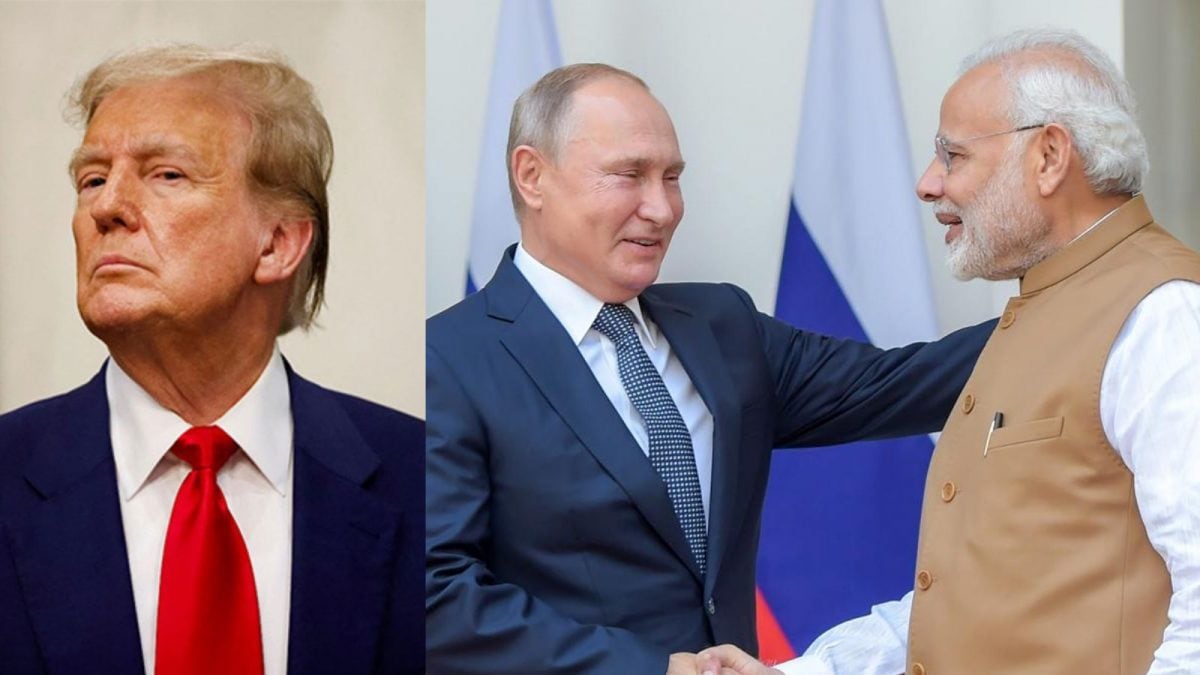
US President Trump and Russian President Putin with PM Modi | File Image: AP
Standing beside his Russian counterpart Sergey Lavrov in Moscow, External Affairs Minister S Jaishankar was unambiguous. “We are not the biggest purchasers of Russian oil, that is China,” he said, pushing back against what he described as a “perplexing” narrative from the West. Addressing media questions about US tariffs on Indian goods, Jaishankar defended India’s decision to import discounted crude from Russia as one driven by national interest, and more importantly, one that helped stabilise the global energy market.
“We are a country where the Americans have said for the last few years that we should do everything to stabilise the world energy market, including buying oil from Russia,” Jaishankar stated, clearly suggesting that India was now being unfairly penalised for doing exactly what the West had informally endorsed.
Recommended Stories
The comments come at a time when India finds itself at the centre of a geopolitical energy debate, triggered by Washington’s decision to double tariffs on Indian goods, now totalling 50 per cent, with an additional 25 per cent penalty imposed specifically over energy trade with Russia.
The premise behind the penalty, that India is the “largest buyer” of Russian oil and thus fuelling Moscow’s war chest, has been repeatedly contested by New Delhi. Jaishankar, in Moscow, laid out the data: India is not the top importer of Russian oil (that would be China), not the biggest buyer of Russian LNG (that would be the EU), and not even the trade partner with the sharpest post-2022 surge in volume with Moscow.
What India has done, however, is purchase discounted Russian crude in large volumes, and in doing so, play an outsized role in keeping global oil prices from spinning out of control.
Eric Garcetti’s Comments That Strengthen India’s Case
A 2024 video of former US Ambassador to India Eric Garcetti resurfaced this week, and it’s being seen in India as a quiet but powerful validation of Jaishankar’s position.
Speaking at the Conference on Diversity in International Affairs, Garcetti had openly stated: “They bought Russian oil because we wanted somebody to buy Russian oil at a price cap. That was not a violation or anything. It was actually the design of the policy because, as a commodity, we didn’t want the oil prices going up, and they fulfilled that.”
Garcetti was referring to the G7’s “price cap” mechanism, which permitted the purchase of Russian crude as long as it was sold below $60–65 per barrel. India’s imports, almost entirely conducted under that cap, were therefore not only legal, they were aligned with what Western economies wanted to avoid: a global oil price spiral.
Garcetti’s remarks were not an outlier. In 2022, US Treasury Secretary Janet Yellen had similarly remarked, “We’re happy for India to buy as much Russian oil as it wants… even above the cap.” The West’s priority at the time was to keep Russian oil flowing and global prices in check, a goal India’s purchases helped achieve.
How Did India’s Russian Oil Buys Actually Help The Global Market?
India’s large-scale purchase of discounted Russian crude began in earnest after February 2022, when Western sanctions forced Moscow to redirect exports away from Europe. In that moment of upheaval, India emerged as a critical buyer, absorbing millions of barrels per day and effectively stabilising the market.
Before 2022, Russian crude made up less than 0.2 per cent of India’s total oil imports. By 2024–25, that share had surged to 36–40 per cent, with imports averaging between 1.7 and 2 million barrels per day. This shift played a central role in absorbing redirected Russian supply and preventing a global price shock.
Had countries like India not stepped in, a massive volume of Russian oil would have become “stranded”, unsellable due to sanctions. That would have created an artificial supply shortage in the global market, pushing Brent and WTI crude benchmarks into dangerous territory.
Had India exited the market, much of the displaced Russian crude would likely have been redirected to China at even deeper discounts, further concentrating energy leverage and tightening competition for West Asian oil. Analysts estimate that any disruption in Russian flows could push global crude benchmarks up by $10–15 per barrel, a risk India’s purchases helped avert.
India’s timely entry acted as a circuit breaker. The displaced barrels were rerouted to Asian buyers, market liquidity was maintained, and volatility was curbed. Prices remained elevated but manageable, avoiding the catastrophic inflation that analysts feared would ripple across both developed and developing economies.
Moreover, India negotiated steep discounts which helped reduce its import bill and, more significantly, shifted some demand away from Middle Eastern producers. This redistribution further eased price pressure and introduced competitive equilibrium into the market.
How Did India Navigate Sanctions Without Violating Them?
India’s strategy was not to circumvent sanctions, but to work within their technical parameters. The G7’s price cap was designed precisely to allow Russian oil to flow, but only at capped rates. India’s purchases mostly fell within those limits, and were often conducted using non-dollar currencies such as rupees or dirhams, through alternative channels that reduced dependency on Western financial institutions.
This approach enabled India to legally and diplomatically maintain oil trade with Russia without attracting formal sanctions. It also diversified global energy payment routes, making the system more resilient.
Why The West Quietly Tolerates What It Publicly Criticises
Despite publicly urging India to scale back energy ties with Moscow, Western capitals, particularly in Europe, continue to benefit from India’s Russian oil trade. The contradiction lies not just in rhetoric but in the very mechanics of global energy flows.
India refines much of the crude it imports from Russia into high-grade diesel, petrol, and aviation fuel. Some of that is re-exported. According to Vortexa and Kpler data, a significant share of these refined products is shipped to Europe, especially the Netherlands, France, and Italy.
In other words, Russian-origin oil, though barred from direct import under EU sanctions, is still entering European economies in altered form.
Indian refiners act as de facto intermediaries, re-routing Russian energy through global trade lanes. As long as the oil is transformed into a new product and not shipped directly from Russian ports, it bypasses the legal restrictions.
This “grey zone” allows the EU to uphold its sanctions policy on paper while still accessing critical energy supplies in practice. For India, it offers profit margins and global relevance; for Europe, it prevents fuel shortages and price spikes.
Pressuring India to stop these imports would risk shrinking the pool of refined products available globally, a move that could reignite inflation in fuel prices, particularly in the West. That is a cost neither Washington nor Brussels appears willing to bear amid fragile post-pandemic recoveries and persistent inflation concerns.
About the Author

Karishma Jain, Chief Sub Editor at News18.com, writes and edits opinion pieces on a variety of subjects, including Indian politics and policy, culture and the arts, technology and social change. Follow her @kar…Read More
Karishma Jain, Chief Sub Editor at News18.com, writes and edits opinion pieces on a variety of subjects, including Indian politics and policy, culture and the arts, technology and social change. Follow her @kar… Read More
Loading comments…
Read More