
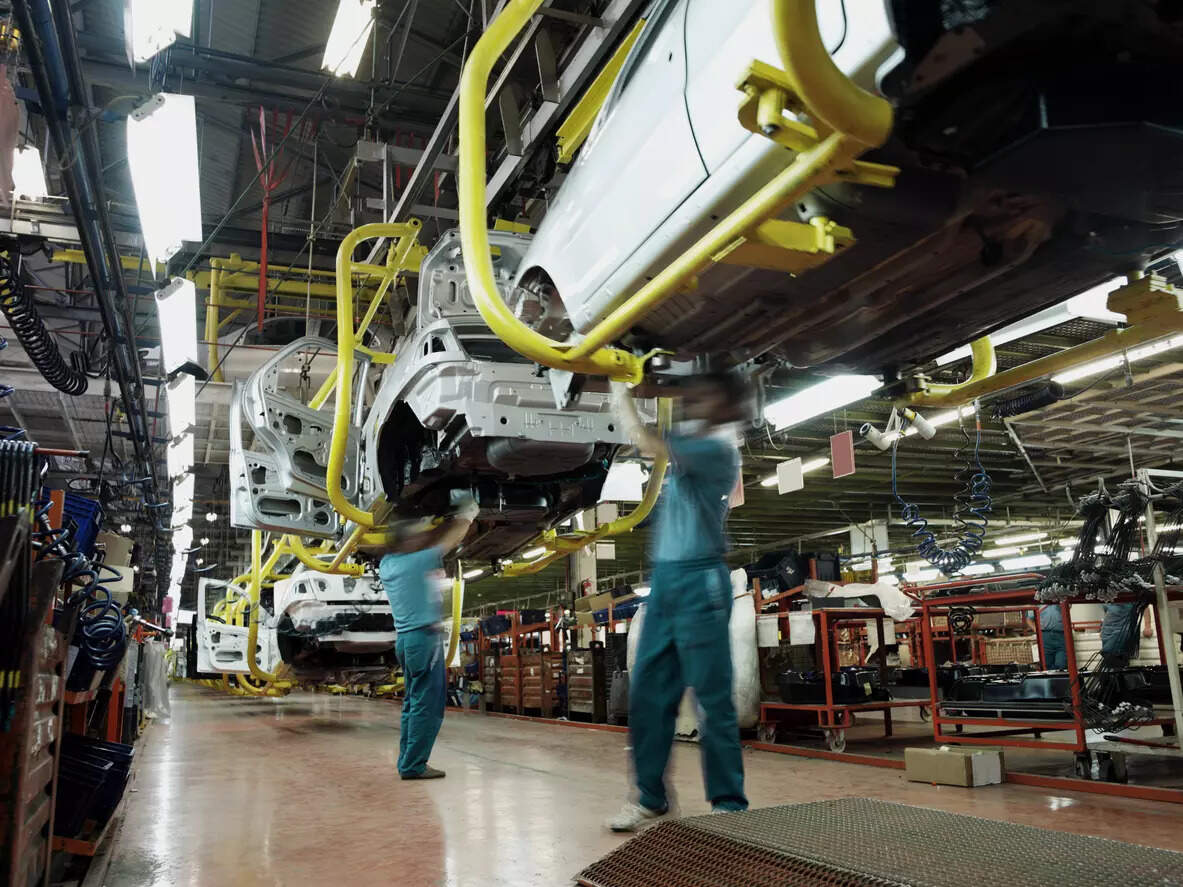
On a dark February morning at Mercedes-Benz’s vast Untertuerkheim plant, workers arriving for the early shift are met by activists from Zentrum, a self-styled union affiliated with the far-right Alternative for Germany (AfD) party.
“Game-changer,” reads the pamphlet they are handing out ahead of elections to the factory’s works council, at which Zentrum aims to challenge mainstream unions it says have failed to shield the automotive industry from thousands of job cuts.
Currently confined to the fringes of auto union politics, the far right hopes to harness anxieties among workers in Germany’s powerhouse industry to build grassroots influence that could help the AfD on a national stage. The country’s carmakers are struggling with the shift to EVs and Chinese competition.
“We have established ourselves,” said Oliver Hilburger, 56, who founded Zentrum in 2009 and himself works at the plant in Stuttgart.
Reuters spoke to about a dozen trade union and works council representatives and officials in the auto sector ahead of the elections, held by companies across Germany every four years, as well as politicians and activists.
The premier of one of Germany’s 16 states, several senior members of the national governing coalition and union representatives were among those who said they are worried the far-right will make gains in votes happening from March to May.
The AfD, which was classified by federal authorities as “right-wing extremist” last year, is shunned by Germany’s political mainstream.
“It should be a cause for concern if groups close to the AfD could gain a stronger foothold in companies,” said the state premier, declining to be identified in order to speak freely.
Works councils are a pillar of the corporatist model which proponents say helped foster stability and prosperity in Germany after World War Two, giving about 37 per cent of employees a formal voice within companies.
Officials at IG Metall, the main union at companies like Mercedes and Volkswagen, say many far-right candidates plan to stand in elections to works councils in the auto industry’s southern heartland.
Although some are only loosely affiliated with the AfD, they could give the party – which leads nationwide opinion polls and is on track to make gains in five state elections this year – a bigger platform to woo workers.
“A works councillor can present AfD arguments once every quarter to tens of thousands of people at a works assembly,” said Lukas Hezel, part of an IG Metall initiative to counter the far-right. “That is a much more valuable political position than a local councillor.”
Spying an opportunity, the AfD is giving Zentrum, the most established far-right labour movement, more support.
“If you want to shape a society, elections alone are not enough,” said the AfD’s deputy parliamentary leader Sebastian Muenzenmaier after hosting Zentrum at a party event ahead of March 22’s state election in Rhineland-Palatinate.
“You need a mosaic – the party, a trade union, cultural initiatives, maybe a musician, a publisher, a bookshop. Each has its own role, but all move in the same direction.”
Mercedes, Volkswagen and VW-owned Audi declined to comment directly on the works council elections but issued statements avowing democratic values like tolerance and diversity.
“The AfD advocates economic policies and, in some cases, even constitutional and xenophobic positions that are incompatible with the values of Mercedes-Benz,” a company spokesperson said.
Some observers warn of a broader risk to democracy if the big unions are weakened, drawing parallels with fragmentation of labour movements during the Great Depression that undermined their ability to organise against Nazism in the 1930s.
“To assume the unions will scrape through the next works council elections with nothing more than a black eye would be fatal,” said Klaus Doerre, a trade union expert at Kassel University. “The potential for a breakthrough is there.”
At Untertuerkheim, some workers stride past the four Zentrum activists but many accept the campaign material.
“We’ve gone through 800 flyers,” Hilburger says, fetching another box from his van.
The big unions, which describe themselves as non-partisan but explicitly defend values such as social justice and opposition to racism and far-right extremism, have traditionally dominated works council elections.
The AfD says the unions serve a left-wing agenda that no longer represents ordinary workers, and has sought to discredit them through a series of parliamentary inquiries.
“Today, it’s no longer the cigar-smoking factory owner who bullies people. Today, people are more afraid of a powerful works council if they have the wrong opinion,” Hilburger said in an interview.
The leaflet handed out to Mercedes workers accuses IG Metall, which has over 2 million members, of standing by as job cuts mount but offers few concrete proposals to fix the crisis.
Zentrum, whose status as a union is disputed because it does not take part in collective bargaining negotiations, currently has around 150 works council members plus 15 affiliates, Hilburger said, out of tens of thousands nationwide. Seven are at Untertuerkheim, where it will stand 207 candidates this year, a few more than in 2022.
An affiliated group at Volkswagen’s all-electric plant in Zwickau will field 24 candidates, up from eight in 2022, Hilburger said, while Zentrum’s three candidates at Audi Ingolstadt could make a breakthrough in auto centre Bavaria.
Hilburger could not give a total number of candidates.
“These are showcase companies, success here is symbolically important,” said Doerre. “If they can succeed at Mercedes or Volkswagen, it signals maybe they are a force to be reckoned with.”
The crisis in carmaking could offer a chance to scoop up protest votes from workers disenchanted with established parties and trade unions.
Where weekend football results used to dominate shop floor chatter, now “the conversation immediately and almost exclusively turns to politics”, Hilburger said.
The AfD initially put Zentrum, whose leader Hilburger for years played guitar in a skinhead band, on an “incompatibility” list of organisations too extreme to work with. Members voted to remove it in 2022, when the party shifted rightwards.
Jens Keller, a city councillor in Hannover, is one of several AfD officials who are also Zentrum activists.
“The AfD has discovered all these people they already have… They now increasingly want them to become active in workplace politics,” said Andre Schmidt, a political analyst at Leipzig University.
An exit poll by Infratest dimap after last year’s federal election showed some 38 per cent of blue-collar workers voted AfD, up 17 percentage points from 2021, while just 12 per cent chose the centre-left Social Democrats.
Hildegard Mueller, who heads the VDA automotive industry association, has warned that “simple, populist and emotionally charged” far-right messaging could prove persuasive given job insecurity and policymaker inaction.
“It is not only the AfD waiting at the factory gates; representatives close to the AfD will be running on lists,” she said.
Traditional unions are fighting back: Hezel said they have hired 10 people for the Association for the Preservation of Democracy, founded by IG Metall in 2019 to counter workplace extremism. They argue that groups like Zentrum are sham unions whose goal is disruption not upholding workers’ interests.
The Christian Trade Union Confederation (CGB) has warned that some works council candidates are not disclosing ties to the AfD, describing them as “more dangerous than Zentrum, whose closeness to the AfD is at least known”.
An Opel Ruesselsheim works council member elected in March 2025 on the slate of CGB’s metalworkers’ union was later reported to have ties to far-right groups.
Trade union density has roughly halved since the 1990s, to about 14 per cent of German employees, and the AfD has challenged their embedded role in civil society and politics.
“Unions are the only ones still competing with them to be the voice of workers,” said Schmidt.