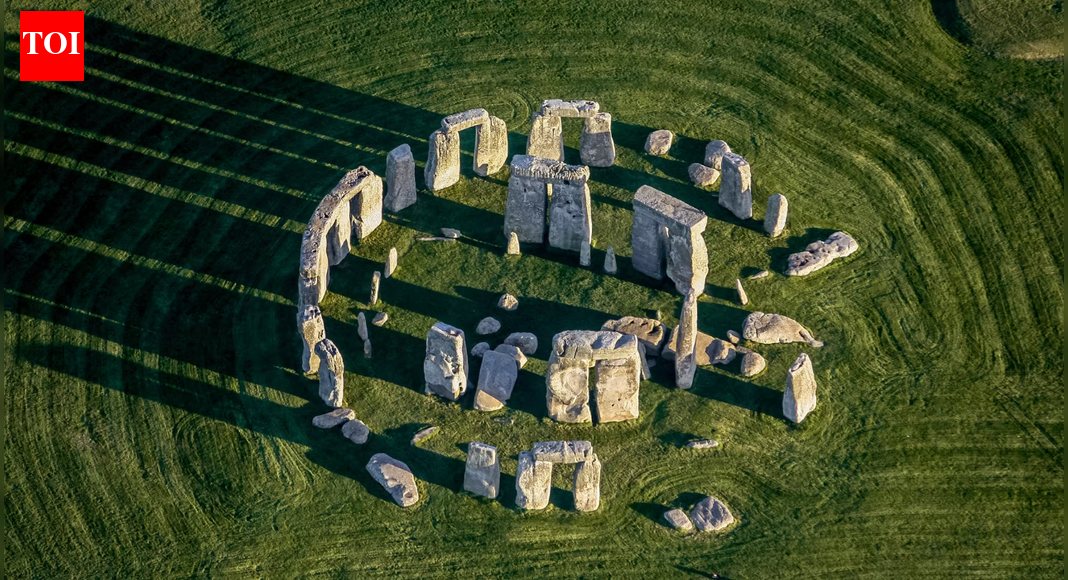


Near Stonehenge in Wiltshire, archaeologists confirmed a ring of twenty man-made pits around Durrington Walls, each about ten metres across/ Image: History.com
Stonehenge has long appeared to be the centrepiece of Britain’s ancient ritual world. Yet scientists now argue it may have been only the visible tip of something far grander. Beneath the surrounding landscape near Stonehenge in Wiltshire, researchers have verified a massive circuit of man-made pits, one of the largest prehistoric structures ever identified in Britain, suggesting the builders inscribed their beliefs into the earth on a scale we never previously recognised. The whole complex was built between 3100 BC and 1600 BC, and clearly the people who created it had a purpose driving their work.
What exactly has been found?
The newly confirmed structure sits around Durrington Walls and Woodhenge in Wiltshire, within the wider Stonehenge World Heritage Site.Archaeologists have identified around 20 massive pits, each roughly 10 metres in diameter and more than 5 metres deep, set at regular intervals to form what they call the Durrington pit circle. According to the research team, these pits are more than 4,000 years old and were deliberately excavated by humans, evidence that the Stonehenge landscape contains engineered features far beyond the iconic stone circle above ground.Professor Vince Gaffney of the University of Bradford told the BBC that the pits were not only intentionally dug, but also carefully positioned relative to another nearby monument, a level of effort that implies planning, measurement and purpose. Taken as a single design, he said, the precision is striking:“The circle is pretty accurate. It suggests that people were pacing the distances out to make sure that the pits were aligned at the same distance all the way around as the distance from the henge to the earlier enclosure.” The pits were first outlined in 2020, based on large-scale geophysical survey work around Stonehenge. At the time, some archaeologists hailed the feature as “one of the largest prehistoric structures in Britain”, and even suggested it might be early evidence of numerical counting because the circle is too large to have been laid out by eye alone. But there was a problem: not everyone was convinced the features were artificial. Some specialists argued they might be natural hollows in the chalk, and the whole “ring” a coincidence. The new study, published in Internet Archaeology, called The Perils of Pits is intended to settle that argument.
How did archaeologists prove the pits are man-made?
Because the pits are so large, they can’t simply be dug out and inspected without a vast excavation. Instead, the team combined several scientific techniques to “see” into the ground and date what was there – a strategy Gaffney describes as unprecedented for a site like this. “The exceptional size of the pits demanded a novel strategy to explore them without the need for a major, and very expensive, excavation,” he said. “As no single technology can answer all the questions; multiple types of geophysics equipment was used to establish the size and shape of the pits.”Before any dramatic claims were made, researchers began by scanning the landscape around Durrington Walls using high-resolution survey tools. The data revealed a striking circular pattern beneath the soil, as if an enormous ring of voids were hiding in the chalk. To investigate further, the team used methods such as electrical resistance tomography to estimate how deep these features went, followed by radar and magnetometry to visualise their shapes underground. This confirmed that real, steep-sided hollows existed where the model predicted, but it still left open the question of whether humans or nature created them.To answer that, the archaeologists turned to the soil itself. They extracted slender cores from deep within the pits and analysed the layers of sediment using techniques designed to read history in the earth. One method, optically stimulated luminescence, dates soil by measuring when it was last exposed to sunlight, effectively telling us when the pits were originally opened and when they were eventually filled in. Another method, sedimentary DNA analysis, pulled preserved fragments of ancient biological material from the soil. In these samples, researchers found traces of animals such as sheep and cattle, evidence of a human-shaped landscape of settlement, grazing and ritual activity rather than a random geological formation. Dr Tim Kinnaird of the University of St Andrews, who used luminescence dating on the sediments, described the complex as a kind of “super henge”, and said the dates showed the pits were dug in the late Neolithic and kept open for roughly 1,000 years, spanning changing cultures. The crucial point, Gaffney told the Guardian, is that the same soil pattern appears again and again in cores from different pits around the ring: “They can’t be occurring naturally. It just can’t happen. We think we’ve nailed it.” Taken together, the depth, shape, dating and repeated soil signatures convinced the team that these are not random sinkholes but deliberately excavated features, forming a single monumental design in the landscape.
What might the pit circle have meant?
No one is pretending we now know exactly why Neolithic communities dug a ring of yawning shafts around Durrington Walls – the people who did it left no written explanation, and the pits themselves are now infilled and invisible on the surface. But the scale and layout make one thing clear: this was not casual ditch-digging. Some pits are thought to be 10 metres wide and 5 metres deep, cut into hard chalk. Carving perhaps 20 of them, accurately spaced over more than a mile, would have demanded planning, labour and an agreed vision of what the circle was for. Gaffney and his colleagues think the structure may have been tied to ideas about an underworld, in contrast to Stonehenge’s familiar alignments with the Sun and sky, and at least shows that ancient peoples were able to muster a significant workforce to put all this together. “Now that we’re confident that the pits are a structure, we’ve got a massive monument inscribing the cosmology of the people at the time on to the land in a way we haven’t seen before,” he said.“If it’s going to happen anywhere in Britain, it’s going to happen at Stonehenge.”The pits’ long life , apparently maintained or respected for around a millennium, suggests that whatever the original purpose, later communities kept recognising the circle as meaningful, even as practices shifted.For now, archaeologists are careful to emphasise what remains uncertain: whether the pits marked a boundary, guided movement through the landscape, signalled restricted areas, or acted as symbolic markers of some kind. What the new research does establish, though, is significant. It shifts the Durrington pit circle from speculation to confirmed human construction, a large, deliberate feature that changes how we understand the wider Stonehenge area. Instead of thinking only in terms of the stones themselves, we have to recognise a landscape shaped by people both on the surface and below it. Go to Source