
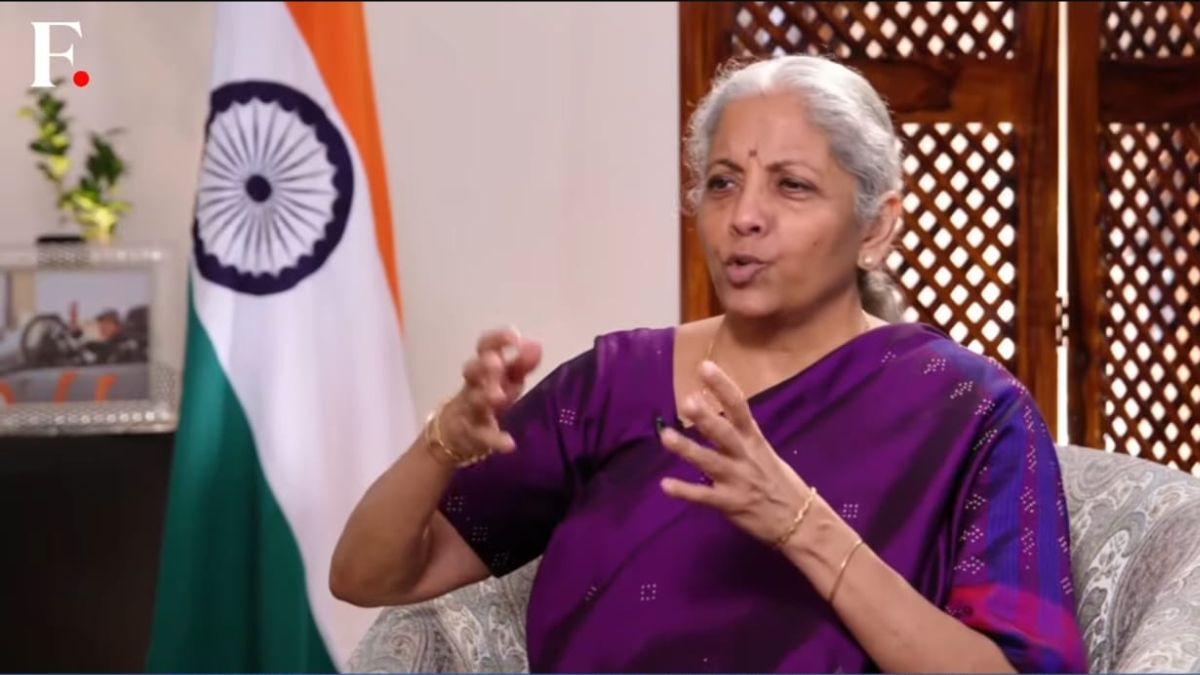
 "Absolute dominance once enjoyed by a hegemon is now contested, says FM Sitharaman")

Finance Minister Nirmala Sitharaman on Friday painted a stark picture of the shifting global order, taking a swipe at the Donald Trump administration’s recent policies, saying that the “absolute dominance once enjoyed by a hegemon is now contested”.
Speaking at the Kautilya Economic Conclave 2025, Sitharaman said the world was witnessing not temporary disruptions but a “structural transformation,” with profound implications for trade, finance and energy security.
“Wars and strategic rivalries are redrawing the boundaries of cooperation and conflict. Alliances that once appeared solid are being tested, and new coalitions are emerging,” she observed.
The finance minister emphasised that India’s rise as a stabilising force was neither accidental nor transient, but the result of prudent economic management and resilience built over the past decade.
From dominance to contestation
In a pointed remark interpreted as an indirect reference to the United States, Sitharaman said that Western liberal values, once considered the sole model for prosperity, were no longer uncontested.
“For decades, many Asian nations absorbed the material gains of globalisation without adopting the same political values that underpinned Western society. Today, they assert alternative models of growth and governance, drawing on their civilisational continuities. Their emergence questions the assumption that Western liberal values are the only path to economic success,” she said.
The minister argued that the post-Cold War consensus of open markets and multilateral cooperation had become “a relic of the past.”
What followed was three decades of contested equilibrium, which allowed nations to pursue prosperity through integration and interdependence. That equilibrium, she said, has now been upended.
A turbulent global arena
The global economy, according to Sitharaman, is under intense strain from trade tensions, heightened tariffs, volatile energy markets and rising geopolitical conflict.
She pointed to the ongoing Russia-Ukraine war, new tariffs imposed by the United States under President Donald Trump and the broader decoupling strategies pursued by major powers as catalysts of disorder.
“The rapidity of events unfolding ensures that the world we wake up to often feels different from the one we went to sleep with. Shifts that once transpired over decades are now condensed into months or even weeks,” she said.
She further warned that a zero-sum mindset had taken hold globally.
“Trade imbalances have hollowed out industries in some nations while creating overcapacity in others. Energy imbalances have left countries chronically dependent on imports or reliant on cheap, carbon-intensive power. Net-zero commitments, if pursued without balance, risk constraining growth in developing economies.”
India as a stabilising force
Amid this turbulence, Sitharaman positioned India as a source of stability and resilience. She credited the country’s steady growth trajectory to domestic anchors: fiscal consolidation, improved quality of capital expenditure and inflation management.
“With the steady share of consumption and investment in the overall GDP over the years, India’s growth is firmly anchored in its domestic factors, which minimises the impact of external shocks on overall growth. As a result, the Indian economy is resilient and continues to grow sustainably,” she said.
Her assertion was highlighted by data showing India’s continued strong trade performance, including a merchandise surplus with the US despite newly imposed tariffs. But she cautioned against complacency: “Just as eternal vigilance is the price of liberty, eternal performance is the price of strategic independence.”
Confronting structural imbalances
Sitharaman’s address stressed that the task before nations was not simply to manage uncertainty but to confront deep-seated imbalances in trade, finance and energy.
She called for a new global order that ensured fairness in trade, productive deployment of finance, affordable and sustainable energy and climate action aligned with development imperatives.
She argued that international institutions must evolve to reflect “today’s realities rather than yesterday’s hierarchies,” and that the voices of developing nations must be amplified rather than marginalised in shaping future rules.
“Dislocations define this new global era wherein trade flows are being reshaped, alliances tested, and investments rerouted along geopolitical lines. Shared commitments are being re-examined. Thus, what we face is not a temporary disruption but a structural transformation,” she declared.
Tariffs, trade wars and strategic autonomy
The finance minister’s remarks also came against the backdrop of rising trade frictions with the United States.
India currently faces a 25 per cent penal tariff on imports of Russian oil and arms, on top of reciprocal tariffs on its exports. While negotiations for a bilateral trade deal are underway, India continues to face higher tariffs, even as its trade surplus with the US remains significant.
These developments, Sitharaman said, highlight India’s vulnerability but also its resilience.
The choices India makes now, she added, will determine whether resilience evolves into leadership or remains merely a buffer against external shocks.
Growth as a strategic imperative
Linking India’s economic trajectory to its strategic standing, Sitharaman said the need to maintain a high growth path. “India has to clock GDP growth rates of 8 per cent to become a developed nation by 2047,” she said.
NK Singh, chairman of the 15th Finance Commission, who also spoke at the event, echoed this view. He stressed the importance of improving India’s incremental capital output ratio and replicating the successful Centre-state partnership seen in the Goods and Services Tax for other reforms.
The finance minister positioned India’s growth journey as a twin-track approach: one directed at achieving developed nation status by 2047] and another centred on self-reliance under the Atmanirbhar vision.
Importantly, she clarified that self-reliance was not about turning inward but about securing autonomy while engaging with the world.
Crises before renewal
Sitharaman ended on a note of cautious optimism, suggesting that the current global fragmentation may pave the way for more sustainable and inclusive forms of cooperation.
“History shows that crises often precede renewal,” she said. The challenge, however, is to ensure that inclusive principles guide this renewal.
“For developing countries, this is a necessity, not just a romantic aspiration. We cannot afford to be passive spectators in a world where decisions elsewhere determine our destinies. We must be active participants, shaping outcomes where possible and preserving autonomy where necessary,” she said.
Eternal performance, not complacency
The finance minister’s message was clear: India’s resilience is real, but it cannot be taken for granted. The turbulence of the global order offers both risk and opportunity and India’s strategic autonomy will rest on continuous economic performance.
“There is no room for complacency or self-congratulation beyond a quiet confidence in our abilities to take the right decisions and execute them,” Sitharaman said.
With inputs from agencies
End of Article
 "Manchester attack was just a matter of time, say Jewish leaders")
 "‘I’ll do it for nothing’: Former Crystal Palace manager offers to replace Ruben Amorim at Manchester United")
&description=Absolute+dominance+once+enjoyed+by+a+hegemon+is+now+contested%2C+says+FM+Sitharaman)