
- Critics, public fear rearmament deviates from nation’s pacifism.
Edited by: Keith Walker
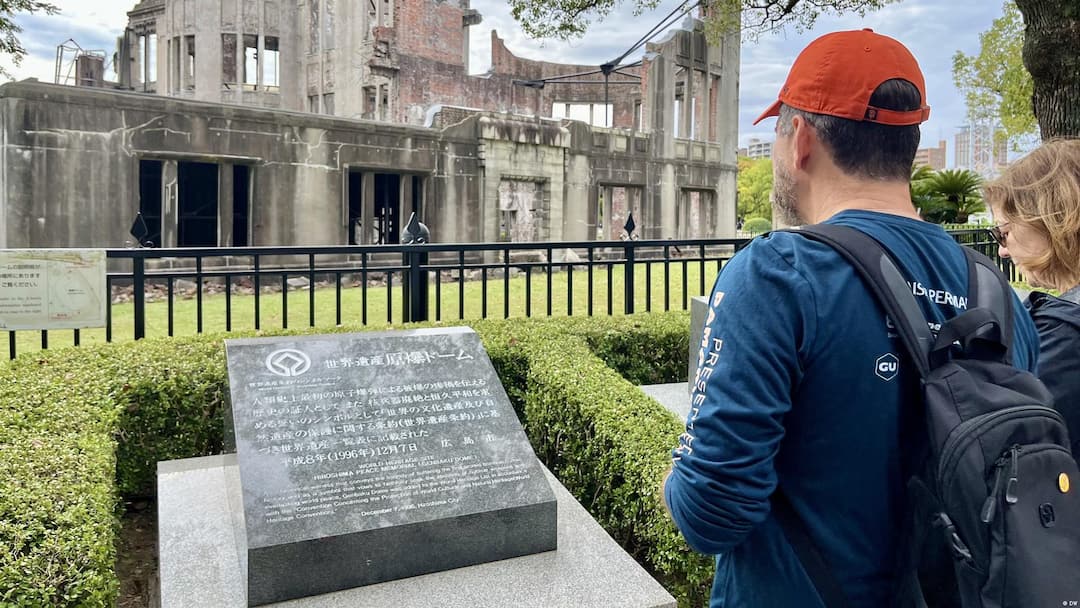
Japan on Thursday commemorates the 81st anniversary of the nuclear attack on Hiroshima.
On August 6, 1945, the US dropped an atomic bomb on the Japanese city of Hiroshima during the last days of World War II, killing close to 80,000 people in the initial blast. Three days later, the US dropped a bomb over Nagasaki.
“Japan adopted a pacifist constitution in reflection on World War II,” noted Masako Wada, assistant secretary general of Nihon Hidankyo, or the Japan Confederation of A- and H-Bomb Sufferers’ Organizations.
Japan “earned the trust of the international community as a country that promised never to wage a war again,” added Wada, who survived the Nagasaki bombing as a 1-year-old.
However, in recent years, Japan has increased defense spending, eased restrictions on weapons exports and expanded the role of its military, citing growing risks from China, North Korea and Russia.
“The current administration is destroying that [trust],” Wada told DW, referring to Japan’s recent efforts to pivot away from decades of strict postwar pacifism.
“Japan’s recent military buildup is no different from recreating the arms race that led the country toward World War II,” said 84-year-old Masashi Ieshima, who survived the Hiroshima bombing at the age of 3.
Survivors warn against rearmament
Ieshima was playing in the entrance of his house, just 1.2 miles (2 km) from the hypocenter, when the blast shattered all the windows in the house, sending shards of glass into his mother.
Seventy years later, he underwent surgery for thyroid cancer, which was officially recognized as an atomic bomb-related illness. His father, who was also exposed to the Hiroshima atomic bombing, died of laryngeal cancer.
“It makes my blood boil to see Japan justify its military buildup and the easing of arms export restrictions over the possibility of a Taiwan conflict,” said Ieshima, who serves as the chairman of Toyukai, the Tokyo affiliate of Nihon Hidankyo.
“If Japan continues down this path, it could lead to war. And if another war breaks out, I believe it will be a nuclear war.”
The average age of Japan’s atomic bomb survivors, known as “hibakusha,” has reached almost 87. They face the urgent challenge of passing on their testimony and calls for peace to younger generations, including their children, grandchildren, and supporters.
Takako Nakamura, a second-generation atomic bomb survivor from Nagasaki, began working actively as a family testimony speaker in February 2026, following her career retirement.
“People were killed without a trace, not even their bones remain. That is the true nature of the atomic bomb,” the 73-year-old told DW, her voice breaking.
Wada urged people around the world to recognize that the danger of nuclear weapons is “not something in the past, but in front of us right now.”
She said she does not want sympathy for survivors, but empathy. “I want people to think of it as their own issue.”
Japan pushes for military buildup, non-nuclear principles at risk
On Tuesday, Japan’s Defense Minister Shinjiro Koizumi said the country needs to strengthen its military with a “sense of urgency and crisis” as a new government assessment again highlighted growing risks from China, North Korea and Russia, according to Agence France-Presse (AFP).
In the preface to Japan’s latest annual defense white paper, Koizumi said it was “imperative that Japan further reinforce and transform its defense capabilities with a stronger sense of urgency and crisis than ever before.”
The Defense Ministry told DW that Japan must strengthen its defense capabilities to enhance deterrence while maintaining its exclusively defense-oriented policy.
It cited an increasingly severe security environment, including China’s military expansion and activities in the East and South China seas and around Taiwan.
Since taking office in October 2025, Japanese Prime Minister Sanae Takaichi has introduced a series of measures to strengthen Japan’s defense capabilities. Her
Her government also relaxed restrictions on arms exports in April 2026, allowing exports of lethal weapons.
It is also considering revising Japan’s long-standing commitment to the three non-nuclear principles of not possessing, producing or permitting the entry of nuclear weapons onto Japanese territory.
In November 2025, Takaichi said that a Chinese military attack on Taiwan could constitute a “survival-threatening situation” for Japan, potentially allowing Tokyo to exercise its legal right to collective self-defense.
However, the argument that Japan must strengthen its military because China might invade Japan or Taiwan is “not convincing” to the Japanese public, said Koichi Nakano, a professor of political science at Sophia University in Tokyo.
China’s military activities, including its maritime expansion, remain limited compared with Russia’s war in Ukraine and US attacks on Iran, he told DW.
“Japan is being skillfully drawn into the narrative that it must fall into line with Europe and the US to confront so-called rogue states such as China, North Korea and Russia.”
“Japan must responsibly pursue disarmament and establish dialogue,” Nakano said. “It must stop demonizing China and recognize it as a country with which meaningful dialogue is possible.”
Youth in Japan take to the streets in anti-war protests
Meanwhile, around 27,000 people gathered on July 10 outside the Japanese parliament building in Tokyo, holding colorful illustrated placards with messages such as “No war,” and waving glow sticks in the dark.
Reina Tashiro, 36, a member of a civil organization “We Want Our Future,” told DW that they aim to “make it as easy as possible for people to take that first step and join a protest.”
“It is different from the traditional image of demonstrations, where people raise their fists and shout slogans,” Tashiro added. “Our protests may even look stylish.”
Nahoko Hishiyama, who has been involved in civic activism for 24 years since the age of 13 and now serves as co-chair of another activist group, pointed out that recent protests have increasingly been led by people in their 20s to 40s, and more women are taking part.
“Japanese women are often said to be too mindful of how others perceive them. In activism, however, that has been turned into a strength, thinking about how to present our message in a way that resonates with the public.”
Disclaimer: This report first appeared on Deutsche Welle, and has been republished on ABP Live as part of a special arrangement. Apart from the headline, no changes have been made in the report by ABP Live.