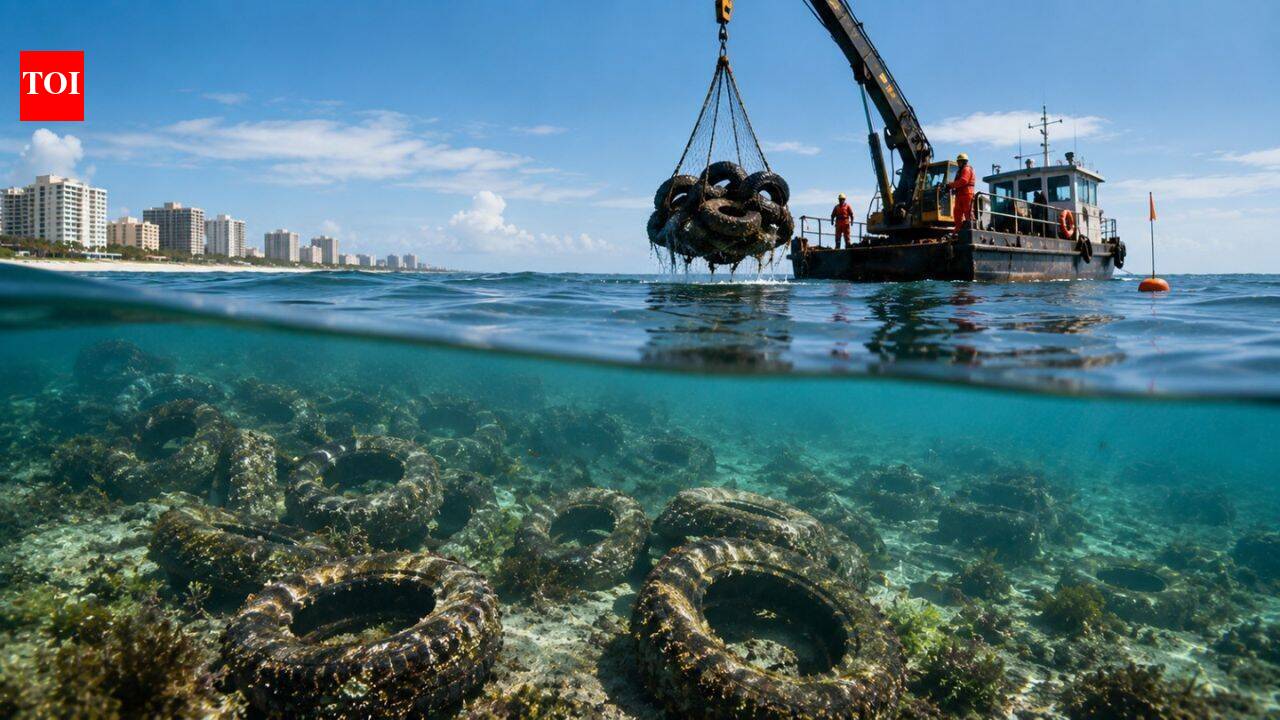

Millions of old vehicle tyres were placed offshore near Broward County for artificial reefs. Shifting currents and storms scattered these tyres, damaging existing coral reefs. Government agencies are now undertaking a massive, multi-year cleanup operation. Specialist divers and equipment are required for this extensive recovery effort. This project highlights the long-term consequences of environmental initiatives.
For a time, placing old vehicle tyres on the seabed was seen as a practical way to create habitat where marine life might gather. Similar projects appeared in different parts of the world during the second half of the twentieth century, reflecting ideas about artificial reefs that were widely accepted at the time. Off the coast of Broward County in Florida, that approach grew to an exceptional scale. What began as an ambitious attempt to improve fish habitat eventually produced a very different legacy. Decades later, shifting currents, tropical storms and hurricanes exposed the weaknesses of the project, leaving government agencies with a vast and technically demanding cleanup effort that is still unfolding years after it first began.
Why millions of tyres were placed off Florida’s coast
As reported by the Florida Department of Environmental Protection, during the 1970s, an enormous number of used tyres were placed offshore near Broward County. Estimates vary, though the total is generally believed to have reached somewhere between one and two million.At the time, the intention was straightforward. The tyres were expected to provide shelter for fish and encourage marine life in areas where natural reef structures were limited. Artificial reefs made from different materials were being explored elsewhere, and tyres were viewed as a low-cost option that could be obtained in large quantities.The long-term behaviour of such a vast collection beneath the sea proved difficult to predict.
How storms turned the tyre reef into a growing problem
Unlike natural rock formations, tyres are relatively light. As years passed, tropical storms and hurricanes repeatedly disturbed the seabed, shifting large numbers of tyres away from their original positions.Instead of remaining in place, many rolled or drifted across nearby coral reefs. The movement caused repeated contact with living coral, creating damage in areas that had not been intended as part of the original project. The problem was no longer limited to abandoned waste on the seabed; it had become an ongoing threat to existing reef ecosystems.Removing the tyres presented its own difficulties. They were scattered across a wide area, many had become partially buried or entangled, and underwater recovery required specialist divers, vessels and handling equipment.
The first step towards removing the underwater tyres
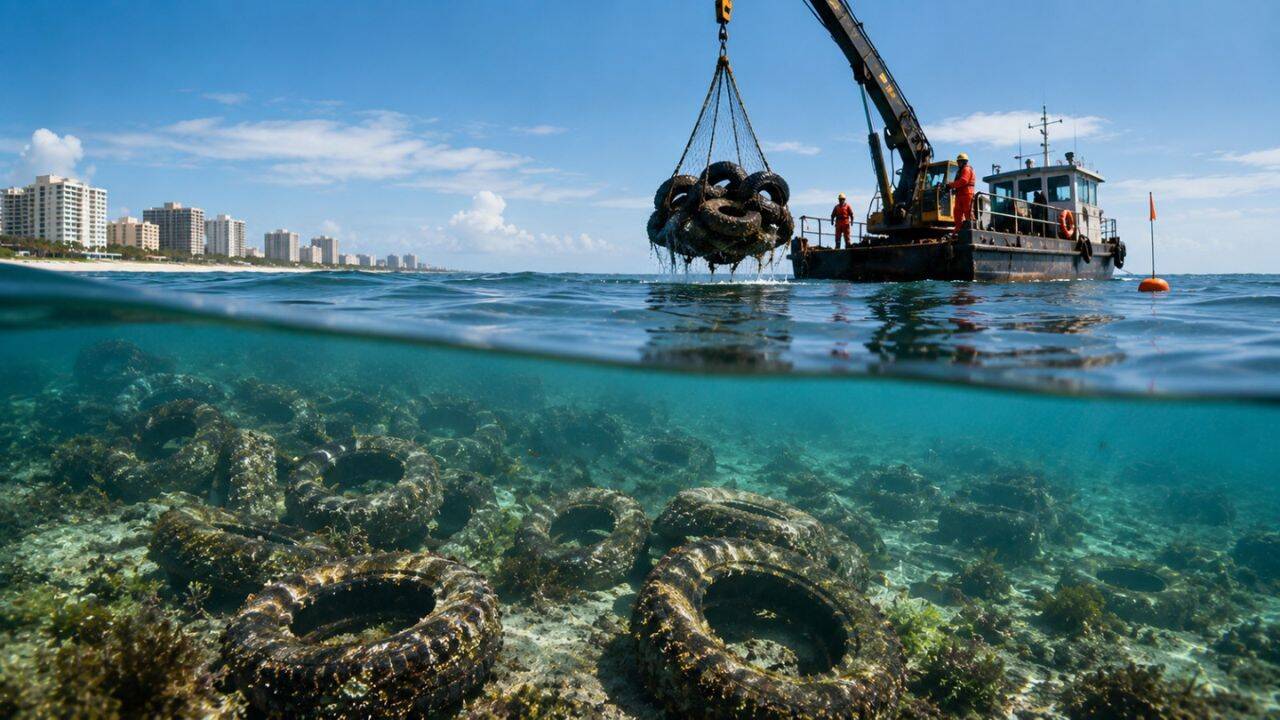
By the mid-2000s, attention shifted from understanding the scale of the problem to working out whether large-scale removal could realistically be carried out.Reportedly, in August 2006, the NOAA Marine Debris Program supported a reconnaissance project designed to examine practical recovery options rather than simply document conditions. The work focused on building a workable removal strategy and assessing how recovered tyres could be transported and disposed of once they reached the surface.Rather than launching directly into a full cleanup, planners chose to begin with a pilot programme. The trial examined how efficiently dive teams could retrieve tyres, the safest methods for loading them onto vessels, the logistics of moving them ashore and the most suitable approaches for processing and disposal after recovery.Those early assessments provided information that could be applied to future operations across the wider site.
A cleanup measured in years rather than months
The scale of the offshore tyre field means recovery cannot be completed quickly. Instead, the work has been organised through long-term contracts that allow removal to continue over many years.One of those agreements, known as Agency Contract SW348, was renewed on 17 February 2023 and is scheduled to remain in effect until 16 February 2028. It supports continuing tyre recovery operations in the Broward County area.A second agreement, Agency Contract SW349, was later introduced to expand available removal capacity. Executed on 2 September 2025, that contract is intended to run until 1 September 2032, providing additional resources for the extended cleanup effort.
An environmental project with a lasting legacy
The Broward County tyre reef is often cited as an example of how environmental projects can produce unexpected consequences long after their original purpose has faded. Ideas that once appeared practical can evolve very differently once exposed to decades of changing weather and ocean conditions.Recovery work continues because the challenge is unusually large. Millions of tyres were placed offshore over half a century ago, and removing them requires careful coordination between divers, contractors and public agencies. The project reflects a gradual shift from creating artificial habitat to repairing damage that only became fully apparent with time, making it one of the most extensive marine debris removal efforts of its kind. Go to Source