
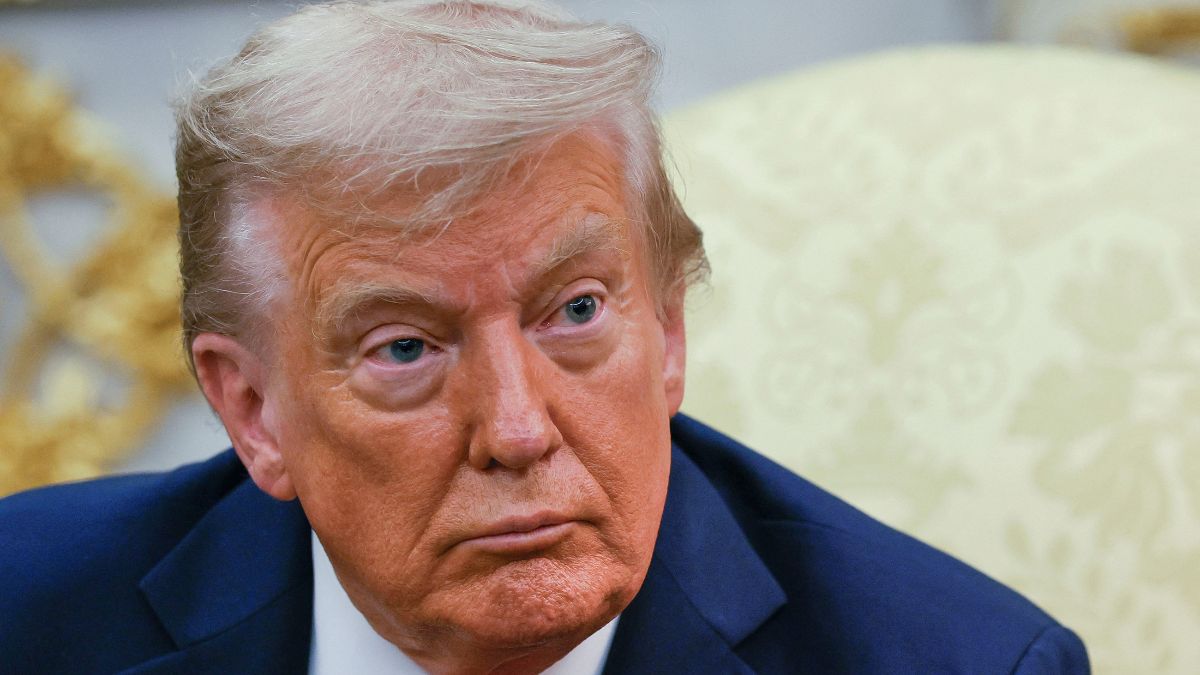
 "<div>Wind farms ugly, solar grabs land, and nuclear energy more American: How Trump views clean energy</div>")

Since returning to the White House, President Donald Trump has been reshaping the United States’ energy policy in ways that have alarmed advocates of renewable energy. His administration has rolled back incentives for wind and solar, halted projects already underway and sought to direct investment toward nuclear power and fossil fuels instead.
According to Reuters, officials close to the president have said the rationale is partly economic, partly aesthetic, and partly nationalistic, as nuclear power is seen as “more American” than wind and solar.
Nuclear as the “patriotic” option
According to Jarrod Agen, director of the US Energy Dominance Council, nuclear power fits more closely with the administration’s long-term vision than other clean energy sources. He argued that nuclear energy is more likely to be built with American parts and by American companies, which makes it a priority for federal financial backing, including loan guarantees and tax breaks, Reuters reported.
Agen described nuclear power as a “long-term play” that had not received the same investment focus as intermittent renewables like wind and solar. He added that the president viewed nuclear expansion as part of a three-pronged strategy to strengthen US energy and technological dominance. These are extending the life of existing coal plants, improving grid efficiency and investing in next-generation nuclear. In this framing, nuclear energy was not just a climate or energy issue but part of a broader competition with China, particularly in the field of artificial intelligence.
Renewables under siege
By contrast, the Trump administration has taken an aggressive stance against wind and solar. Since January, the White House has halted permitting for wind projects on federal land and waters, rescinded Biden-era plans for offshore leasing and revoked permits for projects that were already underway. As per a Bloomberg report, the Revolution Wind project off Rhode Island — 80 per cent complete — was ordered to stop construction, ostensibly on national security grounds.
Trump’s Interior Department has also tightened approval processes for renewable projects, requiring personal sign-off from the Secretary of the Interior for all new wind and solar projects on federal land. This effectively subjects proposals to political scrutiny and delays, while simultaneously expanding opportunities for oil and gas drilling.
Why Trump dislikes wind and solar
The president has made no secret of his disdain for wind and solar power. He has long described wind turbines as ugly, inefficient and even dangerous. In July, after visiting his golf resort in Scotland, he reiterated that “windmills are a disgrace,” calling them bird-killing eyesores and “the most expensive form of energy there is”. Years earlier, he had unsuccessfully tried to block an offshore wind project near the same course.
Solar has fared little better in his rhetoric. Trump has mocked large solar farms as “big ugly patches of black plastic” that despoil farmland and rely heavily on Chinese imports. He has also portrayed renewable power more generally as unreliable, citing the fact that the sun does not always shine and the wind does not always blow. While developers have increasingly turned to batteries to address this intermittency, Trump has remained sceptical, Bloomberg reported.
Reversing the Biden legacy
Trump’s hostility to renewables represents a dramatic reversal of the policies put in place by his predecessor. Under Joe Biden, the Inflation Reduction Act (IRA) was hailed as the most significant climate legislation in US history, providing long-term tax credits and subsidies that spurred a wave of investment in clean energy. But the Trump administration has worked quickly to undermine those measures.
The new tax-and-spending law, branded the “One Big Beautiful Bill Act,” phases out key credits for wind and solar earlier than planned. The Treasury Department has also issued guidance that makes it more difficult for projects to qualify for the remaining incentives. Beyond subsidies, the administration has launched trade probes that could result in new tariffs on wind turbine parts and polysilicon for solar panels, further raising costs for developers.
The cost debate
The administration has justified its actions partly by pointing to rising electricity costs. Officials have argued that adding renewable energy to the grid has driven up prices for households and businesses. Nationally, electricity costs rose at more than twice the rate of inflation over the past year, a trend the White House attributes to the expansion of intermittent power sources, Bloomberg said.
However, independent analyses suggest a different picture. Much of the increase has come not from renewables themselves but from the cost of upgrading the nation’s aging grid. Utilities have been spending heavily on transmission lines, poles and other infrastructure, both to accommodate new sources of energy and to harden systems against extreme weather. According to Bloomberg, analysts warn that slowing down renewables could actually make the supply crunch worse, as coal and gas plants retire and demand grows from industries such as data centres and artificial intelligence.
Economic fallout for the clean energy sector
The administration’s moves have already had significant economic effects. According to the advocacy group E2, $22 billion worth of clean energy projects were scrapped or downsized in the first half of 2025 alone, with job losses and investment shortfalls concentrated in states that had previously benefited from the IRA. Offshore wind, which was just beginning to take off in the US, has been especially hard-hit, as developers face both political uncertainty and financial losses from halted projects.
Smaller and mid-sized renewable developers are considered particularly vulnerable, lacking the resources to weather prolonged policy shifts. Larger firms have expressed cautious optimism that they can continue building projects grandfathered under existing credits, but even they face a tougher economic environment.
Renewables still competitive
Despite the administration’s rhetoric, independent cost assessments show that renewables remain competitive. BloombergNEF estimates that onshore wind and solar are cheap enough to compete directly with new natural gas plants, even without subsidies. Offshore wind remains more expensive but is still cheaper than new nuclear builds, which are slow to construct and face their own economic hurdles.
Blue states like California and New York continue to push forward with renewable energy, seeking to decarbonise their grids regardless of federal policy. Even in red states, renewables have proven popular. Texas, for instance, has led the country in wind generation and ranks second in solar, with most of its new grid capacity since 2020 coming from renewables or batteries. That momentum, however, could falter under Trump’s accelerated subsidy phaseouts.
Long-term outlook
The uncertainty created by Trump’s policies has raised alarms about the long-term outlook for US renewables. Developers and financiers may grow wary of committing to projects if they fear federal support can be withdrawn suddenly, even for projects already near completion. States counting on offshore wind to meet climate goals and rising demand could face setbacks, while the country as a whole risks losing ground in the global clean energy race.
At the same time, the administration’s favoured alternatives — nuclear and fossil fuels — face their own challenges. New nuclear capacity is years away from becoming operational, while gas and coal plants continue to retire due to age and market pressures. As per Bloomberg, analysts warn that slowing renewables could leave the US struggling to meet rising demand while falling behind in energy innovation.
A defining energy philosophy
Ultimately, Trump’s clean energy stance reflects more than economics. It embodies a broader worldview that prizes nationalism, aesthetics and traditional energy dominance over climate goals. Wind farms are derided as ugly, solar farms as land-grabbers tied to China, and nuclear energy as the patriotic option that showcases American technology and resilience.
The result is a sharp break from the trajectory set under Biden and a return to a vision of energy policy where fossil fuels remain central, and nuclear is elevated as the clean alternative worthy of federal support. Whether that approach can deliver affordable, reliable, and competitive energy for the future remains a subject of fierce debate.
End of Article
 "‘Crap Note’: Peter Navarro slams Musk after X fact-checks him over his tirade against India")

&description=Wind+farms+ugly%2C+solar+grabs+land%2C+and+nuclear+energy+%E2%80%98more+American%E2%80%99%3A+How+Trump+views+clean+energy)