
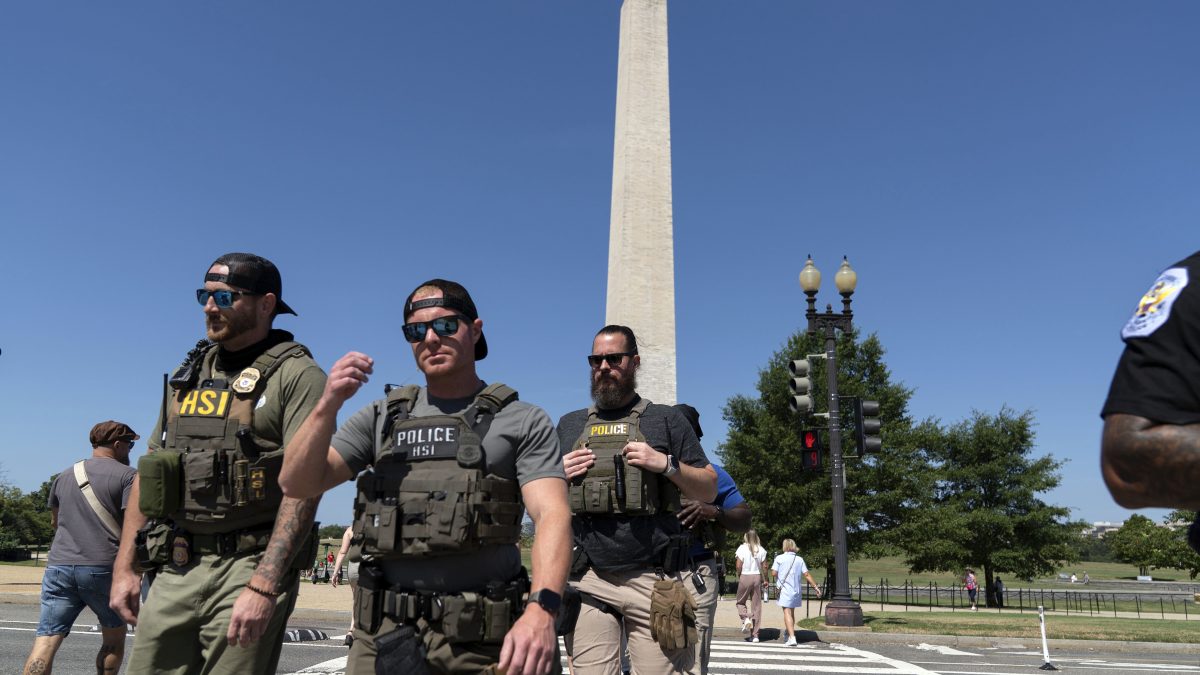
 "Trump deploys federal agents to Washington streets, sparking debate on policing tactics")

It’s a scene that has played out on the streets of Washington and Los Angeles since President Donald Trump declared a crime emergency in the nation’s capital and ramped up deportations nationwide: Federal agents, some in masks, grabbing someone off the street, bundling the person into a car and driving away, ignoring questions from bystanders.
In an executive order signed this month, Trump said the District of Columbia government’s “failure to maintain public order and safety has had a dire impact on the Federal Government’s ability to operate” and that it was his duty as president to use federal agents to restore order. He has threatened to expand those operations — law enforcement duties traditionally reserved for local police — to other cities.
Urban leaders, police officials and civil rights advocates say federal agents are not the best equipped for this type of policing. They also are concerned the strategy will erode the delicate relationship that local police have with the communities they serve.
Here are some key things to know about the differences in how federal authorities and local police operate:
Federal agents typically don’t patrol cities
Federal agents have not historically played much of a role in everyday policing. The job of federal marshal was created in 1789, but the agency’s numbers are small and largely focused on carrying out the work of federal courts. Other U.S. investigative agencies have mostly focused on major interstate crimes and national security matters.
Federal agents “are usually doing major investigations. They’re not navigating day-to-day contact with the public the way that police do,” said Chuck Wexler, executive director of the Police Executive Research Forum.
U.S. Immigration and Customs Enforcement has more traditionally done nationwide work tracking down immigrants who are in the United States illegally but has ramped up operations since Trump took office in January.
Federal agencies are wary of body cameras
After protests over the deaths of Black men at the hands of police in recent years, many cities made policy changes to enhance accountability and transparency.
Most large police departments, for example, require officers to wear cameras on patrol. Many agencies release the footage upon request or under their state public records law. Federal agencies have not embraced such change, despite some tentative steps to keep pace with their local counterparts.
In 2022, Democratic President Joe Biden issued an executive order requiring federal law enforcement agencies to adopt body-camera policies for officers who are on patrol, making arrests and or conducting searches. Trump rescinded that directive, and agencies such as the Drug Enforcement Administration and the U.S. Border Patrol have ended their usage.
Body-worn cameras “have been good for everybody,” said Lauren Bonds, executive director of the National Police Accountability Project. Bonds said such policies protect officers from meritless citizen complaints and make it easier for the public to get justice if they have been wronged. “Across the board, I would say it’s an equally beneficial tool for police and for the public,” she said.
Most local police don’t wear masks
Washington’s mayor, Democrat Muriel Bowser, has questioned why so many of the federal officers flooding the city’s streets are covering their faces.
“Why do they need masks?” Bowser asked. “They are federal officials. They’re paid by the taxpayers. They should be doing their jobs in a way that’s lawful and constitutional.”
Civil rights advocates have complained that such tactics erode trust between communities and law enforcement and make holding individual officers to account for abuses more difficult. Administration officials say masks are needed to protect federal agents.
Troy Edgar, deputy DHS secretary, wrote in an op-ed for Fox News that mask-wearing protects federal law enforcement officers from doxing and harassment. ICE has seen a sharp rise in assaults, with officials targeted on a “near weekly basis,” he wrote.
He said DHS agents clearly identify themselves during arrests by stating their names, showing badges and wearing identifiers on their gear. But photos and videos reviewed by The Associated Press do not show agents always wearing clear badges, tags or other identifiers during encounters with the public.
Masks were once largely forbidden on the federal level unless an agent was working undercover, said Michael Bouchard, a former assistant director at the Bureau of Alcohol, Tobacco Firearms and Explosives who retired in 2007. Being clearly identifiable builds trust and allows people to report any issues they might have with a particular officer, Bouchard said.
“If you’re doing the right thing,” he said, “if you’re acting within the law, what do you have to hide from?”
Federal authorities do not provide detailed information on arrests
Most local arrest reports are a matter of public record. Some local agencies even disclose such information to citizens in email groups or on social media websites.
Getting access to basic arrest details from the federal government has proved far harder. Administration officials have been releasing daily arrest totals and some of the charges that people are facing, but information on which agency made which arrests and who is facing what charges has been difficult to find.
Those seeking details about federal arrests are frequently directed to file a request under the Freedom of Information Act. Most agencies have large backlogs of such requests.
“When the agencies doing the policing have backlogs that measure in years or sometimes decades, FOlA is completely ineffective at getting policing records in any kind of useful time frame,” said Kel McClanahan, an attorney at the firm National Security Counselors who frequently works on public information issues.
Once a loved one is arrested, especially by immigration authorities, families can face a grueling task of trying to find them.
In June, for example, Rosa Soto scrambled to find where a longtime family friend, Martin Guzman, was taken after he was detained by immigration authorities at a Home Depot in Chino, California. It took her days to track him down.
“It feels like the systems you’re supposed to be able to trust and the due process you’re supposed to be able to trust in is no longer existent,” Soto said. “I can’t imagine for someone who knows very little about our justice system to truly be able to navigate it.”
Federal tactics raise concerns about communities losing trust in police
Civic leaders said they fear the federal crackdown could erode uneven progress police have made in building trust with the communities they serve.
“We are getting some violent people off the streets – but in the long run, at what cost?” Jaron Hickman, a senior police commander in Washington, said at a public forum Tuesday.
Norm Nixon, 62, an associate minister at Union Temple Baptist Church in Washington’s historically Black Anacostia neighbourhood, said federal operations were changing the way residents felt about the city’s police force.
“Now, with these federal guys coming in, people just see them all as law enforcement,” Nixon said. “Some of the young people I talk to feel like the local police officers are traitors now, that they are really against us and out to get us.”
End of Article
 "McEnroe expresses deep concern for Medvedev after first-round defeat in US Open 2025: ‘I think he’s so lost right now’")
&description=Trump+deploys+federal+agents+to+Washington+streets%2C+sparking+debate+on+policing+tactics)