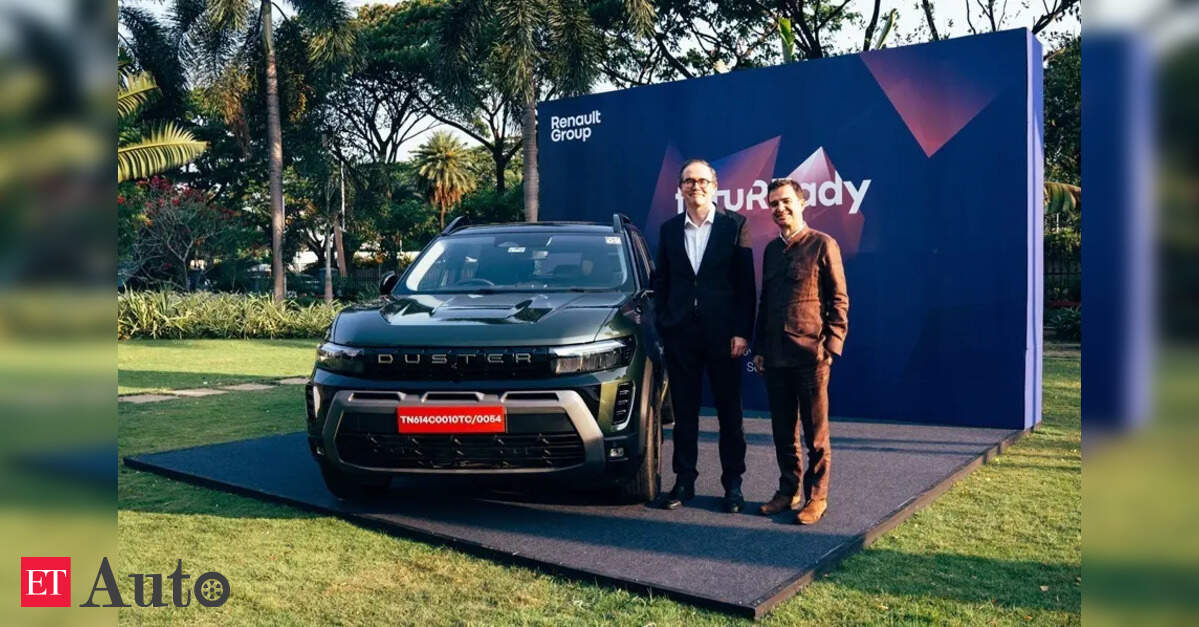

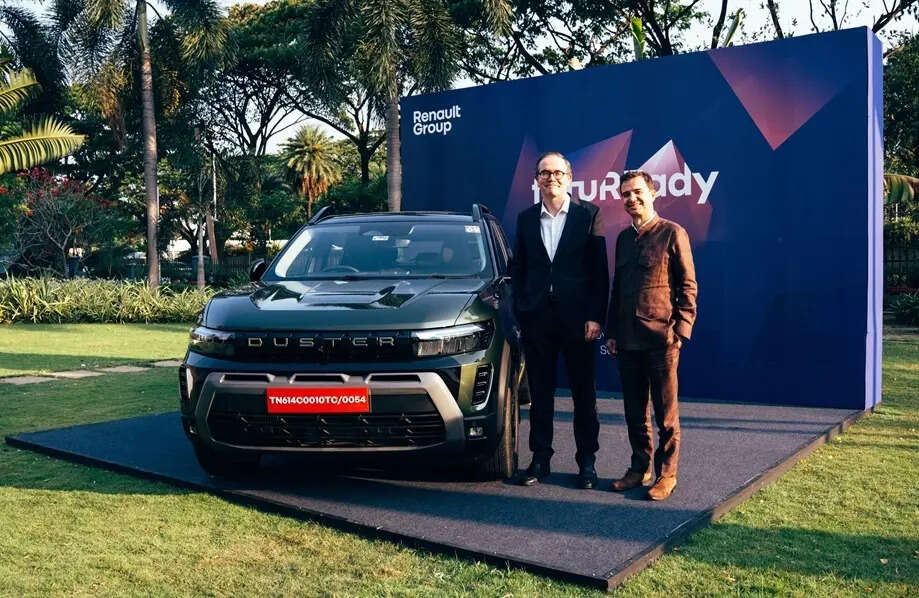
 Francois Provost, CEO, Renault Group and Stephane Deblaise, CEO Renault Group posing with newly launched Renault Duster at the unveil of futuREady India strategy
New Delhi: Renault Group on Thursday reported a strong start to 2026 with consolidated revenue rising 7.3 per cent year-on-year to €12.53 billion in the first quarter, driven by growth across its Automotive division and Mobilize Financial Services (MFS).
The French automaker said revenue growth stood at 8.8 per cent at constant exchange rates compared with Q1 2025.
Renault’s Automotive revenue increased 6.5 per cent to €10.81 billion, while MFS revenue rose 13.0 per cent to €1.72 billion, reflecting stronger financing activity.
The company did not disclose quarterly profit after tax (PAT) or profit before tax (PBT) figures in its Q1 sales and revenue update.
Vehicle sales dip due to Dacia disruption
Renault Group recorded global sales of 546,183 vehicles in Q1 2026, down 3.3 per cent from a year earlier. The decline was attributed to one-off disruptions at Dacia, caused by severe weather conditions that impacted logistics and production.
Dacia sales fell 16.3 per cent to 145,335 units, though the company said volumes began recovering in March with 1.9 per cent growth in Europe. Renault added that Dacia continues to benefit from a strong order book, supported by double-digit order intake growth so far this year.
In contrast, the Renault brand posted a 2.2 per cent rise in sales to 397,602 units, supported by growth in electrified vehicles and the availability of its full light commercial vehicle (LCV) range. Renault’s LCV sales rose 15.1 per cent in Europe, helping the brand move up one position to become Europe’s second-largest player in the passenger car and LCV combined category.
Alpine recorded the strongest growth, with sales rising 54.7 per cent, largely driven by the A290.
Electrified mix crosses 50% in Europe
Renault said electrified vehicle sales in Europe grew 12.0 per cent year-on-year in Q1 2026, taking the electrified mix to 52.3 per cent of total group sales in the region, up 9.1 percentage points.
Battery electric vehicle (EV) sales rose 20.9 per cent and accounted for 17.0 per cent of group sales in the quarter, supported by models such as the Renault 5 E-Tech electric, Renault 4 E-Tech electric, and Scenic E-Tech electric, along with the Dacia Spring and Alpine A290.
Hybrid electric vehicle (HEV) sales accounted for 35.3 per cent of group sales, up 5.1 percentage points, driven largely by Dacia, supported by the Duster and Bigster.
Order book strengthens, outlook maintained
Renault said its European order book improved to around two months of forward sales, compared with 1.5 months at the end of December 2025, supported by double-digit order intake growth since the beginning of the year.
Despite macroeconomic uncertainty, the company confirmed its 2026 guidance, targeting a group operating margin of around 5.5 per cent of revenue, with a stronger second half performance, and automotive free cash flow of around €1.0 billion.
Renault added that cost reduction remains a key priority and said it is taking additional measures to mitigate the potential impact of the Middle East crisis on raw materials, energy and logistics costs.
The company said it will continue its product rollout in 2026, including the new Renault Clio, Renault Twingo E-Tech electric, a new A-segment electric Dacia model, Dacia Striker, and Alpine A390 in Europe.