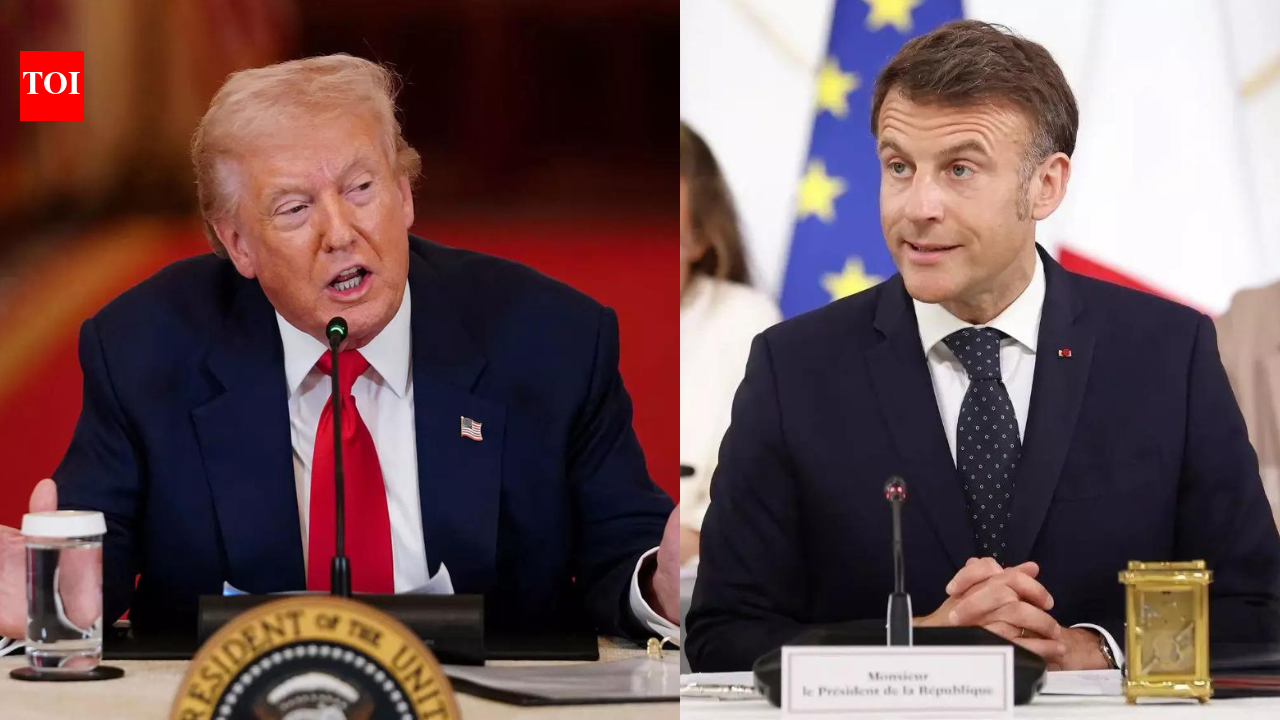

French president Emmanuel Macron on Thursday criticised US President Donald Trump for what he described as inconsistent positions on the Iran conflict, saying “you can’t contradict yourself every day” while dismissing any military attempt to reopen the Strait of Hormuz as “unrealistic”.Speaking during a visit to South Korea, Macron said proposals, “sometimes expressed by the United States”, to militarily secure the strategic waterway were not viable.
“It is unrealistic because it would take an inordinate amount of time and would expose anyone crossing the strait to coastal threats,” he said, pointing to risks from Iran’s Revolutionary Guards and missile capabilities. He added that any resolution required “a ceasefire and a resumption of negotiations” with Iran, according to AFP. The Strait of Hormuz, a critical global oil shipping route, has remained severely disrupted amid the ongoing Middle East conflict.Macron also took a direct swipe at Trump’s messaging on the war. “You have to be serious. When you want to be serious, you don’t say the opposite every day of what you said the day before. And perhaps you shouldn’t talk every day,” he said. His remarks come amid growing divergence among Western allies. The United Kingdom has distanced itself from the conflict, with prime minister Keir Starmer stating that “Iran is not our war,” while France has ruled out participation.
Trump’s shifting stance on Iran war
Since the start of US-led military operations, Trump has made varying statements on strategy, allies, and escalation, drawing scrutiny both domestically and internationally.
Allies vs going solo
Trump has alternated between calling for international support and asserting US self-sufficiency. He urged NATO and other countries dependent on Middle Eastern oil to help secure the Strait of Hormuz, saying they “should be jumping to help us.” Yet, almost in the same breath, he added: “We don’t need anybody… we have the strongest military.”
NATO criticism
Even as he sought support, Trump criticised NATO, calling it a “paper tiger” and stating that a potential US exit from the alliance was now “beyond reconsideration,” raising further questions about policy coherence.
On military escalation
Trump threatened to “obliterate” Iran’s energy infrastructure if Tehran did not reopen the Strait of Hormuz within 48 hours. However, he quickly walked back the timeline, first delaying action by five days and then extending it further, citing ongoing negotiations.
On war objectives
His messaging has also shifted on broader goals, from pushing for aggressive intervention and control of the Strait to Hormuz,to signaling that the conflict could end without securing the waterway, creating uncertainty about US strategic priorities.Mixed messaging on escalation: Trump has alternated between calls for aggressive action and signals of restraint, including indicating openness to ending the conflict without reopening the Strait.
Global and domestic reactions
Trump’s statements have drawn varying reactions globally, with several countries, including European nations, China, and South Korea, showing reluctance to join US efforts in the region.In the US, analysts and political figures have raised concerns over policy consistency. A Pew Research survey found that 61% of Americans disapprove of Trump’s handling of the Iran conflict.The President’s approach has also triggered criticism on social media, where the term “TACO” (“Trump Always Chickens Out”) has circulated in reference to perceived reversals in policy positions.(With inputs from agencies)