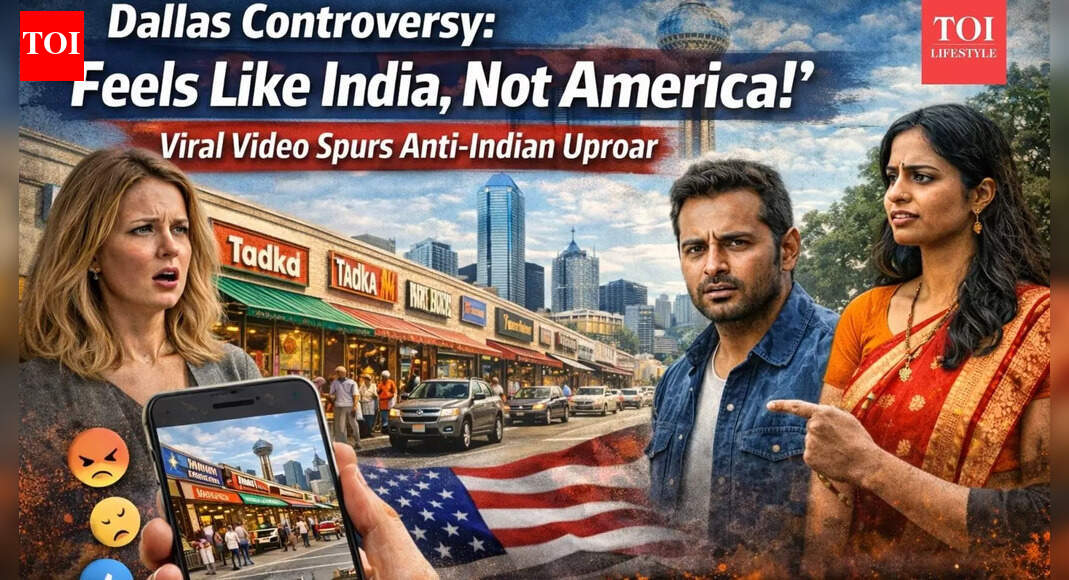

‘This Isn’t America Anymore’: Viral Dallas Video Sparks Racism Against Indian Communities in US
A seemingly off-hand social media video sparked a broader and highly charged conversation about race, immigration and identity after Turning Point USA affiliate and influencer Kambree (@KamVTV) shared a viral clip on X (formerly Twitter), claiming that parts of Dallas–Fort Worth, Texas, no longer feel like America and instead likened the area to “India” due to its visible Indian community and businesses. The video, originally tweeted by content creator Wall Street Apes (@WallStreetApes), shows a street lined with Indian grocery stores and eateries and includes the caption, “Americans in Dallas, Texas say they aren’t in Texas anymore, “We’re in India” This is actually wild, we are losing our country “Dallas Texas is the most Indian place in America” (sic).”In her repost, Kambree wrote “It’s not just Dallas, it’s the ENTIRE DFW area. This started 16 years ago.” amplifying a hostile narrative towards Indian-American communities. The incident went viral and many viewers reacted with overt dislike or resentment towards Indians, hinting at a wider normalisation of anti-Indian sentiment in the United States.
The viral video that started it all
The clip that Kambree amplified first went viral on Instagram late in 2025 when influencer Pigeon Vizion (Harry) toured a stretch of Dallas featuring businesses like India Cash and Carry, Urban Tadka and Pakoda Indian Eatery. In the footage, a friend quips “We just came from Mexico and now we’re in India,” as they pan past the Indian establishments. This portrayal, depicting a multicultural neighbourhood through an exaggerated lens, immediately generated attention and a flood of reactions from across social media. What may begin as viral geographic commentary can quickly morph into something more dangerous when framed in alarmist, “losing our country” language. That framing plays into narratives that have grown more visible on platforms like X, where analyses show a sharp increase in anti-Indian rhetoric and racist framing over recent years.A think-tank report found that hundreds of high-engagement posts portraying Indians as invaders, job thieves or cultural outsiders collectively garnered hundreds of millions of views, indicating how these narratives can spread rapidly online. This trend does not exist in isolation. Long-time residents of US communities with growing Indian populations have shared widespread anecdotal evidence of racist messages, mocking accents and stereotyping in schools and public settings. It is a phenomenon that reflects deeper biases forming in certain pockets of American society.
2025: A year when, some say, America normalised anti-India hate
The rising negative reactions to Indian-linked content like the Dallas clip, mirror broader shifts. What was once subtle xenophobia with jokes about accents or outsourcing, has in some quarters grown into overt hostility, expressed both online and offline. Incidents like protests against a Hanuman statue in Texas, when demonstrators denounced Hindu symbols as illegitimate, are examples of how visibility of Indian culture triggered some Americans’ discomfort. This discomfort, the analysts argue, is partly rooted in anxieties over assimilation, cultural change and demographic shifts.
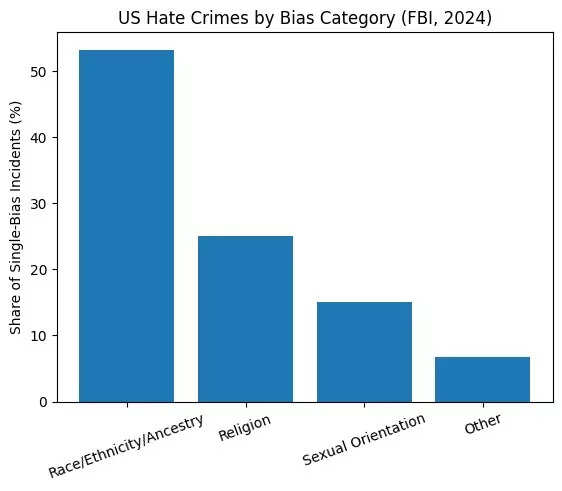
Race- and ethnicity-based bias remains the dominant motivation behind US hate crimes, according to FBI Hate Crime Statistics (2024).
These patterns raise questions about who is seen as fully “American”. Whereas earlier generations of Indian immigrants were often viewed through the “model minority” stereotype of being quiet, hardworking and contributing without challenging cultural norms. Later waves that are more visible in tech, business and public life are eliciting more public debate and, in some cases, resentment. Since Kambree’s tweet, comment sections across social platforms have shown a stark reality.
Rising Anti-Indian voices, racism and community responses
The comments section echoed sentiments similar to the original repost, framing cultural visibility as a form of threat or loss and expressing discomfort with the idea that parts of America can have an unmistakably Indian character. These reactions often dovetail with broader anti-immigrant rhetoric, where communities of colour, especially those seen as economically successful or culturally distinct, become targets of subconscious or overt resentment.
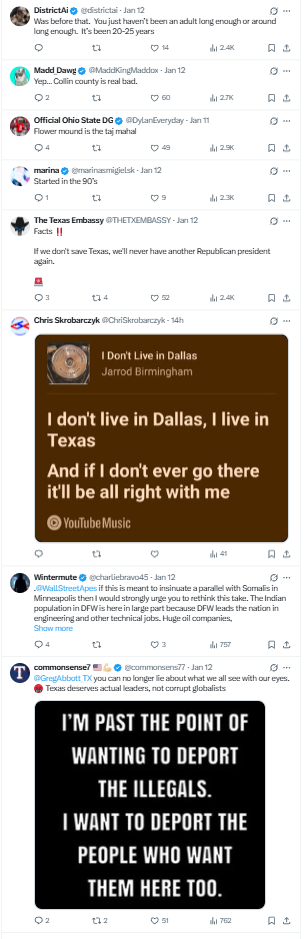
Comments sections normalising “too many Indians” rhetoric.
It is no secret that social media has a role in amplifying division. Researchers tracking trends on X and elsewhere have noted how anti-Indian rhetoric has gained traction alongside discussions about immigration and jobs. Between mid-2025 and late 2025, hundreds of high-engagement posts cast Indians in hostile terms. This shift indicates how online ecosystems can normalise xenophobic tropes when left unchecked.Hate-speech observers have also documented spikes in narratives framing Indians as demographic threats or cultural outsiders, blending resentment over legal immigration with economic anxieties about jobs and visas. This kind of content can bleed into real-world behaviour, creating an environment where subtle prejudice becomes more acceptable public dialogue within a larger context of racialised fear, socio-economic scapegoating and the fight for equal belonging in America. This dynamic, historically seen with earlier immigrant waves, now plays out online in ways amplified far beyond local neighbourhoods.The viral Dallas video incident is not just about food markets or neighbourhood signs, it taps into deep questions about American identity and inclusion. Is cultural visibility a sign of decline to be feared or a natural outcome of global migration and cultural exchange? Does increased diversity strengthen society or make some feel displaced?
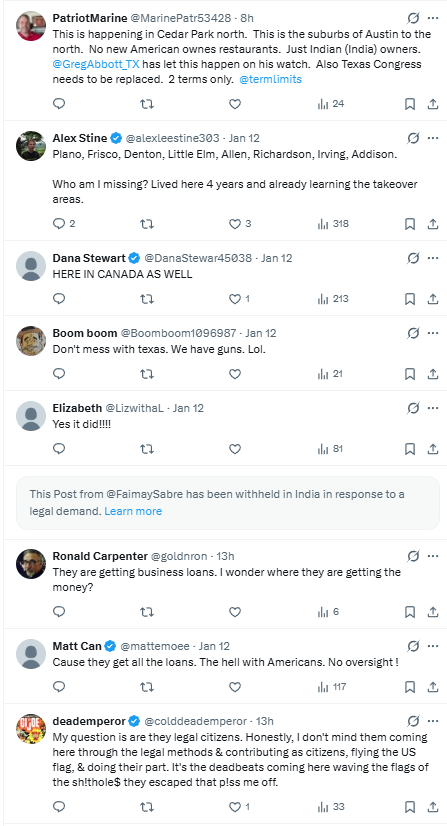
Comments sections normalising “too many Indians” rhetoric.
For many Indian Americans, the answer is straightforward: cultural diversity is a source of pride and enrichment, not a threat. Yet the reactions to Kambree’s repost show that when narratives of loss and fear intersect with race and immigration debates, especially on social media platforms, they can quickly become toxic, shaping perceptions across audiences who may never meet real members of the communities being discussed.Data from 2025 suggests that the people of Indian descent represent one of the fastest-growing Asian populations in the United States, with an estimated 5.2 million Indians and Indian-Americans nationwide. This demographic growth has supported a corresponding rise in Indian businesses, cultural centres and neighbourhood hubs in cities like Dallas, New York and Fremont, California. These communities often serve not only as commercial centres but as social and cultural anchors, offering food, goods and services that resonate with both locals and visitors.As per the Center for the Study of Organized Hate Report, between July–September 2025, just 680 high-engagement anti-Indian posts on X amassed 281 million views, showing how online racism can spread widely. The peak occurred in August 2025, with 381 posts generating nearly 190 million views, a dramatic spike compared with earlier months.
| Month | Estimated Views of Anti-Indian Racist Posts |
|---|---|
| July 2025 | ~20 million |
| August 2025 | ~190 million |
| September 2025 | ~71 million |
Platforms like X and Instagram accelerate how quickly content can go viral and how swiftly it can be interpreted through different lenses. A relatively light-hearted clip about local businesses can be repurposed with politically charged commentary and reach audiences far beyond its original context. This dynamic underscores how influencers, whether political or cultural, can amplify narratives that feed into broader debates about identity, belonging and national character.Sociologists and demographers often frame neighbourhood changes like those in Dallas as a part of normal urban evolution, driven by migration patterns, economic opportunity and cultural clustering. “These spaces don’t represent replacement or loss, they represent growth and the layering of identities that have defined urban America for over a century,” one scholar told The Atlantic in a broader discussion of diaspora neighbourhoods (commentary not directly about Dallas). Such perspectives suggest that reactions rooted in fear often reflect deeper anxieties over globalisation and economic change, rather than the lived experiences of multicultural communities.The Kambree/TPrUSA episode illustrates how politically affiliated influencers can transform innocuous cultural clips into politically charged statements that attract tens of thousands of views and rapid debate. Whether the intent is cultural commentary, humour or provocation, the effect is often the same:
- Rapid spread across platforms
- Polarised reactions
- Debates over identity, immigration and demographics
The virality of such content underlines the importance of contextual understanding, especially when discussing community presence, diversity and demographic patterns in media. It also highlights how quickly digital narratives can shift from celebration to conflict, depending on who retweets, captions or frames the original content.
Bottom line: Controversy reflects broader struggles over belonging
A viral video showing Indian restaurants and shops in Dallas sparked national attention after a political influencer recast it as evidence of the US “losing its country,” triggering debate on cultural identity and immigration. Such framing fuels unnecessary anxiety and reinforces divisive stereotypes, even as demographic shifts reflect broader and long-term patterns of migration and settlement across the United States.The reactions to the Dallas clip and Kambree’s framing reflects a larger debate in the US about race, immigration and identity, one that critics warn has seen anti-Indian sentiment more openly conveyed and monetised on social media. It also highlights the importance of context, empathy and critical engagement when discussing cultural change. As demographic trends continue to evolve, Americans and social media platforms alike face the challenge of balancing free expression with responsible discourse that honours both diversity and dignity. Go to Source