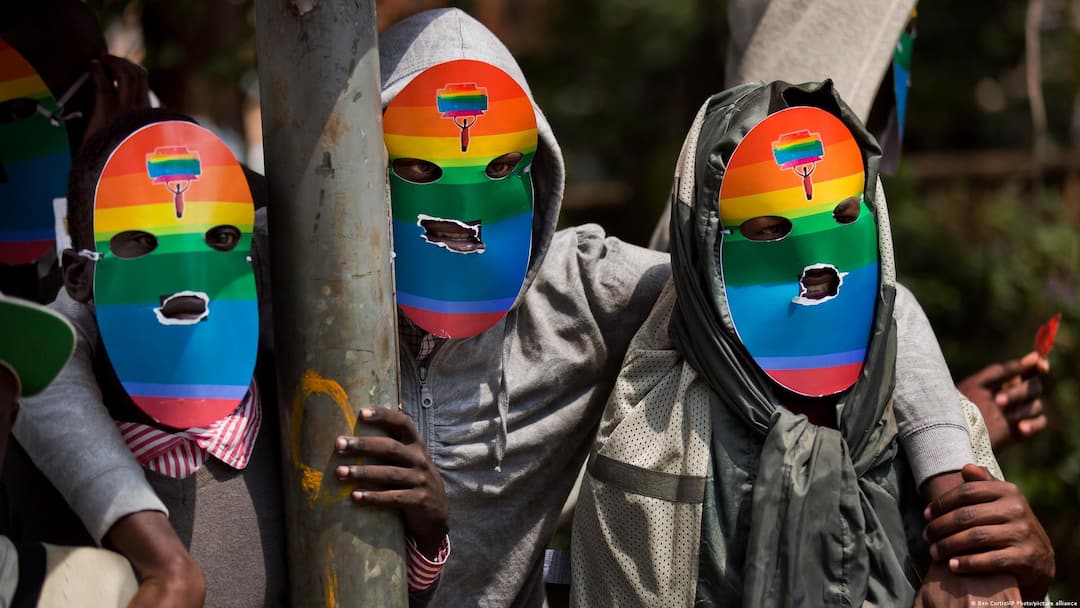

- Kenyan LGBTQ+ groups face severe US funding cuts.
- Cuts forced staff layoffs, reduced vital health services.
- Organizations, communities show resilience, seeking new models.
Edited by: Chrispin Mwakideu
As Pride Month is marked around the world, LGBTQ+ organizations in Kenya are facing one of their toughest periods in years after major US funding cuts disrupted services many in the community depend on.
John Mathenge, director of Health Options for Young Men on HIV/AIDS/STIs (HOYMAS), told DW that the organization runs three facilities in Nairobi (the Kenyan capital), Kajiado (Rift Valley) and Nyeri (Central Kenya).
These centers serve LGBTQ+ people and other key populations, including men who have sex with men (MSM), sex workers, people who inject drugs and transgender individuals. “Pride means a lot to all of us as LGBTI persons in Kenya and globally, and Pride month is a month that we should always be proud of ourselves, but so far we are not because of the funding cuts from USAID,” Mathenge said.
The disruption followed stop-work orders issued by partners in response to US funding cuts.
“You can imagine, in Nairobi, we had almost 25 staff and 110 volunteers, and we had to lay them off, all of them,” he said. Mathenge estimates HOYMAS lost more than half of its funding. “We [are] actually currently working on a small budget. I think we lost almost like 60% of the funding that we used to get from different partners,” he said.
Mathenge says maintaining services has required difficult compromises but stressed that limited support from Kenya’s Social Health Authority has helped.
“The small money we get for primary health care is what we pay our clinicians, like three volunteers, to make sure that the small, small money we also procure some drugs,” Mathenge said.
Still, outreach, healthcare worker training, violence reporting and peer educator programs have been severely reduced.
“Actually, it affected me mentally, seeing that communities, the peer-educated volunteers, cannot even access even the small, small funding that they used to get, some of our staff are now on the streets,” he said.
Keeping clinics in Kenya open despite deep cuts
Unlike some groups that scaled back or shut down, HOYMAS decided to keep operating.
“The facilities are still open. We haven’t closed any facilities, and we tried to do our resource mobilization from individual philanthropies in Kenya to make sure that our community can access services,” Mathenge added.
For Kevin, a university student in Nairobi, the impact was immediate. “In the past, I relied on community organizations for counseling sessions, health information and access to condoms. Since funding cuts began affecting some programs, those services have become less frequent and sometimes harder to access,” he told DW.
“There have been periods when supplies ran low, forcing people to look elsewhere or go without resources they had previously relied on.” Yet he stresses the community’s resilience.
“People see the funding cuts and assume everything stops. It doesn’t. We still fall in love, go to work, pay rent and look after one another. We’re still here, still queer and still moving forward. The funding may have shrunk, but our lives didn’t stop when the grants did. If anything, we’ve learned that resilience is not something donors give us; it’s something we’ve always had.”
Beyond healthcare: trust, safety and everyday life
For many, the impact goes far beyond medical services. Sharon, a resident of Nairobi, says community organizations provide safety and dignity, which are often missing elsewhere.
“One of the biggest changes I have noticed is that access to healthcare support has become more difficult. Like many LGBTQ+ people, I often felt more comfortable seeking services through community organizations because they understood our experiences and treated us with dignity,” she said.
“As funding constraints have affected some programs, it has become harder to access certain services and referrals.” Fear of stigma and discrimination remains a barrier in mainstream healthcare.
“Many people assume you can simply walk into any hospital, but that is not always the reality. Some people fear discrimination or judgment when seeking treatment, which is why community-based support has been so important,” Sharon added.
Her perspective also highlighted the ordinariness of LGBTQ+ persons. “I have a girlfriend, and at the end of the day, our relationship looks a lot less dramatic than people imagine. We argue about money, complain about work, decide what to eat for dinner, and worry about the future like any other couple,” she said.
“The funny thing is that some people are outraged by the fact that I love another woman, but have no problem with me being denied services that help keep me healthy and informed. That has never made sense to me.”
Scrambling for solutions and sustainability
Mathenge warns that service gaps are widening, especially in HIV prevention. “I do a lot of advocacy with the government to make sure that the little drugs they have in government facilities, I actually borrow to make sure that our clinics start running and to make sure that we sustain our clinics,” he said.
The crisis has also prompted calls for new funding models. Mercy, an entrepreneur in Nairobi, says business support programs have declined. “For people trying to become financially independent, those programs made a real difference,” she told DW.
“I have had to rely more on social media and word-of-mouth marketing to grow my business. At the same time, I think this is an opportunity for organizations to focus more on economic empowerment projects that can help people generate their own income rather than depend entirely on donor-funded programs.”
Mathenge agrees. “For me, I will appeal, and I will tell the donors who want to fund the community. Please fund community-led organizations. Community makes a difference,” he said, advocating for income-generating initiatives.
“We fund community income-generating activity, so that even if tomorrow we have no funding, we also have something that, where we’ll be getting the money, like an income-generating activity, which goes back to the community,” he said.
He is also seeking support beyond traditional US donors.
“We [are] also appealing to other partners in different countries, where people promote human rights, like in Europe and in other countries, where people know we are human beings and we cannot be left. You know, leave no one behind,” he said.
For many, the future depends on diversifying support. “I do not think the answer is simply waiting for donors to return,” Sharon said. “Community organizations, government institutions and private companies all have a role to play. If support services are left entirely to foreign donors, people become vulnerable whenever funding priorities change.”
Months after losing most of their funding, organizations like HOYMAS remain open. The grants may have shrunk, but for Kenya’s LGBTQ+ community, the resolve to endure remains strong.
(Disclaimer: This report first appeared on Deutsche Welle, and has been republished on ABP Live as part of a special arrangement. Apart from the headline, no changes have been made in the report by ABP Live. for DW)