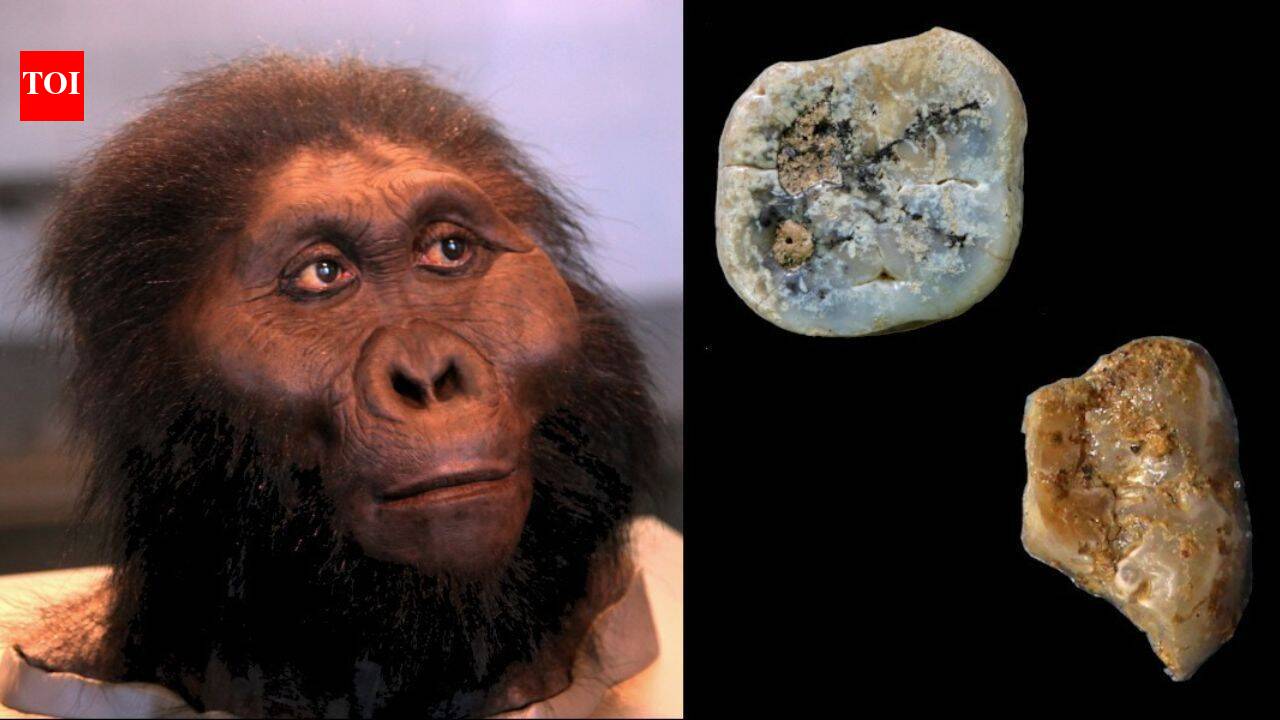

pc: Natural History of Museum ( Teeth image © S.E.Bailey, Homa Peninsula Paleoanthropology Project and model image ©)
For much of the last century, the story of early technology seemed straightforward. The genus Homo made stone tools, and their appearance marked a turning point on the path that eventually led to modern humans. The idea was so deeply embedded in human origins research that even Homo habilis was named for its presumed tool-making skill. Yet the fossil record has a habit of unsettling neat narratives.Across eastern and southern Africa, another branch of the human family lived for well over a million years. Known as Paranthropus, these robust hominins possessed enormous molars, powerful jaws and relatively small brains. They have often been portrayed as evolutionary specialists adapted to chewing tough foods while their more versatile relatives experimented with technology. Recent discoveries are making that distinction harder to maintain. A growing body of evidence suggests that Paranthropus may not have been standing on the sidelines during the earliest chapters of human innovation.
Paranthropus: Powerful-jawed human cousins of ancient Africa
According to a 2023 study published in the journal Science, titled “Expanded geographic distribution and dietary strategies of the earliest Oldowan hominins and Paranthropus”, Paranthropus first appeared in Africa around 2.7 million years ago and survived until roughly 1.2 million years ago. During that long span, at least three species occupied different parts of the continent: Paranthropus robustus in southern Africa, Paranthropus boisei in eastern Africa and the older Paranthropus aethiopicus, often considered a possible ancestral form.Their appearance was unmistakable. Large cheekbones, broad faces and heavily built jaws gave them a very different look from other early hominins. Thick enamel covered teeth that were considerably larger than those of modern humans, reflecting an ability to process hard or abrasive foods.For decades, these anatomical features encouraged researchers to view Paranthropus as a dietary specialist. The common image was of a hominin adapted to cracking nuts and chewing tough vegetation while more flexible relatives expanded into new ecological niches. That interpretation has gradually become less certain. Studies of tooth wear and chemical signatures preserved in fossil teeth point to diets that varied across environments, suggesting a level of adaptability that was not always recognised.Their longevity alone hints at a successful strategy. Paranthropus persisted for around one and a half million years, sharing African landscapes with several Australopithecus and Homo species. They were not a brief evolutionary experiment. They were among the dominant hominins of their time.
Nyayanga fossils and the mystery of the first toolmakers
The connection between stone tools and Homo has long seemed self-evident. Oldowan technology, characterised by simple flakes and stone cores, represents the earliest widespread tool tradition known in the archaeological record. For many years these tools were assumed to be the handiwork of early members of our own genus. That assumption has become increasingly difficult to defend.According to the study, researchers working at Nyayanga in Kenya uncovered some of the oldest known Oldowan tools alongside fossil remains attributed to Paranthropus. The site dates to between roughly 3 and 2.6 million years ago and contains evidence that stone tools were used to process both plant material and animal carcasses, including hippopotamuses.The study does not prove that Paranthropus manufactured the tools. Early Homo species were also present elsewhere in eastern Africa at the time. Yet the association is difficult to ignore. One Paranthropus tooth was recovered from the same archaeological context as stone tools and butchered animal remains, placing these robust hominins directly within an environment where tool-assisted food processing was taking place. As the authors noted, the evidence raises the possibility that Paranthropus either made or used stone tools during this early period.
How ancient tool use is reshaping human evolution
Part of the reluctance to connect Paranthropus with technology stems from old assumptions about intelligence. Their brains were relatively small, closer in size to those of modern chimpanzees than to those of humans. For many years, larger brains were treated as a prerequisite for technological behaviour. The archaeological record is beginning to complicate that picture.According to the study, the Nyayanga discoveries indicate that tool users were processing a surprisingly broad range of resources. Stone implements appear to have been used for cutting meat, accessing marrow and working plant materials. Wear patterns preserved on the tools suggest repeated and varied use rather than occasional experimentation.If Paranthropus was involved in these activities, it would suggest that technological behaviour emerged within a more diverse group of hominins than previously imagined. Innovation may not have been the exclusive property of Homo. Instead, several closely related lineages could have been exploring similar solutions to the challenges of survival.This possibility fits an increasingly complex view of human evolution. Rather than a simple progression from one species to another, Africa during the late Pliocene appears to have been home to multiple hominin groups occupying overlapping territories and perhaps sharing behavioural traits.
Ancient hominin rewriting assumptions about human evolution
The image of Paranthropus as an evolutionary dead end is becoming harder to sustain. Fossil discoveries continue to expand both its geographic range and its ecological significance. A recent study published in Nature described a 2.6-million-year-old Paranthropus jawbone from Ethiopia’s Afar region, extending the known range of the genus hundreds of kilometres farther north than previously documented. The researchers argued that the find points to a more adaptable and widespread hominin than earlier interpretations suggested. Taken together, these discoveries paint a picture of a genus that was neither rare nor narrowly specialised. Paranthropus occupied diverse environments, persisted for an exceptionally long period and may have participated in technological behaviours once considered unique to our own lineage.Whether they were the actual makers of the earliest Oldowan tools remains unresolved. The evidence is suggestive rather than definitive. Even so, the question itself marks a significant shift in thinking. The first chapters of technology may not belong exclusively to Homo after all. Instead, the origins of toolmaking may lie within a wider community of ancient relatives whose stories are only now beginning to emerge from the African fossil record. Go to Source