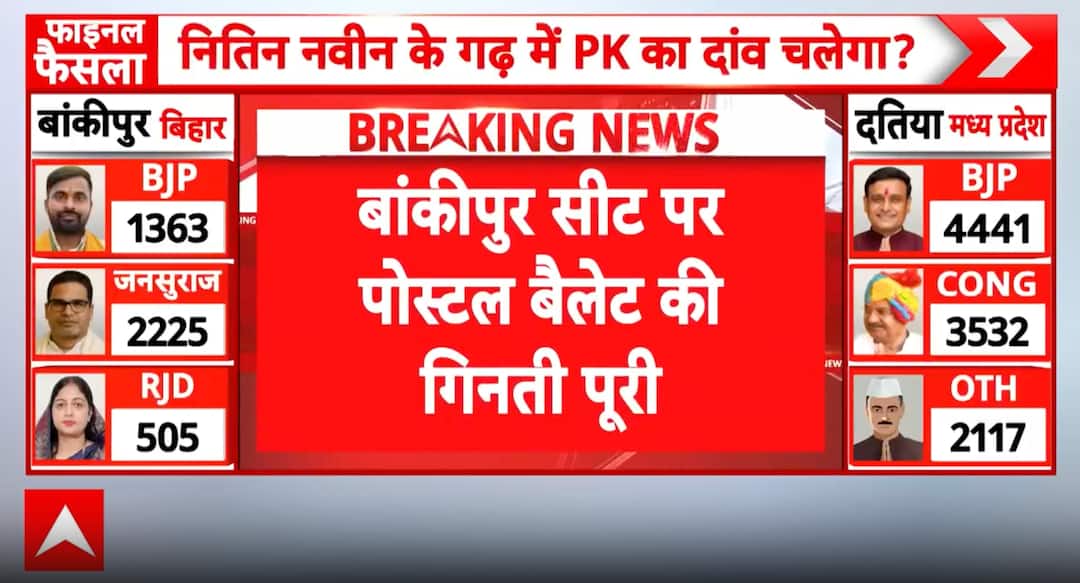
The Bankipur Assembly bypoll in Bihar has thrown up a major political surprise, with Jan Suraaj Party founder Prashant Kishor on the verge of defeating BJP candidate Neeraj Kumar Sinha in a constituency that has long been considered a BJP stronghold. What has drawn particular attention is Kishor’s vote share, which is hovering around 50%, a rare feat in Bihar’s electoral politics.
What Do The Latest Trends Show?
According to Election Commission data, counting has progressed through six of the 31 rounds. Prashant Kishor has secured 11,603 votes, translating to 49.96% of the vote share, while BJP’s Neeraj Kumar Sinha has polled 8,152 votes (35.1%). RJD candidate Rekha Gupta is a distant third with 2,154 votes. Kishor has so far received more than twice as many votes as any other candidate in the contest.
Bankipur has been one of the BJP’s safest Assembly constituencies, remaining with the party continuously since 1995. The seat was first represented by Navin Kishore Prasad Sinha and later by his son, BJP national president Nitin Nabin.
The bypoll was necessitated after Nitin Nabin, who won the seat in the 2025 Assembly elections with 62.66% of the vote, resigned after being elected to the Rajya Sabha. His victory margin and vote share had made Bankipur one of the BJP’s strongest bastions in Bihar.
Why Is The 50% Vote Share Significant?
Crossing the 50% vote-share mark is uncommon in Bihar elections and is widely seen as a sign of a decisive public mandate. In the 2025 Bihar Assembly elections, only eight candidates managed to secure more than 50% of the votes in their constituencies. They included:
- Nitin Nabin (BJP), Bankipur – 62.66%
- Narendra Narayan Yadav (JD(U)), Alamnagar – 53.98%
- Jayant Raj (JD(U)), Amarpur – 53.51%
- Jitendra Kumar (JD(U)), Asthawan – 52.13%
- Romit Kumar (Independent), Atri – 51.66%
- Sanjay Singh ‘Tiger’ (BJP), Arrah – 50.98%
- Maithili Thakur (BJP), Alinagar – 50.43%
- Rama Nishad (BJP), Aurai – 50.06%
The figures underline how unusual it is for a candidate to receive the backing of more than half the electorate in Bihar.
Why Is Prashant Kishor Performing Strongly?
Political observers attribute Kishor’s performance to several factors:
- Breaking into a BJP bastion: Bankipur had remained with the BJP for nearly 30 years, making the contest symbolically significant.
- Campaign centred on change: Kishor pitched the election as a vote against traditional caste-based politics, promoting a narrative of political change that appeared to resonate with urban voters.
- Impact of lower turnout: The bypoll recorded a turnout of 34.30%, down from 41.39% in the 2025 Assembly election. Jan Suraaj argued that the lower turnout reflected a “silent vote for change.”
- Inroads into upper-caste voters: Bankipur has a sizeable upper-caste electorate, traditionally considered supportive of the BJP. Kishor is believed to have attracted a section of these voters.
- Political backdrop: The election was held amid the aftermath of the anti-NEET protests and the resignation of former Union Education Minister Dharmendra Pradhan, alongside debates over law and order and caste politics in Bihar.
- Kishor’s personal profile: Known nationally as an election strategist before entering politics, Kishor has worked with several major parties. His direct entry into electoral politics has helped raise the Jan Suraaj Party’s visibility.
- A crucial electoral test: After Jan Suraaj failed to win any seats in the 2025 Assembly elections and its Bankipur candidate polled less than 5% of the vote, Kishor chose to contest the bypoll himself, making it a high-stakes battle for the party.
Why The Result Matters
The Bankipur bypoll is significant for three reasons. First, it could end the BJP’s uninterrupted 30-year hold over the constituency. Second, Prashant Kishor is on course to secure nearly 50% of the vote, a benchmark achieved by very few candidates in Bihar. Finally, the outcome could reshape Bihar’s political narrative ahead of the next Assembly elections by establishing Jan Suraaj as a more formidable electoral force.