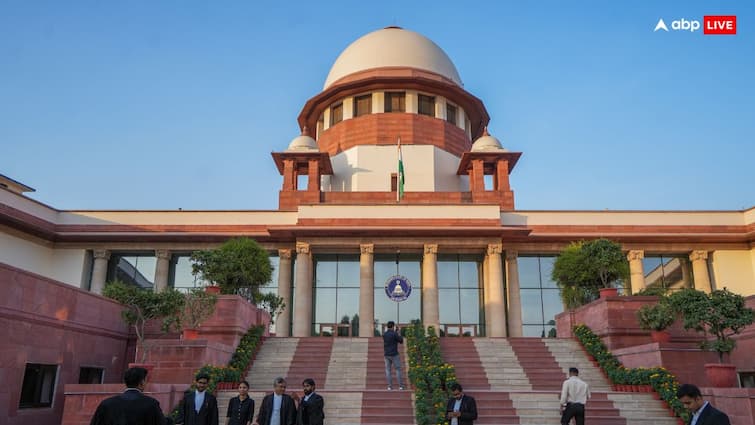

New Delhi, Aug 26 (PTI) The Maharashtra government on Tuesday argued in the Supreme Court that courts couldn’t accord assent to bills passed by state assemblies as the power vested only in governors or President.
Senior advocate Harish Salve, representing Maharashtra, made the submissions before a five-judge Constitution bench headed by Chief Justice B R Gavai.
He was appearing in the hearing over the presidential reference on whether the court could impose timelines for governors and President to deal with bills passed by state assemblies.
“The court cannot issue a writ of mandamus asking the governors to grant assent to bills… Assent to a law cannot be given by the court. Assent to a law has to be given either by governors or by President,” Salve submitted before the bench, also comprising Justices Surya Kant, Vikram Nath, P S Narasimha and A S Chandurkar.
A bench-led by Justice J B Pardiwala invoked apex court’s power under Article 142 to grant assent to Tamil Nadu bills.
Referring to Article 361 of the Constitution, Salve said President, or Governor “shall not be answerable to any court for the exercise and performance of the powers and duties of his office or for any act done or purporting to be done by him in the exercise and performance of those powers and duties”.
He said the court could only inquire into decisions, including the proposed ones, by governors or President.
“The court can only ask what your decision is. But the court cannot ask why you have taken a decision,” Salve added.
Distinguishing the powers of President and governors, he said while the former acts only on the aid and advice of the central government, the latter possesses wider powers, including the authority to withhold assent.
“It is not a feature of Indian federalism that an assent must follow after a few rounds of confabulations. We have a limited federalism with hope that all these functionaries will act with wisdom,” he said.
He said Governor’s power was not amenable to judicial review.
Referring to Article 200, which deals with the powers of governors with regard to bills, Salve said this provision does not set out a time limit under which the Governor has to act.
He said the passage of bills were also based on political deliberations and at times such a process might take 15 days and at times, six months.
Such decisions are not taken by sitting in an ivory tower, he added.
Salve said once constitutional schemes delineate the power, their exercise by high constitutional functionaries was not amenable to judicial review.
He said the language of Article 361 — governors and President shall not be answerable to any court any exercise of powers and dutie — was “very clear”.
“If the court accepts the position of existence of power to withhold assent, then the court cannot ask as to why he withheld assent.” Salve continued, “Without making the Governor answerable, there is no test to examine the correctness of withholding (assent to a bill) and that means, the inability on the part of the court to examine.” Governor’s authority to withhold assent is constitutionally recognised, though using the term “veto” would be misleading, he added.
“Calling it veto is an uncharitable characterisation… but yes, Governor has the power to withhold. It is inherent in Article 200, and consistent with Article 201 which allows the Union to withhold assent even if the bill is within the state List,” Salve said.
When Justice Narasimha said under Salve’s reading even a money bill could be withheld at the threshold.
“Yes, because once a bill has undergone amendments on the floor of the house, the Governor may still withhold assent. I am only on the existence of the power, not how it is used,” Salve said.
Senior advocate N K Kaul, appearing for Madhya Pradesh, said under Article 200, Governor had three clear choices, assent, withhold assent, or reserve the bill for President.
The proviso allowing Governor to return a bill, he argued, was a consultative mechanism, not a substantive veto.
Senior advocate Maninder Singh argued on behalf of Rajasthan.
The proceedings are underway.
Earlier the bench asked whether the judiciary would be left powerless if Governor simply refused to act.
“When the house has passed a bill, can Governor sit on it indefinitely? Suppose a bill is passed in 2020, will the court be powerless if there is no decision even in 2025,” the bench asked.
In May, President Droupadi Murmu exercised powers under Article 143(1) to know from the top court whether judicial orders could impose timelines for the exercise of discretion by the president while dealing with bills passed by state assemblies.
(This report has been published as part of the auto-generated syndicate wire feed. Apart from the headline, no editing has been done in the copy by ABP Live.)