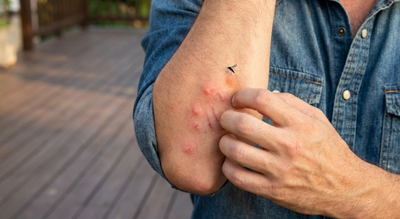
Mosquitoes target people who release more carbon dioxide, body heat and skin chemicals that signal an easy blood meal/ Representative Image
If you have ever stood outside with friends and watched mosquitoes ignore everyone else while repeatedly landing on you, the experience can feel personal. Scientists say it is not. According to decades of entomology research, mosquitoes are not random biters. They make layered decisions based on what they can see, smell, and sense once they land, and some bodies give off far more of the signals they are looking for than others.Researchers stress that no single factor explains why one person becomes a “mosquito magnet”. Instead, insects combine multiple cues, starting from a distance and narrowing their choice step by step, until they decide where to bite.
Carbon dioxide, heat and what mosquitoes notice first
Entomology professor Jonathan F. Day, who has studied mosquito behaviour for years, says the process begins before a mosquito ever gets close enough to land. The most important long-range signal is carbon dioxide, released every time a person exhales.
“The amount of CO₂ you produce, like people with high metabolic rates, genetic, other factors, increases the amount of carbon dioxide you give off,” Day explained. “The more you give off, the more attractive you are to these arthropods.”People with higher metabolic rates naturally release more carbon dioxide. Larger bodies, pregnant women and those who have been exercising also emit higher levels, making them easier for mosquitoes to locate from a distance. Mosquitoes then use sight to narrow in on a target. Day says clothing plays a role because mosquitoes fly low to avoid wind and visually contrast shapes against the horizon.“How you’re dressed matters,” he said. “If you have on dark clothes, you are going to attract more because you’ll stand out from the horizon, whereas those wearing light colours won’t as much.”Once a mosquito gets close enough to land, other signals come into play. Body heat becomes a key factor. Day describes it as a “really important tactile cue”, noting that some people naturally run warmer than others, which helps mosquitoes locate spots where blood vessels sit closer to the skin.Dermatologist Melissa Piliang of the Cleveland Clinic has also pointed out that people who have been drinking alcohol, exercising, are pregnant or overweight may be more attractive to mosquitoes because of changes in body heat, metabolism and skin chemistry.
Blood type, antigens and why the science is disputed
Beyond smell, heat and vision, scientists have also explored whether blood type plays a role. The idea centres on antigens, which are proteins found on the surface of red blood cells. These antigens differ depending on whether someone has blood type A, B, AB or O.Some people, known as “secretors”, release traces of these antigens through bodily fluids such as saliva, sweat or tears.According to Healthline, people with blood type O secrete H antigen, which is a chemical precursor to A and B antigens. Researchers suspect mosquitoes may be able to detect these substances on the skin.Several studies suggest blood type O may be particularly attractive. A 1974 study involving 102 participants reported that “mosquitoes preferentially selected hosts of blood group O”. A2004 studyfound that “blood group O subjects attracted more” mosquitoes than other blood types, although its authors added an important caveat: “ABH antigens did not, in general, influence the landing preference of mosquitoes among ABO blood groups.”Further research in 2019 observed the “highest preference” for blood group O when mosquitoes were offered feeders filled with different blood types.However, experts stress that these findings are not definitive. Pharmaceutical companyPfizer notes that the question of blood-type preference remains controversial. In its summary of existing research, Pfizer states that experimental and laboratory data have fuelled speculation but remain contradictory, adding that skin odours and microbiota, the bacteria that naturally live on human skin, may play a larger role than blood type alone.Day reinforces that point, explaining that mosquitoes rely on a combination of cues rather than one deciding factor. “These cues let them know they are going to a blood source,” he said. “Perhaps CO₂ is the most important.”With more than 3,000 mosquito species worldwide and more than 350 chemical compounds identified in human skin odours, medical entomologist Joseph Conlon, technical adviser to the American Mosquito Control Association, has said researchers have only begun to understand why mosquitoes favour certain people.For now, science suggests there is no single reason mosquitoes prefer one person over another. Instead, attraction builds from breath to clothing to chemistry, with each factor nudging the insects closer, or steering them away. Go to Source