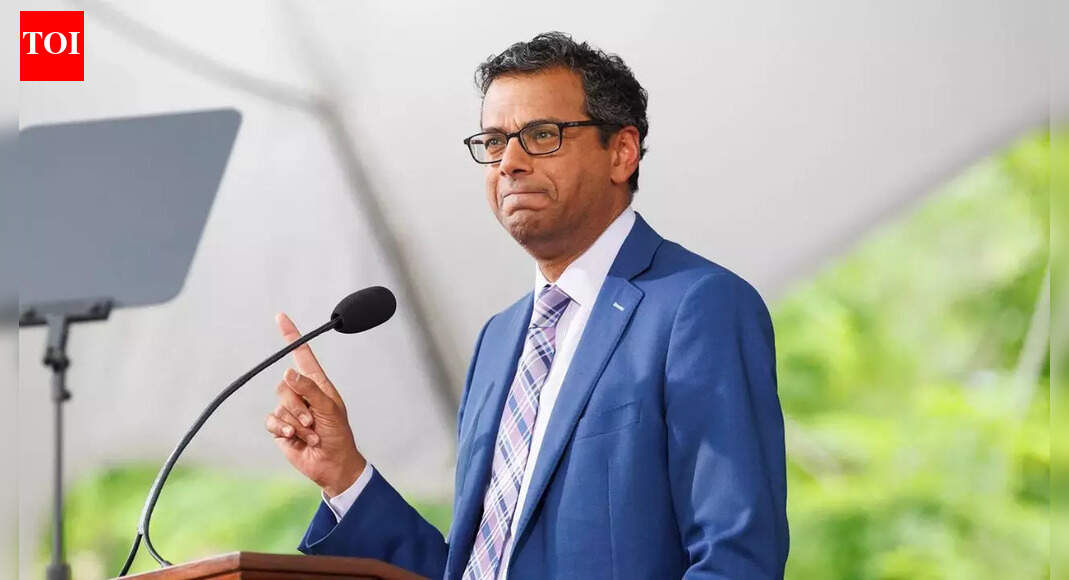


USAID was built to make survival feel ordinary. It existed so that childbirth would not be a gamble, hunger would not quietly hollow out childhoods, and outbreaks would be spotted early enough to remain footnotes rather than funerals. Its work was repetitive and procedural by design, because global health only improves when prevention becomes routine. When the system worked, no one noticed. When it stopped, the damage registered everywhere at once.Atul Gawande understood this logic long before he ever entered government. The Indian-origin surgeon and writer made his career by rejecting medicine’s addiction to heroics and insisting instead on discipline, design, and follow-through. People did not die, he argued, because solutions were missing; they died because systems failed to carry those solutions to the bedside consistently. His famous insistence on checklists, pauses, and enforced communication was not about reducing ambition but about reducing avoidable error. It was a philosophy built for scale.When Gawande was appointed assistant administrator for global health at USAID in 2022, he found himself responsible for a machine that mirrored his beliefs. The agency’s global health division spanned dozens of countries, supporting maternal and child health, infectious disease control, nutrition, and surveillance networks that could identify outbreaks like Ebola or avian flu within days. It was not a laboratory of innovation so much as a factory of follow-through, converting existing medical knowledge into predictable outcomes for people who rarely benefit from predictability.Gawande left the role in early 2025, just before Donald Trump returned to office. The dismantling that followed was swift and destabilising. USAID’s operations were frozen, staff were dismissed, and the bulk of its programmes were terminated or abandoned mid-stream. From the vantage point of Washington, this was framed as reform and reassessment. From the field, it felt like gravity being switched back on.Health systems do not fail theatrically. They erode. Vaccination schedules slip. Supply chains fracture. Outreach workers disappear. Clinics continue to exist in name long after their capacity to intervene has been stripped away. A child with moderate malnutrition becomes severely malnourished because there is no longer anyone tracking the warning signs. A mother arrives too late because the system that once pulled her forward has gone silent. Biology does not pause to negotiate with ideology.Gawande later described the result as a “devastating global health void,” a phrase that captured not shock but absence. What vanished was not just funding, but the connective tissue that allowed fragile health systems to hold. The surveillance that caught outbreaks early. The nutrition programmes that prevented irreversible decline. The institutional memory that allowed progress to accumulate instead of resetting with each political cycle.Rather than retreating into abstraction, Gawande chose to bear witness. He returned to Harvard speaking less like a former official than like a clinician describing organ failure. “It’s not just having a solution; it’s the follow-through,” he said, repeating the principle that had guided his work from operating rooms to refugee camps. He warned that while the agency itself might not be rebuilt in its original form, the scientific and human infrastructure it supported still mattered, and that losing it would not be easily reversible.This is where the story sharpens. The tragedy here is not ignorance or incompetence. It is the deliberate dismantling of a system that worked precisely because it refused to be dramatic. USAID did not save lives through spectacle or ideology. It saved them through consistency. It turned survival into a process rather than a plea.Gawande’s career has been devoted to proving that most deaths are preventable when systems are designed to absorb human fallibility. Watching those systems be broken by political choice exposes a harder truth: progress is fragile not because it is idealistic, but because it is boring, and boredom is easily mistaken for waste.The plans to save lives were already in motion. The mechanisms existed. The outcomes were measurable. What failed was not medicine, or knowledge, or intent, but the willingness to let quiet systems keep doing their work.That is not an ending. That is a warning.