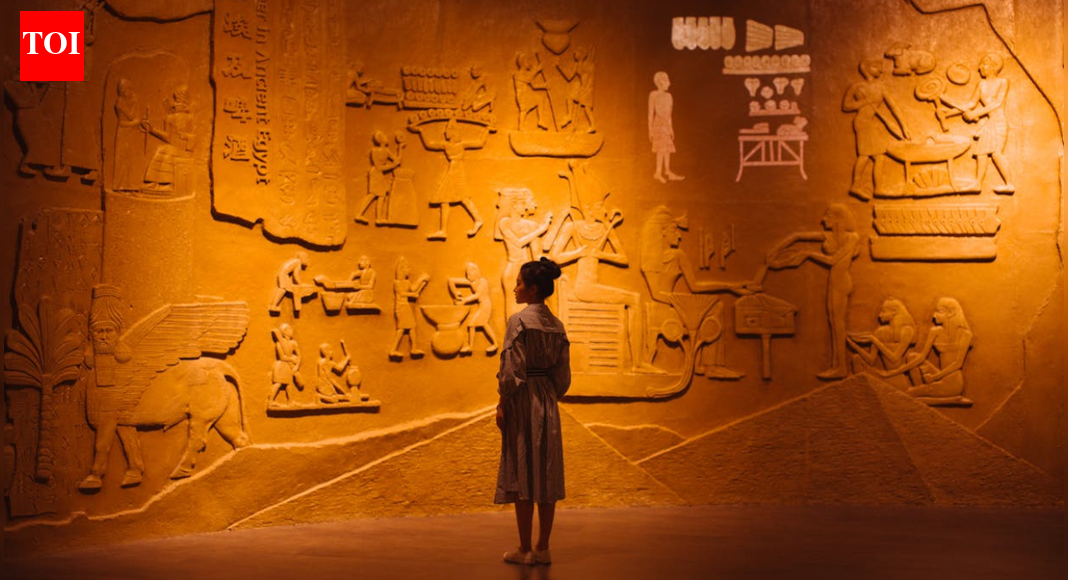

Evidence suggests Ancient Egypt’s New Kingdom began almost a century later/ Image: Pexels
For more than a century, historians have worked with a broadly agreed timeline for Ancient Egypt, anchoring its major eras to king lists, inscriptions and archaeological layers. One of the most important of those turning points is the start of the New Kingdom, the period that followed centuries of political fragmentation and went on to produce some of Egypt’s most recognisable rulers. A new scientific study now suggests that this transition happened later than long assumed. By directly comparing Egyptian artefacts with radiocarbon dates from a major volcanic eruption in the Aegean, researchers argue that the New Kingdom may have begun decades, potentially close to a century, later than traditional chronologies place it.
What historians thought before
In standard historical frameworks, the New Kingdom is dated to roughly 1550–1070 BCE. It followed the Second Intermediate Period, a time of division between rival dynasties, best known for the rule of the foreign Hyksos in northern Egypt and native Theban rulers in the south.The transition between these periods is traditionally linked to King Ahmose I (Nebpehtire Ahmose), often known as Ahmose the Great, the ruler who expelled the Hyksos and reunified Upper and Lower Egypt, establishing the 18th Dynasty. That reunification marked the start of the New Kingdom, an era that would last for nearly five centuries, from approximately 1570 to 1069 BCE, spanning the 18th, 19th and 20th Dynasties.The New Kingdom is widely regarded as Ancient Egypt’s most prosperous and powerful phase, when it emerged as an imperial state with far-reaching military, economic and cultural influence. Its best-known rulers include Hatshepsut, Thutmose III, Amenhotep III, Akhenaten and his wife Nefertiti, Tutankhamun, followed later by Seti I, Ramesses II (the Great), Merenptah, and Ramesses III. Together, these reigns shaped what is often described as the “golden age” of Egyptian imperial power and cultural achievement.One long-standing debate within this framework concerns the eruption of Thera (modern Santorini), one of the largest volcanic events in human history. Archaeologically, the eruption is securely dated to the Late Minoan IA period on Crete (c. 1700–1600 BCE), a phase associated with the height of the Neopalatial civilisation. Its placement within Egyptian history, however, has remained contested. Some historians aligned the eruption with the early 18th Dynasty, situating it during the reign of Nebpehtire Ahmose I (Ahmose the Great) or, in later interpretations, Thutmose III, the fifth pharaoh of the 18th Dynasty and a central figure of the New Kingdom. Others have argued that the eruption must predate Ahmose entirely.
What the new study examined
The new research was carried out by scholars from Ben-Gurion University of the Negev and the University of Groningen, and focuses on a period that has rarely been tested directly with radiocarbon dating: the transition from the Second Intermediate Period to the New Kingdom. Rather than relying on texts or synchronisms alone, the team analysed museum artefacts with secure historical associations. These included:
- A mudbrick from the Ahmose Temple at Abydos (British Museum)
- A linen burial cloth associated with Satdjehuty, a high-status woman from the early 18th Dynasty (British Museum)
- Wooden stick shabtis from Thebes (Petrie Museum)
Each object is historically dated to the late Second Intermediate Period or the early New Kingdom. Importantly, they are not arranged in a clear archaeological sequence, meaning common statistical tools like Bayesian modelling could not be applied. Instead, the researchers compared the uncalibrated radiocarbon dates of these Egyptian objects directly with a large, well-established set of radiocarbon dates for the Thera eruption.
What the dating shows
The result was a clear separation between the two datasets. As the study explains, “it becomes clear that the two data sets have a different time signature.” In simple terms, the volcanic eruption consistently dates earlier than the reign of Nebpehtire Ahmose, the king traditionally associated with the New Kingdom’s founding. This matters because it rules out the long-held assumption that the Thera eruption occurred at, or just after, the beginning of the New Kingdom. Instead, the eruption must predate it.Taken together, the authors argue that their radiocarbon results point to a later start for the New Kingdom than traditionally assumed. Specifically, the data support what scholars call a low chronology for the reign of Nebpehtire Ahmose I, often known as Ahmose the Great, meaning his rule, and the founding of the 18th Dynasty, began later than earlier historical reconstructions suggested.At the same time, the study reinforces a high chronology for the Middle Kingdom, drawing on earlier radiocarbon work linked to Khakaure Senusret III, the powerful fifth king of the Twelfth Dynasty. Senusret III ruled roughly four centuries before Ahmose, at the height of the Middle Kingdom’s political and military strength.The implication is that the Second Intermediate Period, which sits between Senusret III’s reign and Ahmose’s reunification of Egypt, lasted significantly longer than previously thought, reshaping how historians understand the pacing of collapse, fragmentation, and recovery in Ancient Egypt.Taken together, the data point to a longer, more drawn-out transition than previously assumed. As lead author Hendrik J. Bruins put it: “Our findings indicate that the Second Intermediate Period lasted considerably longer than traditional assessments, and the New Kingdom started later.”
Why this matters for Egyptian history
The Second Intermediate Period, dated roughly 1782–1550 BCE, has long been understood as a time of political fragmentation, military innovation and shifting power. It saw the introduction of new technologies such as the horse-drawn chariot, multiple competing capitals, and weakened central authority. If this period lasted longer than previously thought, historians must rethink how quickly Egypt recovered from collapse, how long the Hyksos ruled, and how the early New Kingdom developed its military and administrative strength. Just as importantly, the revised dating helps resolve a decades-old problem in Mediterranean archaeology: how Egyptian history lines up with Minoan, Levantine and Aegean chronologies. By placing the Thera eruption firmly before Ahmose’s reign, the study removes one of the most persistent points of chronological tension between Egypt and its neighbours. Go to Source