
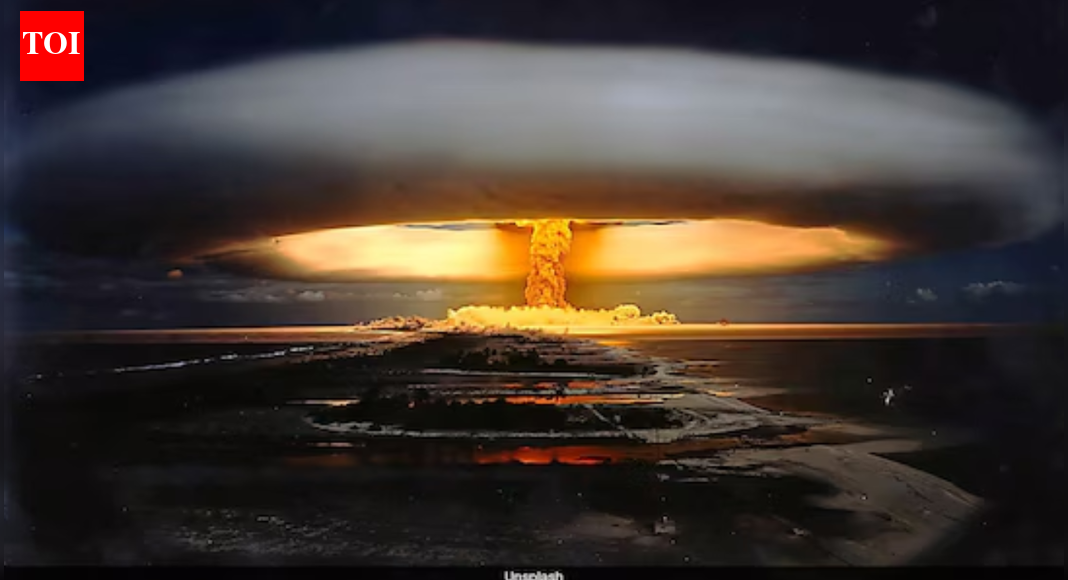


A nuclear bomb test in Mururoa atoll, French Polynesia, in 1971 (Image credit: Alamy Stock Photo)
If World War III ever breaks out, where on Earth would actually be safe? It’s the kind of uncomfortable question that emerges quietly during news alerts, diplomatic escalations, and late-night doomscrolling. Most people don’t really believe civilisation will collapse, but many are aware it could. And that’s why researchers, analysts and risk observers continue to examine which regions might offer the greatest insulation from global conflict, especially in a nuclear era.
The current geopolitical climate, and why people fear a major war
International tensions are at their highest levels in decades. Conflict in Ukraine continues to destabilise European security and fuel fears of escalation involving NATO and Russia. In the Middle East, hostilities between Israel and surrounding states fluctuate between diplomatic friction and open threat. China’s ongoing rhetoric around a future “reunification” with Taiwan raises the possibility of confrontation in the South China Sea, which could drag in the United States. And North Korea continues launching ballistic missiles and performing public nuclear posturing. All of this fuels a wider anxiety that a global war in the 21st century would not resemble the trench warfare of the past. It would likely be hybrid warfare, cyber attacks, supply-chain sabotage, satellite interference, and possibly even nuclear exchange. This isn’t just hypothetical paranoia. A scientific study published in Nature Food modelled the agricultural impact of a nuclear conflict and concluded the aftermath could starve up to 6.7 billion people worldwide due to atmospheric soot and long-term crop failure. That research specifically highlighted that nuclear war would collapse food networks in regions including the United States, Canada, most of Europe and Russia, with some nations nearly losing their entire population to starvation if global trade stopped.However, the same modelling flagged that certain regions, particularly in South America, Oceania and isolated Northern regions — possess agricultural resilience and geographical insulation. Those findings align with independent assessments by global risk monitors, including the Global Peace Index, which evaluates nations based on stability, neutrality, conflict exposure and self-sufficiency. In parallel, a news.com.au analysis recently compiled a list of countries that could serve as safer havens in a global war scenario, drawing upon the Global Peace Index along with additional criteria such as geography, military alignment, distance from likely strike zones, civil-defence infrastructure (including shelter networks), and core self-sufficiency in energy and food production.To be clear: no expert claims any country would be perfectly safe in a world war. The consensus among historians and strategic analysts is that the answer is probabilistic, not absolute. Safety depends on the type of conflict, nuclear targeting strategy, alliance networks, wind-borne fallout, and the collapse of trade and supply routes.If history is any guide, even nations with no interest or investment in a conflict can be drawn in or harmed. During the Second World War, countries such as Belgium, Luxembourg, the Netherlands, and Norway declared strict neutrality, posed no threat to any side, and maintained minimal military presence. Yet, they were invaded and occupied in 1940 by Nazi Germany, simply because of their strategic locations between larger powers. Similarly, other small neutral countries across history have often found their sovereignty compromised due to their geographic or political position.imilarly, during WWI, Norway remained neutral, yet suffered heavy merchant ship losses as its vessels were sunk by German U-boats while transporting non-military goods. These examples show that countries can become victims of geography, proximity or convenience, even when they neither provoke nor participate in war.
Which countries are most often cited as relatively safer
- Analysts and publications have repeatedly referenced specific nations when modelling survivability in extreme war scenarios. One often-cited safe-haven is New Zealand, extremely remote, thousands of kilometres from major population centres and nuclear powers, consistently ranked among the most peaceful nations, and agriculturally self-sufficient. If someone wanted a human civilisation restart-zone, this is usually the first suggestion.
- Western Australia, particularly Perth, appears in similar discussions. Perth is considered the most isolated major city on Earth, and Australia exports more food than it consumes. Its physical distance from NATO countries, Russia, China and the US military sphere makes it statistically less likely to be struck in any intercontinental conflict.
- Iceland is another common candidate. It ranks number one on the Global Peace Index, sits in the middle of the North Atlantic away from continental strike paths, and possesses immense geothermal energy reserves. It has no standing army, but historically its neutrality and location have made it an unlikely target.
- In South America, Chile, Argentina and Uruguay are frequently highlighted. They are buffered by the Andes and the Pacific Ocean, and would likely sit far outside the blast and fallout trajectories of Northern-Hemisphere conflicts. Brazil and Paraguay also appear in agricultural resilience models as regions capable of sustaining domestic populations even after global market collapse.
- In Africa, Botswana is commonly referenced, politically non-aligned, rich in natural resources, and geographically positioned deep in the Southern Hemisphere. Namibia and parts of South Africa are also included in some survival simulations, primarily due to distance from geopolitical flashpoints.
- In Asia, Bhutan is regularly mentioned. It has declared neutrality since 1971, is landlocked high in the Himalayas, and is culturally and politically detached from military blocs. Indonesia is another example, with its long-standing “free and active” foreign policy stance and distance from mainline US–China confrontation zones. Like Bhutan, it is less likely to be a first-strike target.
It’s essential to reiterate: these are not promises of immunity. Experts repeatedly stress that safety depends on the nature of the conflict, whether nuclear, conventional or cyber-economic, and that even in the Southern Hemisphere, fallout patterns and climate effects could indirectly impact nations presumed to be safe. If there’s one truth in all of this, it’s that humans deeply want to believe there is somewhere safe. The uncomfortable reality is that in a true world war, nowhere on Earth would be entirely untouched, but some locations, due to geography, politics and self-sufficiency, would likely endure better than others. Go to Source