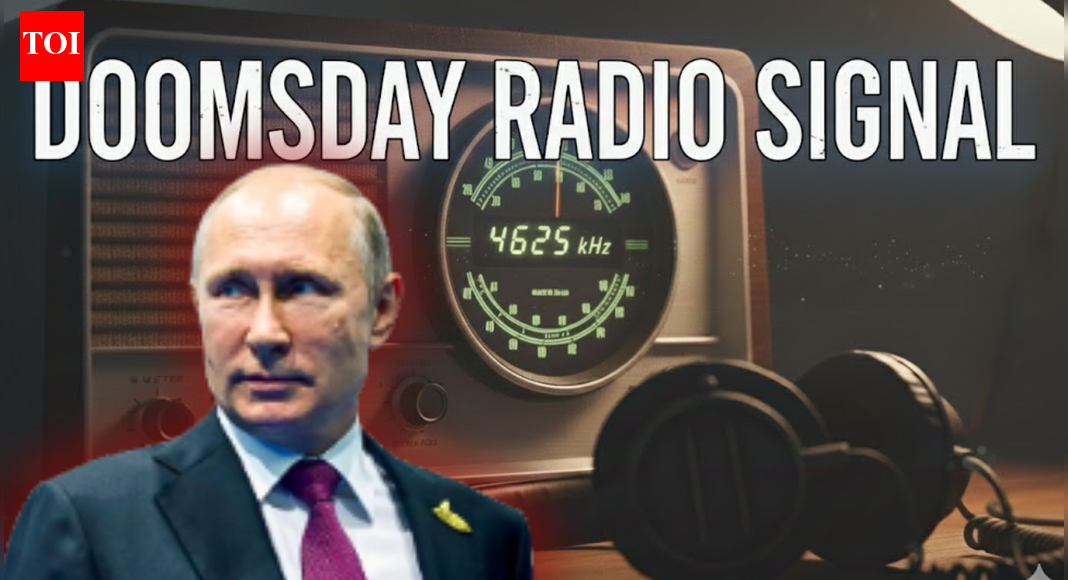

UVB-76 transmitted clustered coded signals in December as NATO–Russia tensions intensified
In the second week of December, a Cold War–era Russian shortwave radio station broke from its usual pattern. Over the course of several days, UVB-76, better known as “The Buzzer,” transmitted an unusually high number of coded messages, including clusters of words, strings of numbers, bursts of Morse code and, at one point, faint music layered over its signature buzzing signal on 4625 kHz.The surge stood out not because the station is mysterious, it always has been, but because this level of activity is rare. Monitoring channels logged fifteen transmissions in a single week. The last time UVB-76 behaved this way was in February 2022, shortly before Russia invaded Ukraine. The timing has drawn close scrutiny as tensions between Russia and NATO continue to sharpen.
What UVB-76 is, Cold War origins and theories
UVB-76 first drew attention in the 1970s. Its signature sound, a mechanical buzz lasting about 1 to 1.2 seconds and repeating roughly two to three dozen times per minute, has earned it the sobriquet “The Buzzer.” From the beginning, enthusiasts tracking shortwave frequencies noted that, more rarely, the monotone tone was interrupted by alphanumeric code groups, strings of words, or names delivered in a clipped, Russian-accented voice. No official explanation has ever been offered by the Kremlin. Western and independent analysts generally assume UVB-76 is run by the Russian military, given the strength of the transmission, its constancy, and its alignment with other known military communication frequencies. In interview with outlet Popular Mechanics, Professor David Stupples, an electronic and radio engineering academic at City University London, has described the pattern as consistent with a military channel that is kept active to assert control over a frequency and reserve it for critical communications during conflict or emergency. He has characterised the broadcast as “almost certainly the Russian government” in origin and speculated that its functions could range from air defence coordination to an emergency broadcast reserve in case of severe national infrastructure loss. Another prominent theory ties the station to Russia’s Perimeter system, sometimes referred to as “Dead Hand,” a Cold War-era nuclear fail-safe that, in concept, could automatically trigger a retaliatory strike if Moscow lost contact with military command. In that framework, UVB-76 is not a standalone doomsday transmitter but part of a broader, redundant command and control architecture designed to survive catastrophic events. Despite these interpretations, the actual meaning of the voice-coded interruptions has never been publicly deciphered. They bear no generally agreed-upon semantic pattern, which has fuelled speculation ranging from simple military testing to more exotic explanations involving sleeper units or psychological signalling.
A surge of unusual signals: April to December 2025
In a year already marked by rising geopolitical friction, several atypical interruptions in the UVB-76 broadcast drew attention from shortwave monitoring communities. These deviations from normal buzzing were notable not only for their frequency but for their timing relative to diplomatic and military developments. On April 15, 2025, observers logged transmissions of four distinct words: Neptune, Thymus, Foxcloak and Nootabu. These were not simple numeric code groups typical of previous occasional messages; they read as discrete word cues, striking listeners as unusual. On May 19, 2025, two alphanumeric code sequences were recorded: “NZhTI 89905 BLEFOPUF 4097 5573” and later “NZhTI 01263 BOLTANKA 4430 9529”. These arrived on the same day that Russian President Vladimir Putin and US President Donald Trump held a bilateral phone call. Analysis by independent monitors noted the coincidence but emphasised that correlation does not imply causation. On September 8, 2025, further transmissions broke the regular buzz with the code “NZHTI”, followed by the word “HOTEL” and a series of numbers, 38, 965, 78, 58, 88, 37. Again, the pattern departed from the rare intrusion listeners had grown accustomed to. Then, on October 14, 2025, a Telegram account known as UVB-76 Ether, which tracks and logs the station’s activity, announced a temporary cessation of the broadcast due to a “power outage.” This was notable because the signal had been remarkably persistent historically, and interruptions were rare and typically brief. Just over two weeks later, on October 29, 2025, another monitored channel, UVB-76 Logi on Telegram, reported a new encrypted message broadcast shortly after a Russian announcement regarding tests of the Poseidon underwater vehicle, a strategic weapon system. That transmission included the word “Brakebrain”. Netizens connected the timing with the military news, although there was no official linkage. The next significant event recorded was on November 14, 2025, when Izvestia, a Russian state media outlet, reported that UVB-76 had fallen silent in the wake of reported drone strikes on nearby power stations. According to that report, the station went off the air after the incident, and when the signal returned, it was followed by a series of transmissions that appeared to “strike fear into European nations,” according to local commentary. Among subsequent messages was a transmission on November 17, 2025 at 14:40 Moscow time, which carried the word “LATVIA,” logged as “NJTI 15854 LATVIA 5894 4167,” alongside other strings such as Vulgar, Nantonyuk, Bolognese and Lesoled. Most recently, during the week of December 8 and 10, 2025, the station reportedly broadcast fifteen cryptic messages: three on Monday, December 8, and eight on Wednesday, December 10. These included code words such as PEPPER SHAKER, TRANSFER, PABODOLL, SPINOBAZ, FRIGORIA, OPALNY, SNOPOVY and MYUONOSVOD. On Friday, December 12, 2025, observers reported a prolonged broadcast of faint music and what appeared to be extended bursts of Morse code alongside the usual buzz, a pattern that has no clear precedent in the station’s long history.
Interpretation, fear, and geopolitical context
The fact that UVB-76 has broadcast patterns deviating from its normal state in 2025, at a frequency, number and complexity not seen since early 2022, during Russia’s invasion of Ukraine, has not gone unnoticed. At that time, according to reporting by shortwave monitoring communities, the station transmitted several messages a week, a marked increase from its usual one or two monthly interruptions. Those events in 2022 represented a rare period of multiple messages over short periods, and they coincided with intense conflict and strategic signalling across Eastern Europe. The recurrence of clustered messages in late 2025, particularly amid heightened tensions involving NATO, Russian military movements and rhetoric, has led analysts and the public to draw parallels, even as no authoritative interpretation exists. The mention of Latvia on November 17 is especially sensitive in this context because Latvia is a member of the North Atlantic Treaty Organization (NATO). Under Article 5 of the NATO treaty, an attack on one member is considered an attack on all, triggering collective defence obligations from the United Kingdom, France, Germany, the United States and others. As commentary in European defence circles has noted, any real indication of aggression toward a NATO state carries the risk of escalating into broader military confrontation.On December 12, 2025, as reports of the extended broadcasts spread, NATO Secretary General Mark Rutte issued a stark warning, underscoring the alliance’s sense of encirclement. “We are Russia’s next target, and we are already in harm’s way,” he said, stressing the urgency of increased defence spending and preparedness. “Russia has brought war back to Europe, and we must be prepared for the scale of war our grandparents and great grandparents endured.” Similar warnings echoed elsewhere, including from Minister Al Carns, who described the “shadow of war” approaching Europe’s doorstep.
What experts actually say, and what they don’t
Despite the breathless language one often finds on social media and in some mainstream headlines, experts on RF (radio frequency) communication and military signalling urge caution. Professor David Stupples, whose research into signal spectrum analysis has explored UVB-76’s characteristics, emphasises that the mere presence of unusual transmissions does not necessarily imply imminent military action or a direct linkage to nuclear command-and-control systems. He has pointed out that maintaining control over a frequency requires ongoing broadcast, otherwise, other actors might occupy it, and that using repeated test signals is a common practice across militaries to preserve channel ownership. Stupples has also underscored the difficulty of attributing semantic meaning to arbitrary word strings. In his assessment, the patterns observed in 2025 are consistent with a powerful transmitter maintained by a state actor for strategic reserve communication, not a public code meant to be easily decoded. What exists in the public record are logs of transmissions, timestamps, and code groups as reported by monitoring communities and Telegram channels dedicated to tracking UVB-76. There is no official Russian confirmation of purpose, structure or interpretation. There is no declassified documentation tying specific messages to defined strategic events. And there is no independent verification that any particular broadcast has operational significance beyond signalling the presence and control of the station itself.
Signal, noise, and uncertainty
The surge of activity from UVB-76 in 2025 is well documented by independent monitoring groups, but its meaning remains opaque. The signals arrive amid sustained tension between Russia and NATO, lending them weight without supplying clarity. Beyond timestamps and transcripts, there is no public evidence linking the broadcasts to specific decisions or actions. What exists is a record of anomaly, precise, unsettling, and unresolved. Go to Source