
Saudi Trolls Use ‘Indian’ as Insult: Emirati Analyst Fires Back, Igniting Cultural War
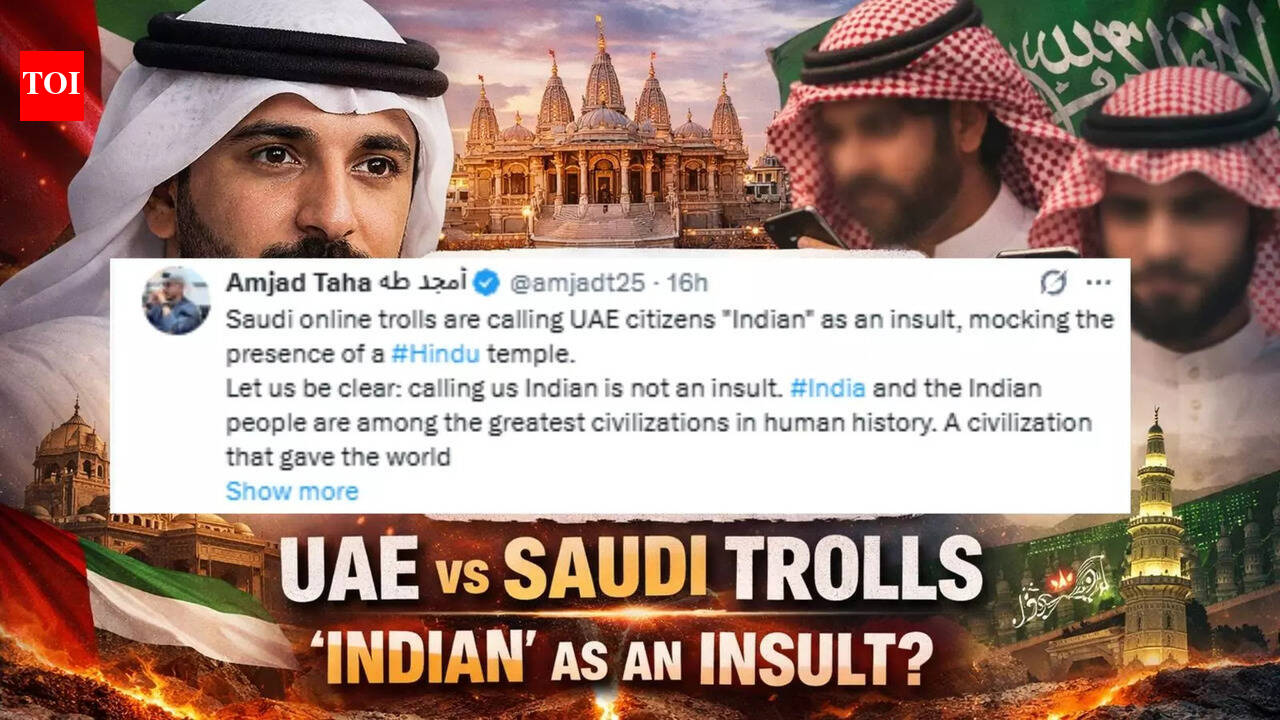
A viral tweet by Emirati political analyst Amjad Taha has ignited a broader online conversation about identity, racism and regional tensions after some Saudi social media users used “Indian” as an insult towards UAE citizens in the context of celebrating a Hindu temple opening in the Emirates. Taha’s response of defending India’s civilisational contributions and calling for mutual respect has sparked a deeper debate about cultural pride, xenophobia and Gulf-Arab relations in the digital age.This is not just a passing exchange of tweets. It reflects long-running cultural tensions and the power of online narratives in shaping public perceptions between neighbouring countries in the Middle East and South Asia.
What Sparked the Online Backlash?
The immediate cause was a wave of derogatory comments on social media by a subset of Saudi users, who mocked UAE’s decision to allow the construction of a Hindu temple, a move seen by many observers as a sign of the UAE’s commitment to religious tolerance. Some of these comments included calling Emiratis “Indian” as a pejorative, a misuse of identity intended to insult rather than describe.This reaction likely stems from broader political and cultural frictions that occasionally surface between Gulf countries on social platforms, often tied to regional politics, national pride and domestic audiences. Observers note that such rhetoric is not new since when tensions rise, for example over foreign policies or regional conflicts, racial or national labels can be weaponised online in ways that deepen divisions rather than reflect broader public sentiment.
Amjad Taha’s response: Turning insult into a lesson on civilisation
Rather than retaliating, Amjad Taha (@amjadt25) took a very different tone in his tweet. He argued that being called “Indian” should not be considered an insult and pointed out that India’s contributions to humanity through mathematics, philosophy, medicine and spirituality rank among the greatest civilisations in history.
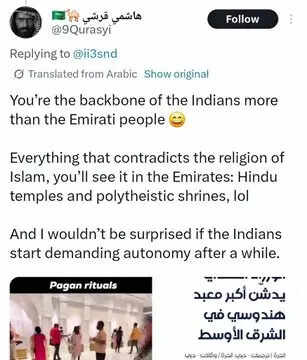
UAE Saudi Twitter Dispute: Indian Identity, Racism and Regional Tensions Erupt Online
Taking to his X (formerly Twitter) handle, he shared a screenshot of a hate message and tweeted, “Saudi online trolls are calling UAE citizens “Indian” as an insult, mocking the presence of a #Hindu temple. Let us be clear: calling us Indian is not an insult. #India and the Indian people are among the greatest civilizations in human history. A civilization that gave the world mathematics, philosophy, medicine, and spiritual depth long before many modern states existed. We live with India, work with India, grow with India, and respect India (sic).”He added, “What is truly shameful is not the UAE’s openness, but the racism shown by #Saudi trolls toward Indians, a people they rely on economically yet look down on online. This is not strength; this is moral weakness (sic).”Taha’s message drew upon the ancient Indian notion of “Vasudhaiva Kutumbakam”, the idea that the world is one family, as a moral lens to challenge racism and celebrate shared human heritage. By invoking Vasudhaiva Kutumbakam, a Sanskrit phrase popularised in diplomatic discourse and often cited in Indian foreign policy rhetoric, Taha sought to shift the narrative from one of insult to one of mutual respect and civilisational pride.He wrote, “As Indian wisdom teaches us: Vasudhaiva Kutumbakam ..The world is one family. #Hindus are proud not because they shout, but because they know who they are. Civilizations do not need insults to feel strong. They stand on knowledge, respect, and time.And history always remembers which civilizations built and which only mocked (sic).”
Gulf social media amplifies identity politics
Online platforms like X are key venues for political and cultural expression in the Gulf, where youth-driven engagement often amplifies polarising content. What might begin as a fringe comment can quickly become a viral flashpoint, shaping perceptions far beyond the original intent. The episode reflects how national identities, especially in multi-national regions like the Gulf (where large Indian diasporas coexist with Arab populations), can be misused in online hostility, even in highly interconnected societies.
Saudi online trolls are calling UAE citizens “Indian” as an insult, mocking the presence of a #Hindu temple.
Let us be clear: calling us Indian is not an insult. #India and the Indian people are among the greatest civilizations in human history. A civilization that gave the world… pic.twitter.com/peYbiR3NvF
— Amjad Taha أمجد طه (@amjadt25) February 2, 2026
The controversy also intersects with broader debates over religious pluralism in the Gulf. The UAE’s move to support infrastructure for diverse faith communities, including Hindu temples, represents a strategic message of tolerance in an increasingly globalised region. Critics of the pejorative comments argued that mocking such developments reflects a lack of appreciation for multicultural coexistence, even as the Gulf states actively promote international business, tourism and cultural inclusivity.
Cultural pride vs online racism
Taha’s counter-message underscores a broader pushback against online racism, not just between nations but within societies that host expatriate communities from South Asia, Africa and beyond. India itself has grappled with online hate campaigns related to religion and culture, as seen in other contexts, for example, hate-speech controversies involving expatriates or social media posts resulting in legal action.In the Gulf, where anti-discrimination laws exist to curb hate speech and protect religious or ethnic groups, such online incidents highlight how digital discourse can clash with legal and social norms on tolerance and coexistence.
Religion, tolerance and Gulf modernisation
India and the Gulf have deep economic and cultural ties. Millions of Indians live and work across Gulf states, including Saudi Arabia and the UAE, contributing to trade, healthcare, construction, education and more. These connections are largely cooperative and mutually beneficial, even if online trolls seek to reduce them to caricature and conflict.Taha’s framing, that calling someone “Indian” should evoke respect instead of derision, reflects a broader recognition in the Gulf of India’s historical and contemporary contributions. India is a major trade partner and cultural influence in the region. Indian civilisational contributions in mathematics, philosophy and medicine have been historically acknowledged worldwide.Many Gulf societies celebrate cultural diversity as part of modernisation agendas. In this context, Internet trolling is a distortion of broader public attitudes, and responses like Taha’s aim to remind audiences that mutual respect and shared human values are more productive foundations for regional discourse.The exchange sparked by Amjad Taha’s tweet and the broader online reaction about UAE citizens being labelled “Indian” underscores how identity, race and online speech intersect in complex ways in the Middle East. While trolling and derogatory comments reflect fringe attitudes, the pushback invoking civilisational respect and inclusive worldviews offers a counter-narrative that emphasises shared humanity over division. Go to Source