
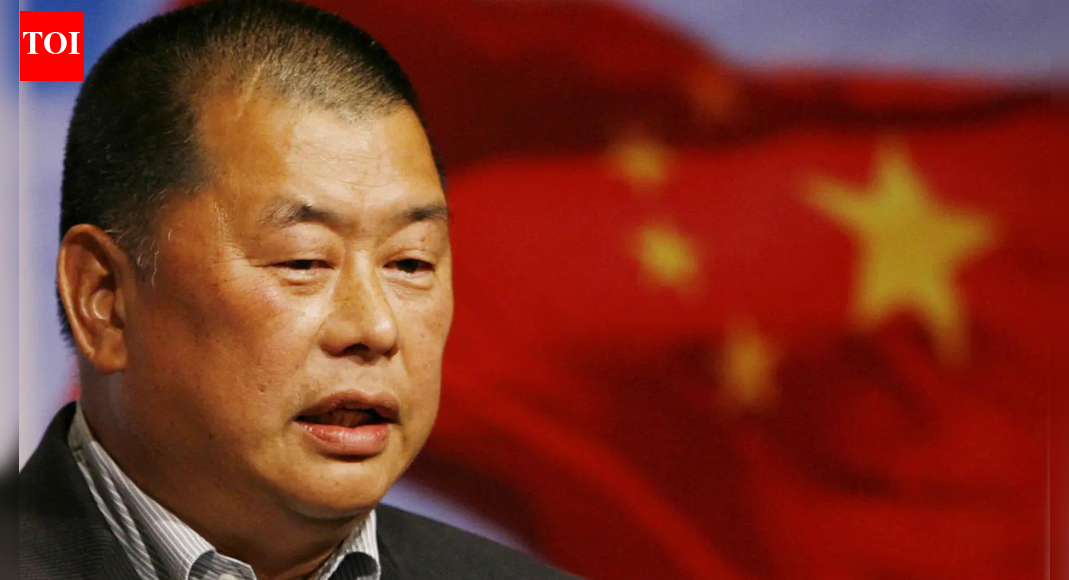


AP file photo
Hong Kong media tycoon and outspoken China critic Jimmy Lai was found guilty on Monday on two counts of conspiracy to collude with foreign forces and one count of sedition under a China-imposed national security law, charges that could see him sentenced to life in prison. The 78-year-old had pleaded not guilty to all charges.A panel of three government-vetted judges ruled that Lai conspired with others to endanger national security by colluding with foreign forces and by publishing seditious articles.
Foreign governments and political observers have closely watched Lai’s 156-day trial as a test of judicial independence and media freedom in the former British colony, which was promised the preservation of Western-style civil liberties for 50 years after its return to Chinese rule in 1997.Speaking before his arrest, Lai told Reuters he would “fight on till the last day.” The 78-year-old has been in custody for over five years, much of it in solitary confinement, during which his health has reportedly deteriorated.”This ruling serves as a declaration to the world that Hong Kong’s freedoms, democracy, and judicial independence have been systematically eroded,” said Taiwan’s China policy-making mainland affairs council, as cited by Reuters.
Why was Lai arrested?
Lai was arrested as Beijing tightened its control over Hong Kong, a city long known for its vibrant press and protest culture. Following months of anti-government demonstrations that drew hundreds of thousands into the streets, authorities launched a sweeping crackdown that has largely stifled open dissent.He was among the first high-profile figures charged under the National Security Law, which has also been used against other activists and opposition politicians, as cited by AP.Beijing has maintained that the law is essential for maintaining the city’s stability. In its wake, dozens of civil society groups have shut down, and tens of thousands of young professionals and middle-class families have emigrated to countries including Britain, Canada, Taiwan, Australia, and the United States.Lai, a rags-to-riches tycoon and former owner of the clothing chain Giordano, entered the media industry following the 1989 Tiananmen crackdown.Lai said he was motivated by the conviction that providing information was synonymous with promoting freedom. His newspaper, Apple Daily, built a wide readership through tabloid-style reporting on politics and celebrities, alongside a firm pro-democracy position that frequently urged readers to take part in protests. Lai also personally took to the streets, including during the large-scale demonstrations of 2019.The most serious charge against Lai was that he and others had invited the US and other foreign powers to take action against China through sanctions or other measures, “under the guise of fighting for freedom and democracy.”A key question in the case was whether Lai continued making such calls after the National Security Law came into effect. Lai did not deny calling for sanctions prior to the law but insisted that he ceased doing so once it was implemented.The prosecution also alleged that Lai had conspired with fellow Apple Daily senior executives, members of the advocacy group “Fight for Freedom Stand with Hong Kong,” and the Inter-Parliamentary Alliance on China to advocate for foreign actions.”If I have to go to prison, I don’t mind. I don’t care. It won’t be something I can worry about, I’ll just relax and do what I have to do,” Lai was quoted as saying in an interview with AP in 2020.

