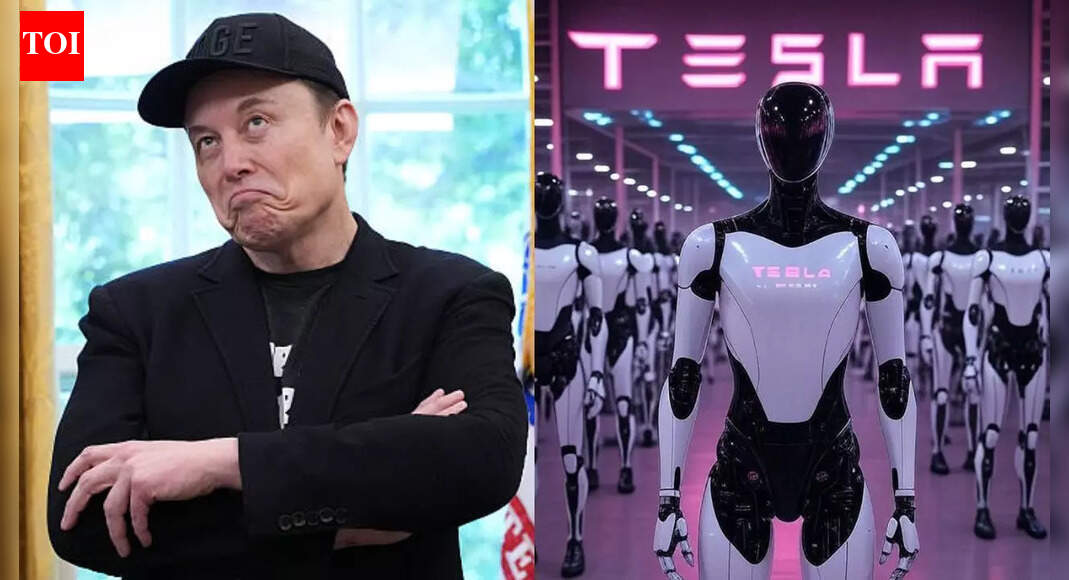

2025 has been equally graceful and damaging for Elon Musk. The 54-year-old topped the net worth of $700 billion and even became the head of DOGE but also had a breakup with his famous frenemy, US President Donald Trump and faced criticism for the shenanigans of his AI venture Grok. While most believe Tesla and X to be one of Musk’s most successful and magnanimous ventures ever, it seems the billionaire has some other thoughts. According to him, his “biggest product of all time” is yet to come.
What is it? It’s his army of humanoid robots that he says could eliminate poverty and the need for work. He has told investors that robots could generate “infinite” revenue for Tesla.
Musk’s robotic dreams
The Tesla co-founder has bet the company and his personal fortune on his vision of the world where Optimus will work in factories, handle domestic chores, perform surgeries, and travel to Mars. While each robot is made by hand today, he has proposed manufacturing millions of them a year. It was in 2021 that Musk shared his bot concept at an event 2021 with a human dancing on stage in a robot costume. “It’s intended to be friendly, of course, and navigate through a world built for humans and eliminate dangerous repetitive and boring tasks,” he said at the time. However, Musk’s dream is far from becoming a reality. In public appearances, the robot is often remotely operated by human engineers. Additionally, the engineers are facing a difficulty creating a hand for both with the sensitivity and dexterity of a human. However, Musk remains hopeful. According to the Wall Street Journal report, his new compensation package allows him 10 years to make Tesla an $8.5 trillion company and sell at least one million bots to customers. If successful, it could have him earning a $1 trillion pay package. “The car is to Tesla what the book was to Amazon,” Adam Jonas, an analyst with Morgan Stanley, said to the outlet. “Tesla used cars as a laboratory to get good at other things.”
Optimus is on the way
Optimus is under development for the world, but it is a common sight at company events and for employees. Inside Tesla’s Palo Alto, California, engineering headquarters, robots circle around the office gathering information on how to move in a room alongside humans. “Who wouldn’t want their own personal C-3PO/R2-D2?” Musk said in November 2025, referencing the droid characters in “Star Wars” movies. “This is why I say humanoid robots will be the biggest product ever. Because everyone is gonna want one, or more than one.”The 6-foot machine practices tasks like sorting Legos by colour, folding laundry and using a drill to screw a fastener in Tesla’s labs, said former employees to the outlet. In October 2025, the bot made its red carpet debut at the “Tron: Ares” premiere in Hollywood and performed a choreographed fight sequence with actor Jared Leto.
What do the experts say?
Robots are a part of many factories where they do heavy lifting or dangerous tasks like moving hot metal, doing mostly programmed tasks. The rest of the tasks that require flexibility and precision are left to humans. When it comes to humanoid robots, the appeal of their being flexible and functioning in human spaces is exciting. But roboticists have struggled to make robots with dexterity, sensitivity and adaptability to move around freely, as per Ken Goldberg, a roboticist at the University of California, Berkeley.“I’ve heard Elon Musk say hands are the hard part. It’s true, but it’s not only the hand—it’s the control, the ability to see the environment, to perceive it and then compensate for all this uncertainty. That’s the research frontier,” Goldberg said. “Getting these robots to do something useful is the problem.”Jonas predicts that by 2050, humanoids will bring in $7.5 trillion in annual revenue across the industry globally. If Tesla is able to crack it, this can supersize its revenues. While Tesla had earlier claimed to put a commercial version of Optimus to work in its own factories by the end of the year, it has not been able to do so. The company is currently working on its third generation of the robot. Go to Source