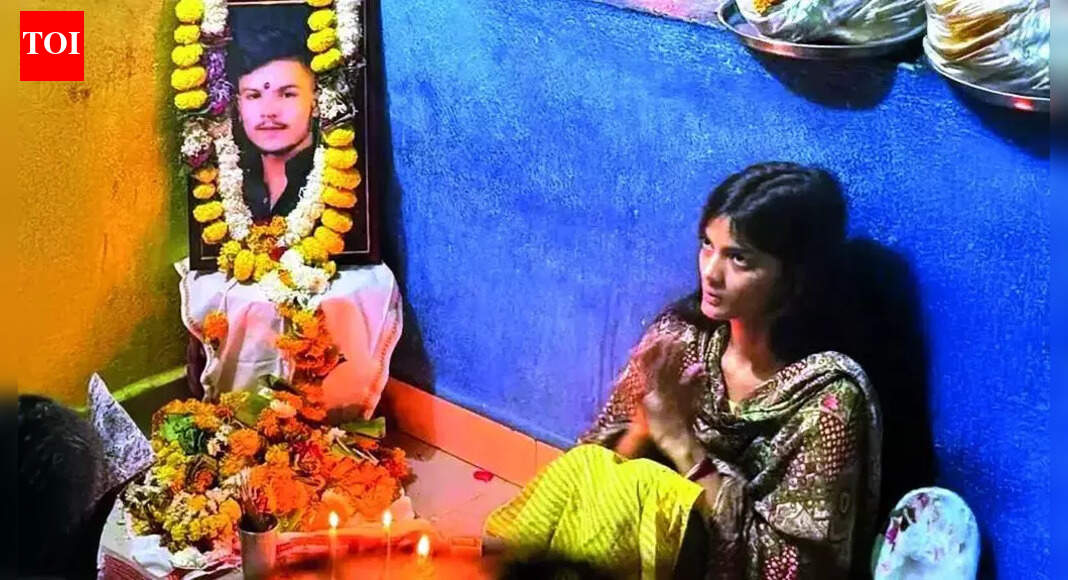


Aanchal Mamimdwar seated before a photograph of Saksham Tate
The visuals are surreal — and deeply unsettling. Men, some struggling to hold back tears, carry a body wrapped in white cloth into a dimly lit room. Moments later, a young woman steps forward, devastated. Through choking sobs, she performs rituals usually reserved for a wedding ceremony, symbolically “marrying” the lifeless body.This is the story of Saksham Tate and Aanchal Mamidwar, a young inter-caste couple from Nanded, Maharashtra — he a Scheduled Caste (SC) youth, she from the Other Backward Classes (OBC) community. The accused are Aanchal’s own family members, who she says had long opposed their relationship.A formal police probe is under way, but the allegations reflect a continuing and uncomfortable reality: caste-based murders, euphemistically called “honour killings,” still occur with alarming regularity across India.
The murder
Saksham and Aanchal had been together for three years. On November 27, Saksham was attacked by a group of six men — including Aanchal’s father and two brothers — and died on the spot.All six have been arrested; two others are still absconding. The accused face charges under several sections of the Bharatiya Nyaya Sanhita (BNS), including murder.But crucially, they cannot be charged with “honour killing” — because Indian law does not recognise the category.This raises a fundamental question: why is there still no specific law against honour killings? And why do such crimes persist even today?
What is ‘honour killing’?
In July 2009, then home minister P. Chidambaram described honour crimes in Parliament as violence — usually murder — committed by family members who believe a relative has brought “dishonour” to the family. Since honour killing is not separately defined under Indian law, the National Crime Records Bureau (NCRB) records it under the broader category of murder.
“Honour crimes are acts of violence, usually murder, mostly committed by family members predominantly against female relatives, who are perceived to have brought dishonour upon the family. These are rooted in antiquated traditions and social values. Since ‘honour killing’ is not a crime classified separately under the Indian laws, no data is collected separately regarding this crime by the National Crime Records Bureau (NCRB) and the same is covered under ‘murder.’"
P Chidamabarm
In many cases, both partners are targeted. In others — as in Nanded — the man becomes the primary victim.The term gained prominence in the 2000s, especially in Haryana, where Khap Panchayat diktats were frequently linked to such crimes. As media penetration grew, cases from other states also came to light.The Manoj–Babli case that changed the conversationIn 2007, newlyweds Manoj and Babli were murdered by her relatives on a Khap’s orders. In 2010, five perpetrators were sentenced to death — the first death sentence in an honour killing case in India. The high court later commuted four of these to life terms.
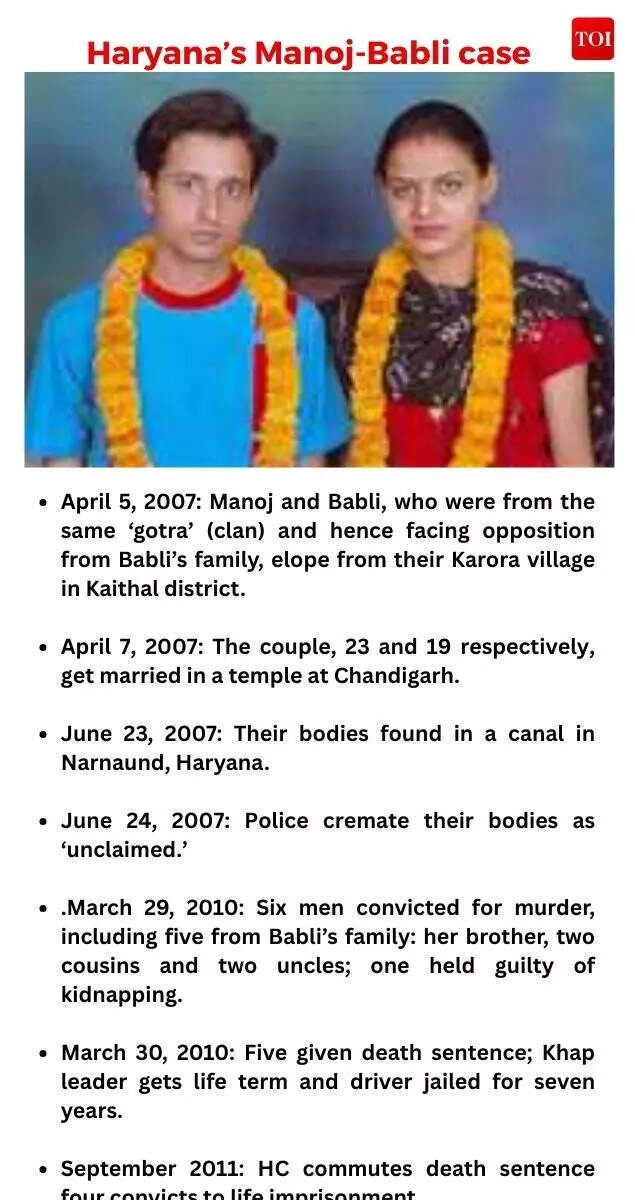
Manoj-Babli case timeline
Where honour killings occur — and where they don’t
Although widely associated with Haryana, NCRB data from 2017–2022 shows a different picture:Jharkhand recorded the highest number, with 66 of 221 cases.
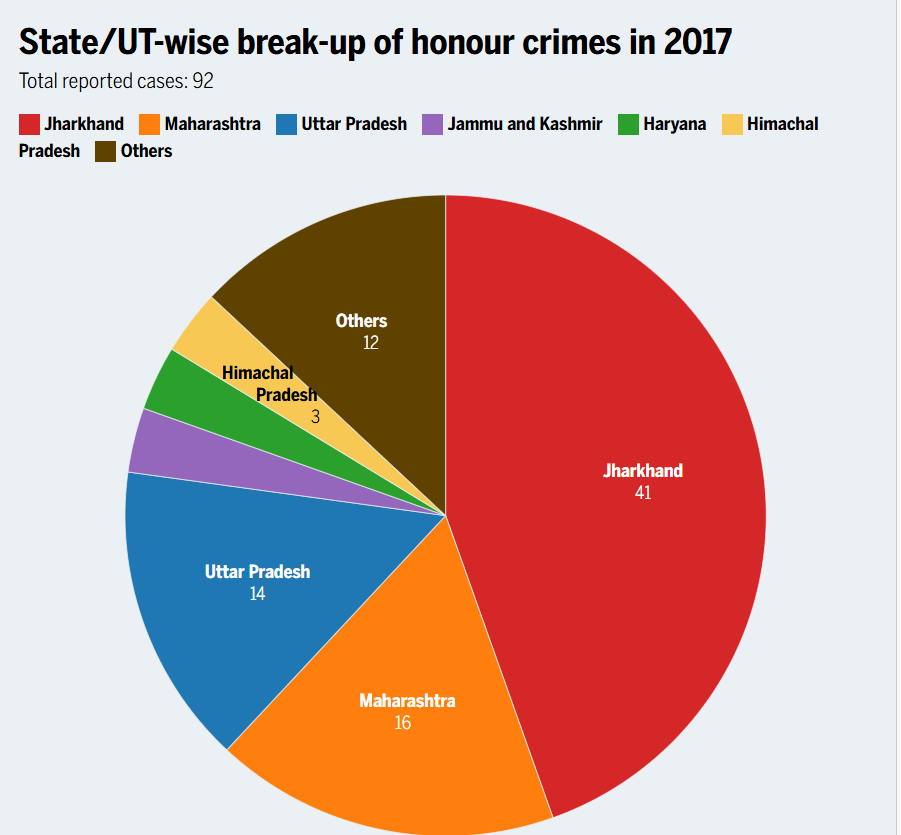
Honour crimes in India in 2017 (data source: NCRB)
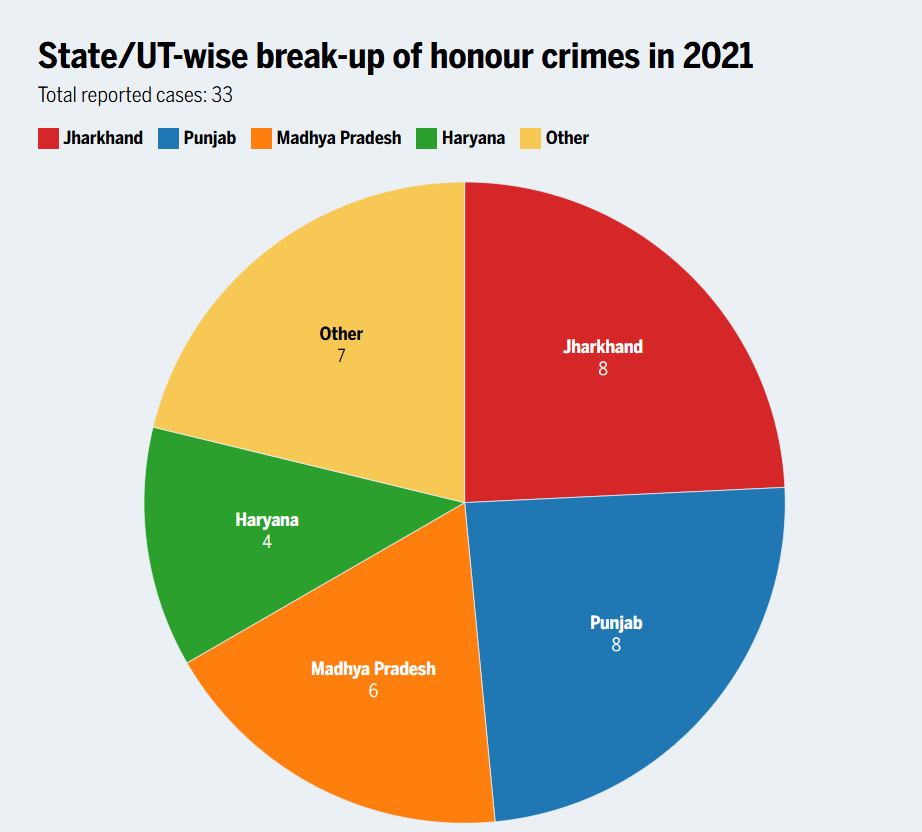
Honour crimes in India in 2021
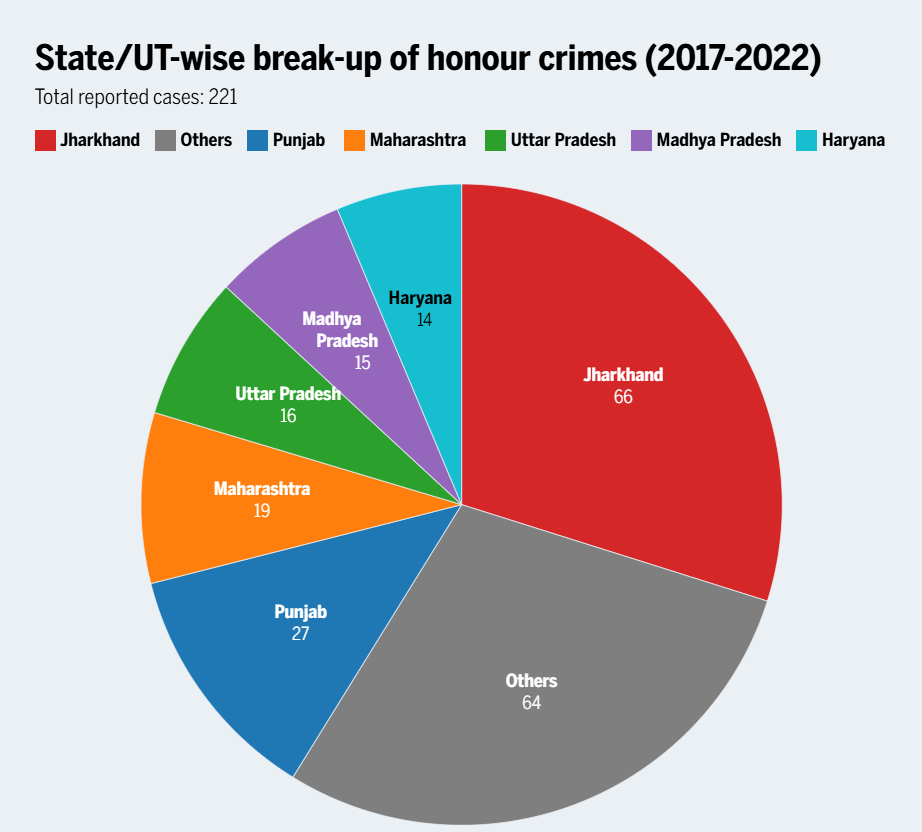
Honour crimes in India from 2017-2022 (data source: NCRB)
Haryana reported 14 cases, though activists say many more go unreportedEven allowing for underreporting, the data challenges common assumptions about where honour crimes are concentrated.Why cases remain hiddenDr Mayura Sabne, assistant professor of law at Gandhinagar’s Karnavati University, told The Times of India:
“The police cannot intervene unless a complaint is filed. Victims often fear community retaliation. When family members are the accused, cases stay private. Many women do not report because they end up facing harassment themselves.”
Dr Mayura Sabne
Chidambaram, in his 2009 speech, also spoke about the “privacy” surrounding such killings, noting that motives remain concealed within families.
"It is difficult to identify or classify an honour killing as such in any given community, since the reasons for these killings often remain a closely guarded private family matter."
P Chidambaram
In the Nanded case, two policemen are now under inquiry after Aanchal alleged they had “instigated” her brother to attack Saksham — raising questions about local police conduct.
What the law currently provides
Rajasthan is the only state with a dedicated law against honour-based violence — the Rajasthan Prohibition of Interference with the Freedom of Matrimonial Alliances Act, 2019.
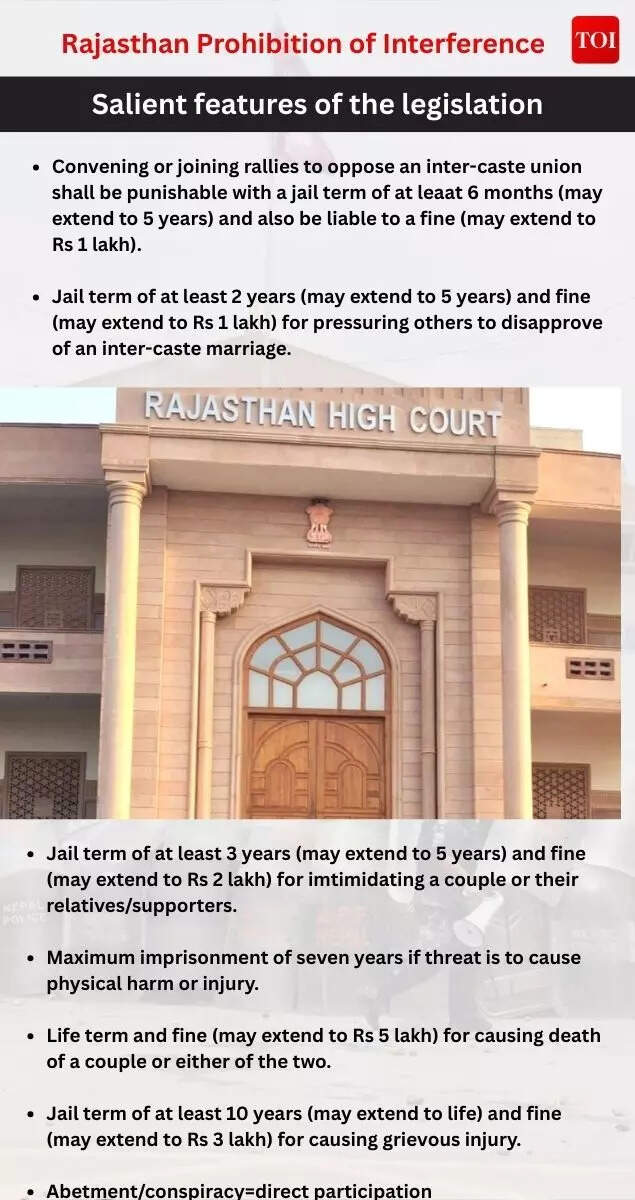
Rajasthan Act, 2019
Elsewhere, honour killings are prosecuted under general BNS (formerly IPC) sections on:
- Murder / culpable homicide
- Attempt to murder
- Abetment
- Criminal conspiracy
- In caste-based cases, the SC/ST (Prevention of Atrocities) Act is often invoked.
Government response and Supreme Court directives
Chidambaram’s 2009 address listed several steps: sensitising police and judiciary, enforcing existing laws, setting up women’s cells, exclusive police stations, counselling, and training officers in gender and atrocity laws.Acting on the Supreme Court’s 2018 judgment in Shakti Vahini vs Union of India, the Centre asked states to:
- Identify districts with past honour killings
- Monitor inter-caste and inter-religious marriages
- Act against illegal Khap gatherings
- Provide safe houses for couples
- Fast-track trials, ideally within six months
Why no national law?
Dr Sabne explains:
“The crime is already covered under other sections. But social customs often override legal norms. When society doesn’t recognise something as a crime, the state struggles to legislate it.”
Dr Mayura Sabne
She compares this to mob lynching and triple talaq — both became explicitly illegal only after sustained public pressure and documentation of harm.
“Honour is abstract. The law deals in certainties. That’s where the gap lies.”
Dr Mayura Sabne
Why honour killings persist
Despite rapid urbanisation, cases continue across Maharashtra, Haryana, Uttar Pradesh, Tamil Nadu and Jharkhand. Sabne attributes this to deeply embedded patriarchy:
Women are expected not to marry outside caste or religion. Society still tries to govern adult relationships. This controlling nature drives many crimes."
Dr Mayura Sabne
Recent cases of suspected honour killing in Maharashtra
- August 26, 2025 (Nanded): Man allegedly kills daughter, her lover; dumps their bodies in a well
- April 26, 2025 (Jalgaon): A retired CRPF sub-inspector allegedly shoots and kills his daughter; son-in-law seriously injured
- February 8, 2025 (Pune): Man found dead with stab wounds; family alleges he was under pressure from in-laws to divorce
- January 6, 2025 (Jalna): Minor pushed off cliff allegedly by her cousin; family disapproved of her relationship
- July 14, 2024 (Chhatrapati Sambhajinagar): Man killed in Chhatrapati Sambhaji Nagar; wife blames her father, cousin
The way forward
The Nanded case is a stark reminder of the legal and social vacuum that allows honour-based violence to thrive. While BNS provisions can prosecute murder, they do not capture the motive of perceived dishonour, nor the targeted nature of such killings.Beyond legal reform, the challenge is societal: confronting caste prejudice, gender control, and family-driven violence.As Sabne notes, digital documentation under the new BNS framework may improve evidence collection. But lasting change will require a deeper social shift — one that recognises the right of young people to choose whom they love, without fear of being punished for it Go to Source