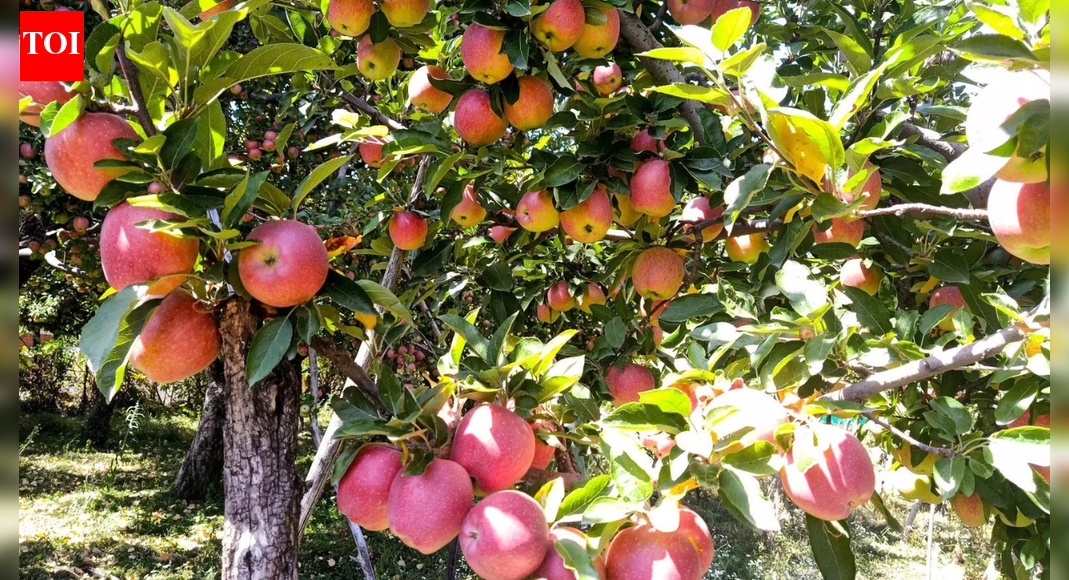

SRINAGAR: In Srinagar, for once, politics took a back seat on December 8, when the conversations revolved not around the tug-of-war between CM Omar Abdullah and LG Manoj Sinha, or another round of security briefings. In the J&K assembly corridors this Monday, lawmakers gathered instead to confront a deadlier political blind spot: Cancer among its farmers.The House Committee on Environment, chaired by CPM legislator MY Tarigami, convened the session with top officials, experts and scientists in the state.Horticulture sustains millions here but receives little policy attention. For years, farmers have sprayed orchards unaware of the toxicity of constant pesticide exposure, leading to a rise in malignant brain tumors among those who power the valley’s billion-rupee apple economy and contribute more than 70% of India’s total apples.The original study on the danger of pesticides in Kashmir’s apple orchards was done by Sher-i-Kashmir Institute of Medical Sciences (SKIMS). It had then identified a “quite strong and possible” link between the chemical exposure and malignant brain tumours among orchard farmers.Examining over 400 cancer patients between 2005 and 2008, the study had pointed to alarmingly high incidences of primary brain cancer in districts that form Kashmir’s core fruit belt including Baramulla, Anantnag, Budgam, Shopian and Kupwara. The findings, largely ignored at the time, have resurfaced amid growing medical evidence of pesticide-linked health disorders in the valley.Tarigami told TOI on Thursday: “We don’t want to create panic among farmers who spray their orchards every season. But neither can we sit idle when data indicates a serious health hazard. If pesticide spray is harming lives, it must be addressed.”The committee has now sought inputs from scientists and health practitioners to design field studies that capture exposure levels, chemical compositions, and long-term health outcomes in apple-growing districts.Kashmir’s apple boom began with 1950s land reforms under Sheikh Abdullah, diversifying farming from rice to horticulture. By the 1960s, orchard cultivation expanded through scientific spraying schedules and grafting techniques. Today, 3.35 lakh hectares employ 3.5 million people and contribute nearly 10% to J&K’s GDP, generating at least 400 man-days of work per hectare per year, making it central to Kashmir’s rural economy.Dr Shahid Rasool, principal scientist at CSIR-IIIM, said: “Orchardists now use 15 rounds of fungicide and insecticide each season, often far beyond limits. Believing it boosts yield, many over-spray — every 10–12 days instead of 18–21.”Few can afford protective gear; chronic cough, rashes and irritation are common. “Without gloves, goggles and masks, the risk multiplies,” Rasool warned, urging PPE subsidies and safer practices.While policymakers have just begun to react, local researchers have been raising red flags for years. Dr Sobia Nisar, physician-researcher in the department of medicine at Government Medical College, Srinagar, has spent the past six years studying the biochemical impact of chronic pesticide exposure on residents of Shopian and Pulwama: two districts synonymous with ‘Apple wealth.’“The initial idea was to check pesticides residue levels in the fruit,” she said. “But what we found was far more disturbing. Traces of these compounds in human blood samples.”The study, soon to be published, documents pesticide residues in the bloodstream of orchard workers and nearby residents, alongside higher rates of obesity, lipid disorders, and metabolic syndrome. “When such patterns emerge consistently across populations exposed to pesticides, it demands urgent scientific scrutiny,” Nisar added. Equally worrying are her team’s findings of early kidney function impairment among some farmers.Tarigami said the committee’s deliberations in the meeting will be followed by recommendations to the health and horticulture departments on monitoring, research funding, and worker safety. Go to Source