
Last Updated:
Each time, panic swept through the state, people took to night vigils, innocents were assaulted, and in some cases, lives were lost—all in pursuit of shadows that never existed

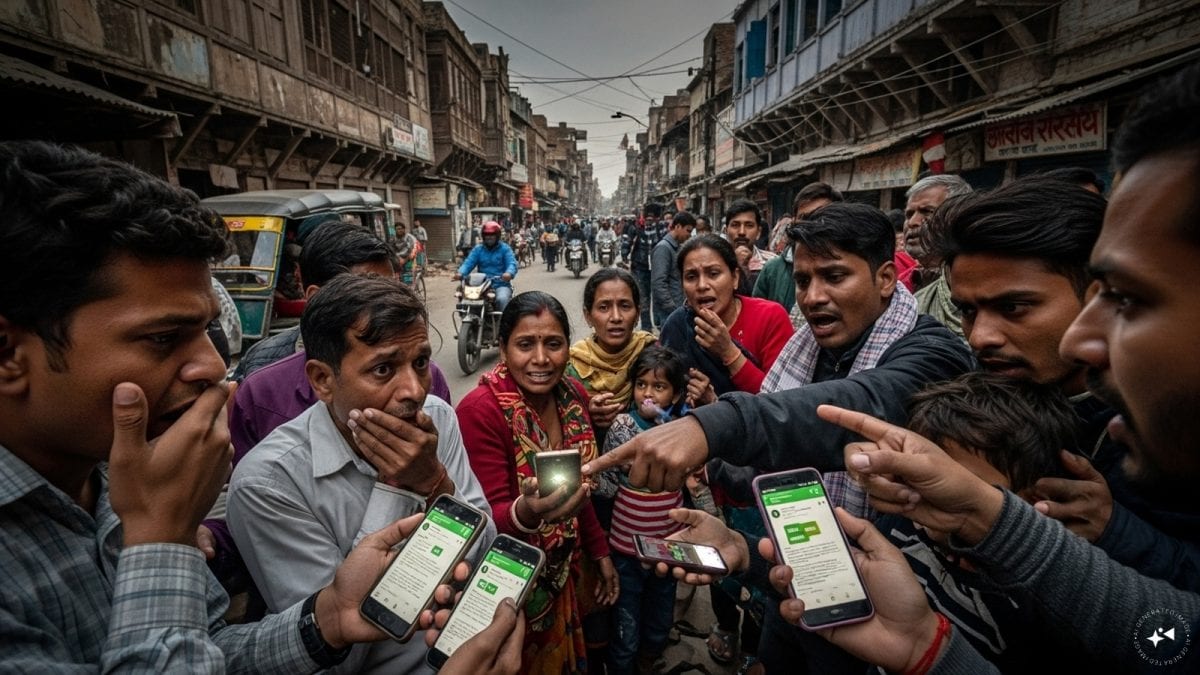
Social media has made the problem worse, say experts, as now it takes just hours for tales to spread.(AI-Generated Image)
‘Drone wale chor’—the rumour that led to the fatal lynching in Raebareli—is not a new phenomenon in Uttar Pradesh. The state, over the years, has witnessed waves of mass hysteria triggered by bizarre rumours—from ‘muhnochwa’ to ‘choti katwa’, from ‘monkey man’ to ‘silbatte wali budhiya’. Each time, panic swept through towns and villages, people took to night vigils with lathis, innocents were assaulted, and in some cases, lives were lost—all in pursuit of shadows that never existed.
News18 delves deep into the past to decode the recurring pattern of fear, rumour, and mob behaviour—a social phenomenon that resurfaces every few years, wearing a new face but driven by the same psychology: mistrust, superstition, and the hunger for a collective thrill.
Recommended Stories
The ‘Drone Chor’ Scare
In the past two months, the so-called “drone chor” panic—the belief that thieves use drones for night-time surveillance—has gripped almost every corner of Uttar Pradesh, from Saharanpur to Jaunpur. It began in western UP, where villagers claimed drones were being used to “mark” homes for robbery. Soon, the fear spread eastward like wildfire.
Police across districts have received hundreds of calls every night. Villagers, armed with sticks, have been guarding their rooftops. The moment red, green, or blue lights flicker in the sky, crowds rush out shouting, “Pakdo chor ko!” (Catch the thief!), often attacking whoever they suspect.
In Raebareli, this hysteria turned deadly when a man was lynched by villagers who mistook him for a drone thief. In Jaunpur, three youths were thrashed for tying LED lights to a kite. In Muzaffarnagar, two men were caught using LEDs on pigeons to scare villagers.
“People don’t realise these are just toy drones or harmless lights,” said a senior police officer in eastern UP. “We’ve found no evidence of thefts linked to drones. The entire thing is an illusion that has spiralled out of control.”
Former UP DGP Sulkhan Singh told News18, “This isn’t new. Uttar Pradesh has a long history of rumour-driven panic. People link any unfamiliar sight, a light, a sound, a face, with superstition. The drone scare is a modern version of that same old psychology.”
When ‘Muhnochwa’ Haunted UP
The most famous case of mass hysteria in UP remains the “Muhnochwa” scare of 2002. It began in Ballia and Ghazipur and spread across eastern UP and Bihar. People claimed a flying creature with flashing red and blue lights attacked people at night, scratching their faces before vanishing into the dark.
In many villages, people stopped sleeping on rooftops. Some jumped off their terraces in panic, leading to at least seven deaths. The government even deployed police patrols and called in experts from IIT Kanpur and the Indian Air Force.
Police investigations found nothing supernatural—just glowing gas balloons and pranks involving battery-powered bulbs. Scientists later said the sightings could have been ball lightning, a rare atmospheric electrical phenomenon.
Former DGP Vikram Singh, who was ADG (Law & Order) at the time, recalls, “People were terrified. They said the creature had claws and half-human features. Some even attacked wandering ascetics and sadhus, suspecting them of being ‘muhnochwa’. It was pure rumour, amplified by fear.”
The ‘Choti Katwa’ Fear Wave
Fifteen years later, in 2017, another wave of panic hit northern India—this time about a mysterious figure who was supposedly chopping off women’s hair at night. From Delhi-NCR to Rajasthan, Haryana, and UP, rumours of the “Choti Katwa” spread through WhatsApp and word of mouth.
Terrified women stayed indoors after sunset. Villagers hung lemons and chillies outside homes, painted turmeric handprints on walls, and organised night patrols. In Agra, a 65-year-old woman was beaten to death on suspicion of being the “choti katwa”.
Police investigations again found no evidence. “A few pranksters took advantage of the fear,” recalled Sulkhan Singh. “One boy even went around cutting hair under a blanket. Once people started believing it, every haircut became proof of a ‘mystery attacker’.”
‘Monkey Man’ & Other Urban Legends
Back in 2001, Delhi and Ghaziabad witnessed another phase of terror—the Monkey Man scare. Rumours spread that a half-man, half-monkey creature with metal claws and glowing eyes was attacking people at night.
Retired IG RK Chaturvedi, who was then SP City, Ghaziabad, recalls, “We received multiple complaints daily. Some people even showed us scratch marks claiming they were attacked by the Monkey Man. The panic was so deep that people slept with sticks beside their beds. But our probe found all marks were self-inflicted or accidental. No creature ever existed.”
Similar waves have followed—the “Silbatte wali Budhiya” in 2015, and now, the “Drone Chor”. Each time, the details change but the pattern remains eerily the same.
The Psychology Of Panic
Experts say these rumours thrive in conditions of fear, uncertainty, and lack of awareness. “In rural settings where scientific literacy is low and trust in institutions is weak, a single incident, even a misinterpreted light, can create a chain reaction,” said a senior psychologist at King George’s Medical University, Lucknow.
Social media has made the problem worse. “Earlier it took days for such tales to spread. Now, with WhatsApp and Facebook, it takes hours,” the expert added. “Rumours give people a sense of participation; they become part of a story bigger than themselves.”
In all these cases, one thing is constant: people’s urge to explain what they cannot understand. As former DGP Sulkhan Singh summed up, “It’s part superstition, part curiosity, and part social bonding. Rumours travel fast because they excite and unite people, even if for the wrong reasons.”
October 07, 2025, 15:27 IST
Loading comments…
Read More