
Last Updated:
From Uttarakhand to Himachal and Jammu & Kashmir, extreme monsoon rains have repeatedly unleashed flash floods and landslides across the Himalayas


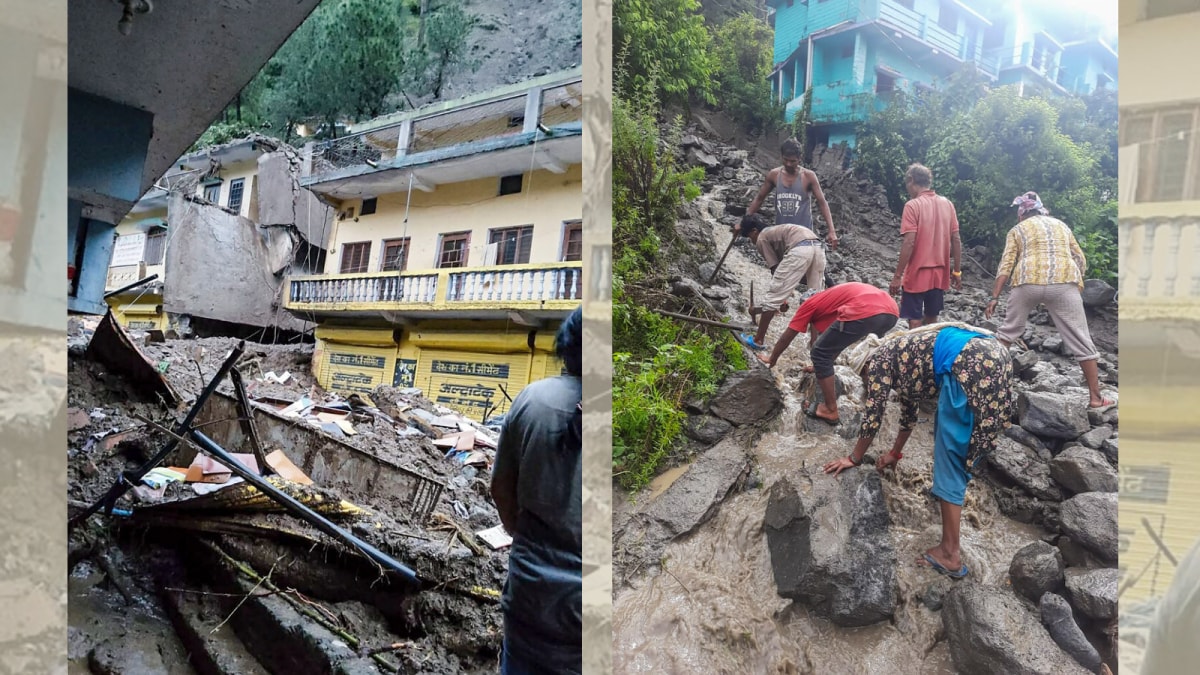
Rescue operation underway at a disaster-hit area after heavy rainfall, at Tharali, in Chamoli district, Uttarakhand. (Image: PTI)
On Friday, cloudbursts triggered debris flows in the Rudraprayag and Chamoli districts of Uttarakhand, leaving two people missing and several families trapped. Chief Minister Pushkar Singh Dhami said the incidents occurred in the Bareth Dungar Tok area of Buskedar tehsil and the Deval area of Chamoli. Mud and rubble submerged large parts of Bareth Taljaman in Basukedar, cutting off access and prompting emergency shelter for displaced families.
Chamoli District Magistrate Sandeep Tiwari confirmed that two people were untraceable, multiple roads had been closed, and livestock losses had been reported. The state government said rescue and relief operations were underway on a war footing, with the Chief Minister in contact with local officials.
Recommended Stories
This is not an isolated event. From Kedarnath to Kullu, cloudbursts have become a recurring feature of India’s Himalayan monsoon. They strike with little warning, dump unimaginable volumes of water in minutes, and often leave behind a trail of destruction.
So what exactly is a cloudburst and why are these extreme weather events striking India more often, and with greater force?
What Is A Cloudburst?
A cloudburst is a highly localised, intense rainfall event defined by the India Meteorological Department as over 100 millimetres of rain in one hour over an area of around 30 square kilometres or less. While the numbers may vary, the impact is often uniform: rapid deluge, flooding, landslides, and widespread damage within minutes.
Unlike sustained monsoon rain, a cloudburst delivers the equivalent of days’ worth of precipitation all at once. Because the terrain often cannot absorb this sudden volume, the result is a surge of water rushing down slopes, inundating valleys and built-up areas.
What Causes A Cloudburst?
A cloudburst happens when a huge amount of moisture in the air suddenly falls as heavy rain in a short time, usually within minutes. It’s most common in hilly or mountainous areas like the Himalayas.
Here’s how it works: during the monsoon, warm air carries a lot of moisture from oceans and plains. When this air hits a mountain, it’s forced to rise. As it goes up, it gets cooler. The cooling causes the moisture to condense and form dense clouds.
Normally, clouds move and release rain gradually. But in a cloudburst, the clouds get trapped in one spot, and the rising warm air below keeps feeding them with more moisture. At some point, the clouds can’t hold the weight of the water anymore, and they release it all at once.
In steep valleys, this sudden downpour doesn’t have anywhere to spread. So, it rushes downhill in narrow streams, triggering flash floods, landslides, and debris flow that can wipe out homes and roads in minutes.
Why Are Cloudbursts Becoming More Frequent In India?
Multiple scientific studies and weather records suggest an increase in both the frequency and intensity of cloudbursts in the Himalayan region, particularly over the past two decades. One of the main drivers is a warming atmosphere.
According to Anil Kulkarni of the Divecha Centre for Climate Change at the Indian Institute of Science, rising temperatures increase the air’s moisture-holding capacity, which in turn increases the volume of rainfall when condensation occurs.
Speaking to Hindustan Times, Kulkarni said, “Mountainous regions due to higher slope are associated with upward movement of air mass. As atmospheric moisture is moved upward, it increases the size of water droplets. In the meantime, additional moisture is added at lower altitude. This significantly increases moisture in the air column. This leads to cloudburst.”
A July 2024 study published in the Journal of the Geological Society of India identified Uttarakhand as a hotspot for extreme events, documenting a marked increase in cloudbursts and flash floods post-2010. Another 2025 review in Springer Nature found rising trends across Uttarakhand, Himachal Pradesh, Jammu and Kashmir, and Ladakh between 1970 and 2024.
Which Parts Of India Are Most Vulnerable?
The Himalayan states of Uttarakhand, Himachal Pradesh, Jammu and Kashmir, and parts of Ladakh are most prone to cloudbursts, especially during the southwest monsoon season from June to September. These regions combine high mountains, steep slopes, and narrow river valleys, ideal conditions for sudden, intense rainfall to cause flash floods and landslides.
IMD records and case studies from disaster agencies highlight the following incidents:
- 2013 Kedarnath floods: Over 6,000 killed and 4,500 villages affected after a cloudburst triggered flash floods and landslides.
- 2019 Arakot disaster: 19 deaths and over 38 villages impacted in Uttarkashi due to a cloudburst in Arakot Nala.
- 2023–2025: Increasing incidents across Kullu, Lahaul-Spiti, Nainital, Chamoli, and Rudraprayag. The August 5, 2025 Dharali incident in Uttarakhand is suspected to have been linked to a hanging glacier collapse.
The Indian Institute of Science has identified 219 hanging glaciers in the Alaknanda and Bhagirathi basins alone. These are increasingly unstable due to global warming, increasing the risk of sudden floods.
Is Climate Change Responsible?
Cloudbursts are natural meteorological events, but several climate scientists say human-induced global warming is making them more frequent and intense. Research cited in Science (2006) showed rising trends in extreme rainfall events across India in the second half of the 20th century. A study on the 2013 Kedarnath flood, published in Climate Dynamics in 2015, found more than half of the extreme rainfall was linked to greenhouse gas emissions and aerosols.
Roxy Mathew Koll of the Indian Institute of Tropical Meteorology, speaking to CNN, said: “Warmer oceans are loading the monsoon with extra moisture, and a warmer atmosphere holds more water, fuelling intense rainfall when moist air is forced up steep mountain slopes.”
With monsoon dynamics shifting, longer dry spells punctuated by short, extreme rain bursts, the Himalayan region is experiencing an uptick in destructive cloudbursts.
Why Are These Events So Destructive?
In the Himalayas, steep gradients and narrow valleys funnel rainwater rapidly downstream. If a cloudburst occurs in a hilly zone, the concentrated runoff has few escape routes, which leads to flash floods, landslides, and destruction of anything in its path.
Another major issue is the location of many habitations and infrastructure projects in vulnerable zones. Manish Shrestha, a hydrologist at the International Centre for Integrated Mountain Development, told HT that the damage caused in the August 5 Dharali incident was worsened because of “dense settlements near riverbanks that fall in the right of way of the river.”
Deforestation, road construction, and quarrying activities in fragile mountain zones further destabilise slopes and reduce the land’s ability to absorb rainfall. This amplifies the impact of even moderate cloudbursts.
Can Cloudbursts Be Predicted?
Forecasting cloudbursts is a major scientific challenge. Their small spatial scale, sudden onset, and brief duration make them difficult to detect in advance using traditional models.
According to the India Meteorological Department, radars can detect the build-up of dense clouds and give short-term warnings, but forecasting the exact time and location of a cloudburst is not yet possible. To improve early warning systems, Doppler weather radars have been installed across various parts of the Himalayas. Additional observatories have been established to collect hyperlocal atmospheric data.
Despite this, communication and evacuation remain challenges, especially in remote, high-altitude regions where access is limited and warning times are short.
What Can Be Done To Reduce The Risk?
Experts and disaster management authorities have put forward several recommendations to reduce the impact of cloudbursts in India:
- Avoiding construction in flood-prone areas and enforcing zoning restrictions.
- Afforestation and protection of natural wetlands to improve water absorption.
- Strengthening embankments, check dams and drainage systems before monsoon season.
- Installing Doppler radars, lightning sensors, and real-time data systems in hazard zones.
- Monitoring glacial lakes and hanging glaciers to detect instability early.
- Improving community-level early warning communication through decentralised systems.
A 2022 study by the Geological Society of India called for pre-emptive relocation of families in vulnerable zones, saying such measures should be implemented well before the onset of the monsoon. The Wadia Institute of Himalayan Geology has also suggested using hazard zonation maps and satellite data for planning infrastructure in high-risk areas.
About the Author

Karishma Jain, Chief Sub Editor at News18.com, writes and edits opinion pieces on a variety of subjects, including Indian politics and policy, culture and the arts, technology and social change. Follow her @kar…Read More
Karishma Jain, Chief Sub Editor at News18.com, writes and edits opinion pieces on a variety of subjects, including Indian politics and policy, culture and the arts, technology and social change. Follow her @kar… Read More
Loading comments…
Read More