
 The draft also proposes specific mechanisms to reward manufacturers for incorporating low-emission and alternative fuel vehicles.
The debate over whether carbon di-oxide (CO2) emission limits for small cars, which are lighter and more fuel efficient, should be less stringent, is heating up.
The Bureau of Energy Efficiency (BEE) released the draft CAFE (Corporate Average Fuel Efficiency) 3 norms in September and these norms define emission caps for OEMs’ vehicle fleets for a five-year period starting 2027-28.
One of the key provisions in the draft, which defines a lower emission cap for cars weighing up to 909 kg, has become the biggest bone of contention.
This particular proposal allows the CO2 emission limit for such cars to be lower by 3 grams. The proposed relaxation for small cars now has set off a rather public tussle between OEMs like Maruti Suzuki India, Toyota Kirloskar Motors etc – OEMs with a sizable portfolio of small cars – and some big car OEMs including Tata Motors.
The former group is lobbying for the lower emission cap for small cars to stay while the latter group is pushing for uniform emission standards for all vehicles, regardless of weight. A car in India weighs anywhere between 750 kg to 2500 kg, making the industry average car weight 1170 kg.
As the debate rages on, with multiple letters being written to different ministries by OEMs supporting their respective points of view, a senior government official told ETAuto that his ministry was aware that “the large car lobby is seeking permission to continue to pollute for longer…we will align our views with what the Ministry of Power finally agrees to. The final CAFE 3 regulations will likely be based on ‘real world’ emission targets and ICAT is already defining those…the final norms may tighten fleet wide emission targets by 20-25 per cent, this will not be too steep in the end”. When asked about different OEMs lobbying for and against relaxation to small cars, he said “we cannot allow large cars to continue polluting for longer”, without elaborating further. Meanwhile, in its response to the CAFE 3 draft, the Society of Indian Automotive Manufacturers (SIAM) has said its members have “mixed” views “on the topic of benefit of 3g for petrol cars below 909 kg unladen mass”.
Also Read: Tata Motors ‘comfortable’ with CAFE-3 norms: Shailesh Chandra
SIAM’s response follows weeks of internal discussions with members offering diametrically opposite points of view. A final decision on CAFE 3 norms is still some time away though, and would involve at least three ministries – road transport and highways, heavy industries and power.
What CAFE 3 draft says
The draft introduces a mass-based linear formula to determine the Annual Average Fuel Consumption Standard (expressed in petrol equivalent litres per 100 kilometres) that a manufacturer must meet. The standard is directly linked to the manufacturer’s weighted average unladen mass of its fleet and the proposal speaks of annual tightening from 2027-28 to 3.01 litres/100 km by 2031-32. Put simply, this means each year, the permissible emission of the entire fleet of vehicles of each OEM will be lower and each OEM has to show its Annual Average of Actual Fuel Consumption to be less than or equal to the standard fixed for that year.
The draft also proposes specific mechanisms to reward manufacturers for incorporating low-emission and alternative fuel vehicles.
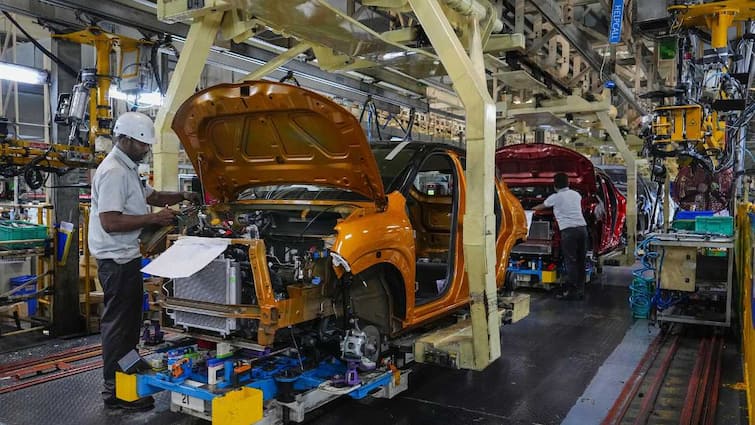
Also, the draft norms refer to vehicle models with specific characteristics being eligible for an additional reduction in their manufacturer-declared CO2. This eligibility is partly defined by mass. So, a model with unladen mass up to 909 kg, engine capacity up to 1200 cc and length up to 4,000 mm is eligible for a further reduction of 3 gm of CO2. This is the provision which has riled up some OEMs.
Also Read: Carmakers split over proposed emission rule exemption seen to favour Maruti Suzuki
Maruti versus Tata
Maruti Chairman R C Bhargava has long championed the cause of small cars and various reports have quoted him justifying the proposed relaxation of emission standards for cars weighing less than 909 kg. Bhargava has pointed to the fact that small cars are less polluting and easier on the pocket and that just about one in 10 car buyers would benefit if the regulation were to favour the demand of OEMs with large car portfolios.
Meanwhile, Shailesh Chandra, MD and CEO of Tata Motors Passenger Vehicles, said during a recent analyst call that “first intent of CAFE has been to drive OEMs towards greener technologies at a fleet or portfolio level with no specific target set for either individual cars or car segments. So, OEMs are actually free to manage their portfolio with appropriate green technologies and meet the targets.
Second, the small car classification was recently reaffirmed under GST 2.0 based on length and engine capacity. By this definition we are the second largest producer of small cars in the country with over 85 per cent of our sales…We have absolutely no concerns in meeting CAFE norms even with such a high share of small cars. And, we see absolutely no justification for any special concession for this specific category of cars or any category of car, maybe small or big.”