India’s economic ascent continues with a GDP surge in the second quarter of FY26, supported by resilient domestic demand, moderating inflation, services sector growth, and higher labour force participation, even as reforms gather pace and consumption remains optimistic.
Led by positive growth momentum in agriculture, manufacturing, and a slew of service sectors, India’s GDP growth surpassed expectations, posting 8.2 per cent in the second quarter of the financial year 2025-26, as steady inflation and rising exports sustained the country’s growth narrative, government data showed Friday. The moderation in inflation is consistent with the RBI’s decision to maintain the repo rate at 5.50 per cent with a neutral stance, reflecting confidence in price stability and growth prospects.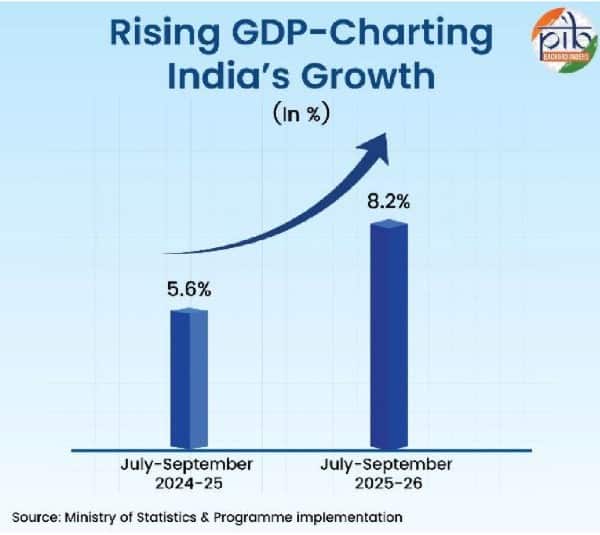
Gross Domestic Product (GDP) is one of the primary indicators of overall economic performance and reflects the rate of economic expansion. As per the latest data, the real GDP of India, adjusted for inflation, is estimated to grow by 8.2 per cent in Q2 of FY 2025-26 against the growth rate of 5.6 per cent during Q2 of FY 2024-25. The GDP in Q1 of FY 2025-26 grew at 7.8 per cent against the growth rate of 6.5 per cent during Q1 of FY 2024-25. The nominal GDP has witnessed a growth rate of 8.7 per cent in Q2 of FY 2025-26.
Devendra Kumar Pant, Chief Economist, India Ratings and Research, views the 2QFY26 growth as higher than the consensus and Ind-Ra forecast (7.2 per cent). The strong growth momentum in agriculture, manufacturing, financial, real estate and professional services, public administration, defence and other services has helped GVA growth in 2QFY26 to an eight-quarter high of 8.1 per cent. “Strong agriculture growth and decline in inflation are getting reflected in strong rural consumption growth and have brightened the scope of strong consumption growth in 2HFY26 as well, and are expected to continue at least in 1HFY27,” notes Pant.
The monthly economic review of the Finance Ministry for October also highlighted growth indicators that support the 8.2 per cent GDP expansion. Economic activity has gained momentum following the reduction in the GST, as reflected in the performance of various high-frequency indicators, and momentum was also evident in the production economy. In October, the manufacturing sector continued to show improvement, with the Manufacturing Purchasing Managers’ Index (PMI) rising to 59.2 from 57.5 in September. This increase was driven by GST relief, productivity enhancements, and investments in technology. Additionally, service activity remained strong, with the PMI for services in October 2025 at 58.9, well above the 50 mark that separates expansion from contraction, the Finance Ministry Review stated.
Aditi Nayar, Chief Economist, ICRA, highlights that it is for the second consecutive quarter that India’s GDP growth significantly surpassed expectations, printing at a six-quarter high of 8.2 per cent in Q2 FY2026, in contrast to the widespread market expectation of some moderation. “The upside surprise in the Q2 GDP growth print was driven by services, even as the agriculture and industrial sectors largely reported prints along expected lines,” Nayar observes.
Dharmakirti Joshi, Chief Economist, Crisil, which raised FY 2026 GDP forecast to 7 per cent after the first half clocks 8 per cent, also agrees that India’s real GDP growth at 8.2 per cent in the second quarter exceeded expectations. “Private consumption was the main driver of higher real growth. From the supply side, manufacturing and services saw a significant rise with the rationalisation of and reduction in the goods and services tax (GST) rates is bolstering private consumption, complementing reduced income tax and interest rates cuts.
With growth accelerating, India’s position as the fastest-growing major economy stays on track, supported by resilient domestic demand, higher labour force participation, revival in domestic investment and strong investor sentiment, which also signal a stable and broad-based economy. As reforms gather pace and consumption remains optimistic, India is firmly on course to become the third-largest economy by 2030, with GDP projected at USD 7.3 trillion. The current growth phase reflects the strength of decisive policymaking, structural reforms, and India’s deepening global integration, the Finance Ministry said.
“India is set to retain its position as the fastest-growing major economy globally. Crucially, this period has been marked by high growth accompanied by muted inflation—an indication of the economy’s underlying resilience,” agrees Sujan Hajra, Chief Economist & Executive Director, Anand Rathi Group.
Playing a pivotal role in the growth of the country, the year-on-year real gross value addition in the primary sector rose 3.1 per cent in Q2 FY 2025-26. Similarly, the secondary saw a growth of 8.1 per cent and the tertiary sector expanded by 9.2 per cent, giving a boost to the real GDP growth rate in Q2 of FY 2025-26. The real GDP in the first half (H1) of the current financial year (April-September 2025-26) registered a growth rate of 8 per cent in comparison to the 6.1 per cent growth rate witnessed in H1 of FY25. The primary sector grew at a moderate 2.9 per cent, whereas the secondary sector grew 7.6 per cent, and the tertiary sector at 9.3 per cent exhibited sustained expansion.
A key enabler has been the softening inflation, underscoring the economy’s robust fundamentals and effective price management measures. Headline inflation, measured by the Consumer Price Index (CPI), eased to 0.25 per cent over the previous year, marking the lowest level recorded in the current CPI series. The inflation remains well within the tolerance band of RBI, primarily driven by a sharp moderation in food inflation, which showed a decline of 5.02 per cent over October 2024, supported by easing prices of oils and fats, vegetables, fruits, eggs, cereals and products.

The trend also reflects the positive impact of the recent decline in GST rates. India’s wholesale price index (WPI) based inflation also eased to (-) 1.21 per cent in October 2025 over October 2024, reflecting a decline in prices of key items including food articles, crude petroleum and natural gas, electricity, mineral oils, and basic metal manufacturing etc. The year-on-year inflation rate for the WPI Food Index fell further to (–) 5.04 per cent in October 2025, down from –1.99 per cent in September 2025. This continued reduction in wholesale inflation indicates the strengthening purchasing power of businesses and advancing market sentiments
Rural inflation fell to (–)0.25 per cent while urban inflation stood at 0.88 per cent, indicating a multi-dimensional moderation across regions. The sustained moderation in inflation reinforces purchasing power, supports real consumption growth, and provides monetary policy space to nurture investment and output expansion.
According to Pant, a sustained decline in inflation has brightened the scope for high consumption demand despite tariff-related issues. “Strong real growth and weak nominal growth make monetary policy decisions difficult, while strong 8.0 per cent growth in 1HFY26 does not support the argument for monetary easing, weak inflation and nominal GDP growth in 1HFY26, much lower than the budgeted GDP growth, makes a case for monetary easing,” opines Pant. “RBI may go for monetary easing of 25-50 basis points in the rest of FY26 to support nominal GDP growth. GDP growth in FY26 may exceed Ind-Ra’s forecast of 7.0 per cent,” he adds.
The growing Index of Industrial Production (IIP), which measures growth in manufacturing, mining and electricity, reflects the strength of industrial activity, registering a robust growth of 4.0 per cent year on year in September 2025, driven primarily by a 4.8 per cent expansion in the manufacturing sector. A rising IIP signals robust production, higher employment, and stronger investment momentum, reinforcing the economy’s overall growth trajectory. The top three positive contributors are manufacture of basic metals with a growth of 12.3 per cent, manufacture of electrical equipment with a growth of 28.7 per cent and manufacture of motor vehicles, trailers and semi-trailers with a growth of 14.6 per cent.
From a use-based classification perspective, several categories posted commendable growth. The top three contributors are infrastructure & construction goods, which expanded by 10.5 per cent, consumer durables by 10.2 per cent and intermediate goods by 5.3 per cent in September 2025. Such diversified growth across primary goods, capital goods, intermediate goods and consumer durables segments signals both strong investment activity and resilient consumption demand. In combination with manufacturing gains, these patterns reflect a well-balanced industrial upturn that strengthens the foundation for sustained, inclusive economic expansion.
The trade sector remained robust in April–October 2025, reflecting strong global demand and steady improvements across key export categories. Both merchandise and services exports recorded healthy growth, reinforcing the economy’s resilience amid global uncertainties. Cumulative exports (merchandise and services) rose by 4.84 per cent to USD 491.80 billion, compared to USD 469.11 billion a year earlier. Merchandise exports grew by 0.63 per cent to USD 254.25 billion, supported by strong demand from key markets such as Spain, China, Hong Kong, the USA and the UAE, driven by robust performance in marine products, meat, dairy & poultry products, other cereals, cashew and electronic goods. Services exports remained a major pillar of resilience, expanding by 9.75 per cent to an estimated USD 237.55 billion in April-October 2025 from USD 216.45 billion in April-October 2024, underscoring India’s growing global competitiveness in computer services and business services.
Joshi estimates the third quarter of FY26 will continue benefiting from some of these tailwinds. While government investment will likely stabilise, there are hints of a belated uptick in private investments. “Consequently, we have raised our forecast of India’s GDP growth for this fiscal to 7 per cent, up from 6.5 per cent. This follows a first-half growth of 8 per cent and an expected slowdown to 6.1 per cent in the second half owing to the impact of higher US tariffs and normalisation of government capital expenditure,” observes the Crisil chief economist.
Hazra expects the RBI to announce a 25-basis-point rate cut, supported by benign headline inflation. “Food prices are likely to remain in deflation, keeping overall inflation comfortably below target through the end of the fiscal year, aided further by the pass-through of GST rate cuts. “With real GDP expanding 8 per cent in H1, full-year growth is now likely to exceed our earlier estimate of 7 per cent even if activity moderates slightly in the remainder of the year.
The projections find endorsement in the Finance Ministry Review, which forecasts a stable overall macroeconomic environment, easing inflation, resilient domestic demand, and continued policy momentum. The favourable impact of GST rationalisation is increasingly visible in consumption indicators, while robust agricultural activity reflected in the strong onset of Rabi sowing and adequate reservoir levels has reinforced the outlook for food supply and rural incomes. The inflation outlook remains encouraging, supported by softening global commodity prices, benign energy markets, and targeted domestic supply interventions.
Notwithstanding challenges of shifting trade policies, geopolitical frictions and financial market volatility which pose potential headwinds to exports, capital flows, and investor sentiment, the confluence of well-anchored inflation expectations, sustained public capital expenditure, and firming rural and urban demand places the economy on a stable footing, positioning it to navigate emerging risks and preserve its growth momentum through the remainder of FY26, positioning the economy for a further expansion next quarter.